
Benning history started in MidTown Columbus 100 years ago
What started as a temporary Army camp on an 84-acre farm was the result of tireless efforts from business leaders and Columbus visionaries.
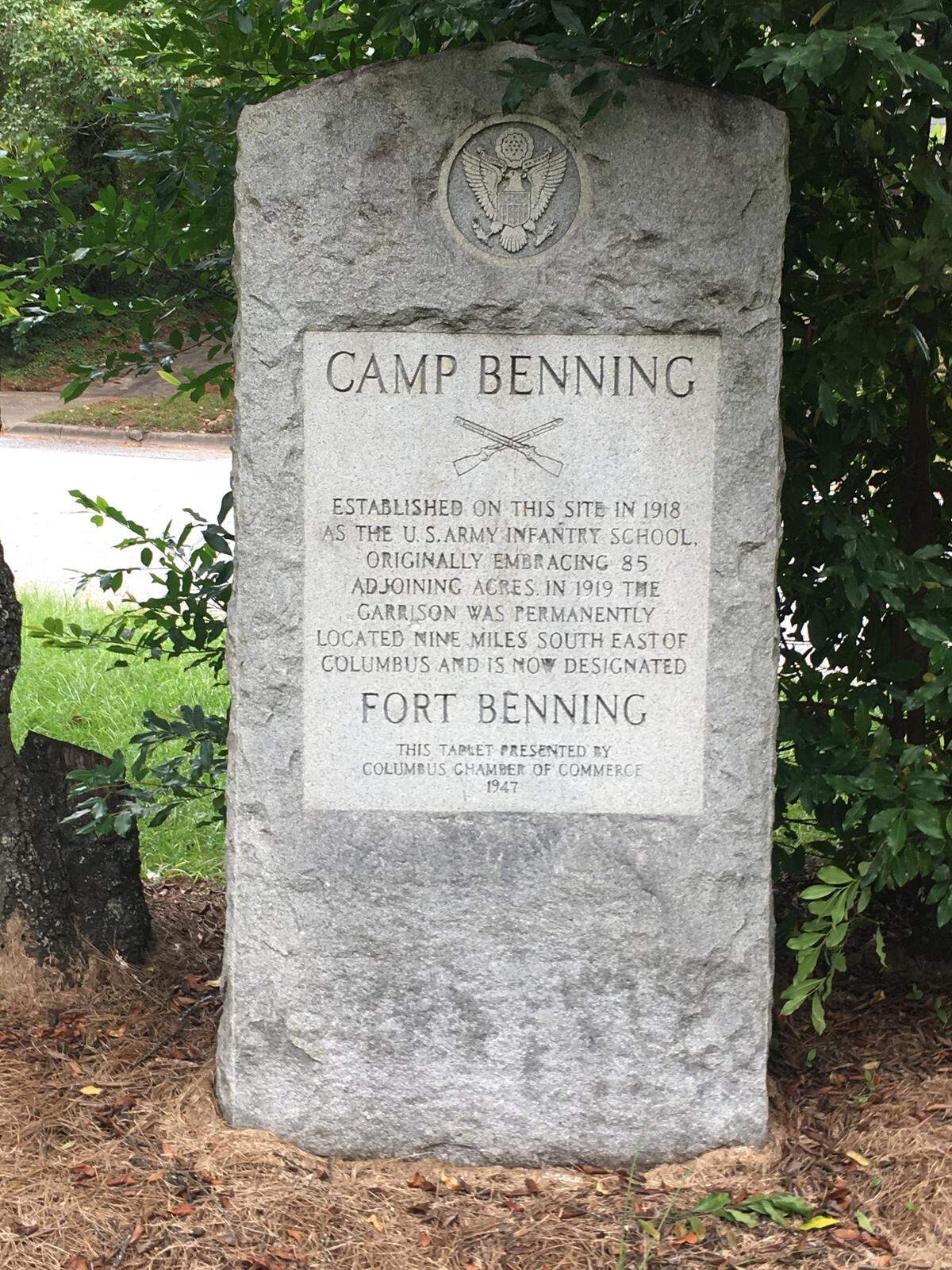
On this day 100 years ago, Camp Benning raised its flag on Oct. 19, 1918, almost two weeks after the first Army troops arrived on Macon Road where the Columbus Public Library and other public buildings stand. The only evidence from the MidTown site that housed 300 tents is a nearby monument in the neighborhood at South Dixon Drive and Mimosa Street.
That small camp led to a bigger location 8 miles down the road and redesignated Fort Benning on Feb. 18, 1922. The Maneuver Center of Excellence is home of the Infantry and Armor schools as the sixth largest military installation in the United States.
“Columbus has been a good neighbor to us and wanted us here,” said Scott Daubert, director of the National Infantry Museum and Soldier Center. “They wanted us here. They courted the government.”
The Columbus Chamber of Commerce started working on securing at least an Army brigade in the area on April 4, 1917, the day after President Woodrow Wilson asked Congress for a Declaration of War against Germany. Two days later, Congress approved the formal Declaration of War.
Leaders knew the benefits of having so many soldiers at Camp Conrad in the North Highlands area of Columbus during the Spanish-American War.
An Encampment Committee of the chamber traveled to Washington, D.C., to lobby for one of the new camps for training soldiers but found little success. Some committee members remained there to speak with members of Congress and War Department officials until February 1918. They thought their efforts were ineffective when they returned home.
Four months before returning home, members of the committee were unaware that Gen. John J. Pershing, commander of the Expeditionary Force in France, sent a telegram on Oct. 21, 2017, to the War Department asking for better trained soldiers.
With a high number of battlefield casualties, the War Department created a special board to select a site to train soldiers on infantry skills and tactics. The board was led by Col. Henry E. Eames, commander of the School of Musketry at Fort Sill, Okla. Due to earlier efforts of the chamber’s Encampment Committee, the board selected Columbus as one of four prospective sites for training.
A full-time representative from the committee was sent back to Washington, D.C., when chamber officials learned the training school would be created. A message sent by telegraph announced on Aug. 17, 1918, that the General Staff of the U.S. Army had approved the recommendation and the Infantry School of Arms would be located near Columbus.
No money was available and no plan had been officially approved by the Secretary of War but Maj. J. Paul Jones was assigned as construction quartermaster. Jones was notified on Sept. 20, 1918, that the Infantry School staff and 367 troops from Fort Sill were headed to Columbus and would arrive by Oct. 1, 1918.
With help from the Columbus chamber, Jones and Eames started a search for the training camp. An 84-acre farm owned by Alex Reid was selected on Macon Road because of its location to downtown Columbus, city water and streetcar service.
No money had been appropriated for the post but it would take $100,000 to build temporary mess halls, tent frames, bath houses and water supply installations for the camp. Folks were so eager to get the post in Columbus, they contributed supplies without getting paid first. Businesses were willing to wait for payment until proper authorization could be handled.
Crews used 400,000 feet of lumber at the site. The 300 tent frames, mess halls and warehouses were completed in seven days. Eames becomes the first commandant of the Infantry School on Oct. 5, 1918.
After troops arrived, it became clear the Macon Road location wasn’t large enough for suitable terrain for rifle ranges, forcing Eams and Reynolds Flournoy to move quickly to select a new site.
An 1,800 acre plantation owned by Arthur Bussey was selected 8 miles away. At a cost of $439,000, the plantation was purchased on Oct. 19, 1918, with his “Riverside” home and numerous buildings. The government also paid $3.6 million for an additional 115,000 acres.
Construction on new facilities and infrastructure soared and Secretary of War approved $9.1 million to fund an Infantry School of Arms for 25,000 men. Construction still didn’t confirm the camp as a permanent site.
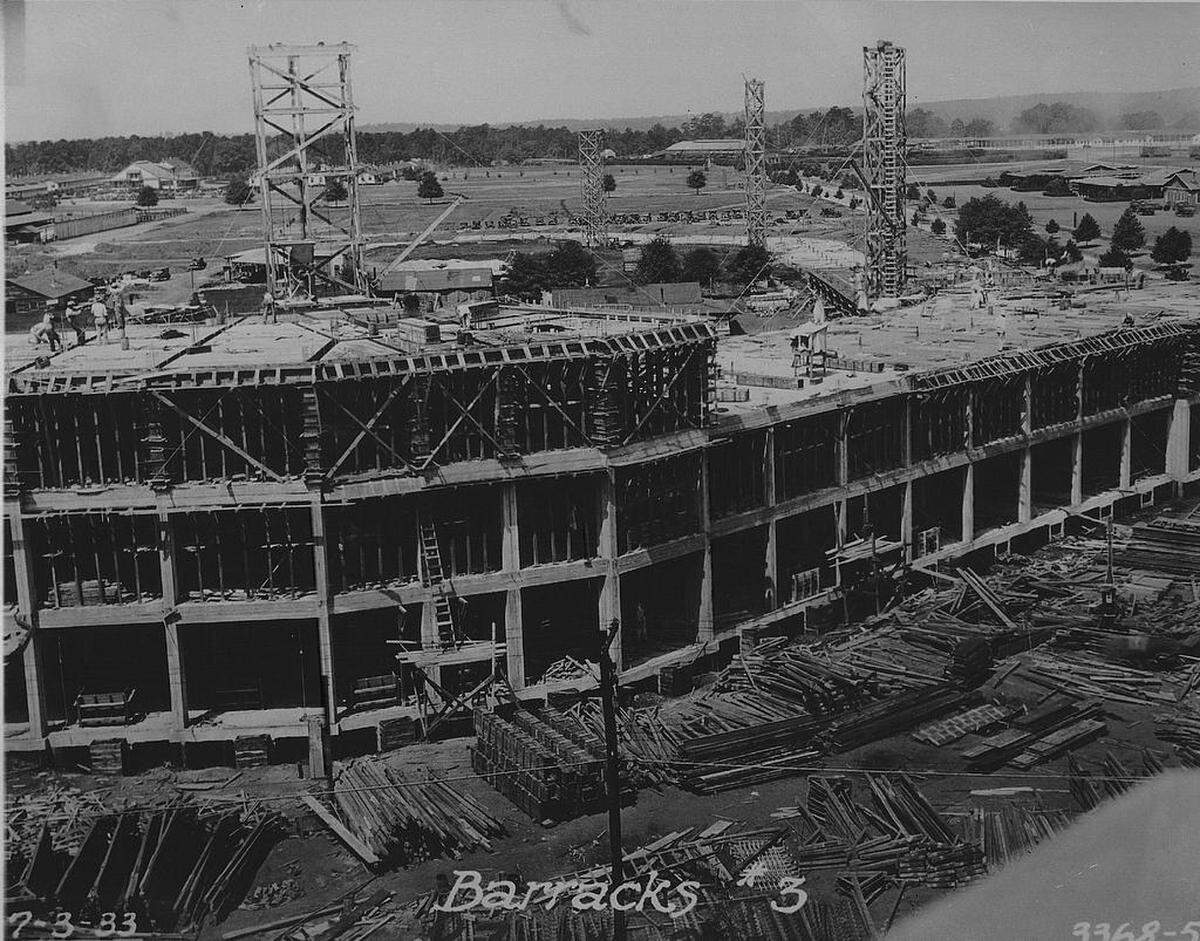
After the war ended on Nov. 11, 1918, the War Department halted funds almost two months later on Jan. 7, 1919, and abandoned all new construction and lease options. A salvage operation was ordered on work already done.
A chamber representative was returned to Washington, D.C., to make a case for Columbus before the Senate Committee on Military Affairs. Chamber members also went to the new camp commander and asked Col. Paul B. Malone to delay dismantling buildings until things were settled at the nation’s Capitol.
For Jones, the word “salvage” was interpreted to mean “save” and he had all the buildings repainted.
To present Benning as a worthwhile venture, military and Columbus leaders lobbied the Senate Committee over the next three months. Infantry officers went before the committee and focused on the necessity of the Infantry School to ensure better training for soldiers. If soldiers had received better training, they felt the loss of life wouldn’t have been so severe in the Great War or World War I.
A bill to establish a permanent Infantry School at the new camp in Georgia failed by an 8-6 vote in early 1920.
The vote prompted a call for more chamber members to join their colleague and Army Officers in the Capitol to reopen the issue. On March 8, 1919, a second vote narrowly won approval by a 7-6 margin, establishing Camp Benning on a permanent basis.
“The soldiers were not trained properly,” Daubert said. “We needed to have a school that trained soldiers.”
Changes at Benning
The fledgling camp grew in the 1920s as technology and weapons improved. Tanks arrived at Camp Benning giving birth to mounted armored maneuver. President Warren G. Harding was the first president to visit Camp Benning on Oct. 27, 1921.
Three months later, the War Department issued General Order No. 1 on Jan. 9, 1922, making Camp Benning a permanent military installation. It was re-designated Fort Benning on Feb. 8, 1922, and named in honor of Confederate Brig. Gen. Henry Lewis Benning as the rapid development of the post ensued.
By the end of the 1930 term, the Infantry School had graduated 5,064 future leaders such as Omar Bradley, George C. Marshall, Joseph Stillwell and others.
The armed forces were still segregated as the Fifth Avenue United Service Organizations opened July 28, 1941, in Columbus for Benning’s 5,000 black soldiers. Lizzie Lunsford, a black business woman, donated $15,000 for the effort and E.E. Farley organized the effort.
As training continued at Fort Benning, Gen. George Patton Jr. was a newly promoted colonel when he was assigned to establish the 2nd Armored Division, known as the “Hell on Wheels” unit on post. Patton was an innovator in military tactics, honing his skills in maneuvers on post before he was sent to North Africa in 1942 as part of Operation Torch in World War II.
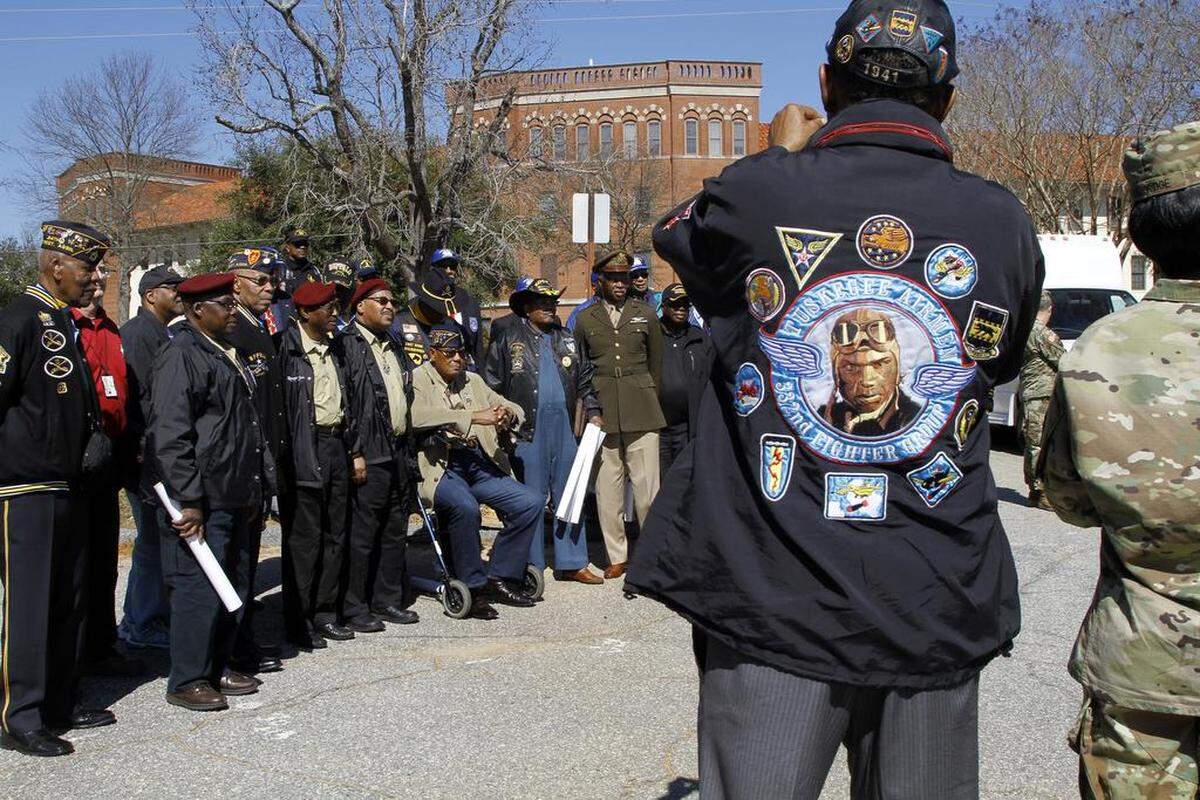
At the Parachute School, the forerunner of the Airborne School, 16 black soldiers graduated on Feb. 18, 1944, as the first troops of the 555th Parachute Infantry Battalion, known as the “Triple Nickles” during World War II. They ended up in Oregon, fighting fires set by the Japanese in the Western United States.
A breakthrough in race relations came on July 26, 1948, when President Harry S. Truman issued Executive Order 9981. It abolished discrimination on the basis of race, color, religion or national origin in the U.S. Armed Forces and eventually led to the end of segregation in the services. The order faced some resistance until the end of the Korean War when the Army’s last segregated units were finally disbanded in 1954.
Benning commanders
Here is a list of Fort Benning commanders from its beginning in October 1918 to today.
- Maj. Gen. Gary M. Brito, March 2018 – present
- Maj. Gen. Eric J. Wesley, March 2016 - March 2018
- Maj. Gen. Austin S. Miller, July 2014 – March 2016
- Maj. Gen. H.R. McMaster, June 2012 – July 2014
- Maj. Gen. Robert B. Brown, November 2010 – June 2012
- Maj. Gen. Michael Ferriter, June 2009 – November 2010
- Maj. Gen. Michael D. Barbero , November 2008 – June 2009
- Maj. Gen. Walter Wojdakowski, August 2005 – November 2008
- Maj. Gen. Benjamin C. Freakley, July 2003 – August 2005
- Maj. Gen. Paul D. Eaton, October 2001 – June 2003
- Maj. Gen. John M. Le Moyne, September 1999 – October 2001
- Maj. Gen. Carl F. Ernst, July 1996 – September 1999
- Maj. Gen. John W. Hendrik, September 1994 – July 1996
- Maj. Gen. Jerry A. White, October 1991 – September 1994
- Maj. Gen. Carmen J. Cavezza, June 1990 – October 1991
- Maj. Gen. Michael F. Spigelmire, September 1988 – June 1990
- Maj. Gen. Kenneth C. Leuer, June 1987 – September 1988
- Maj. Gen. Edwin H. Burba Jr., January 1986 – June 1987
- Maj. Gen. John W. Foss, March 1984 – January 1986
- Maj. Gen. James J. Lindsay, July 1983 – March 1984
- Maj. Gen. RL “Sam” Wetzel , August 1981 – July 1983
- Maj. Gen. David E. Grange Jr., June 1979 – Aug 1981
- Maj. Gen. William J. Livsey Jr., July 1977 – April 1979
- Maj. Gen. Willard Latham, August 1975 – July 1977
- Maj. Gen. Thomas M. Tarpley, February 1973 – Aug 1975
- Maj. Gen. Orwin C. Talbott, September 1969 – February 1973
- Maj. Gen. George I. Forsythe, May 1969 – August 1969
- Maj. Gen. John M. Wright Jr., July 1967 – May 1969
- Maj. Gen. Robert H. York, July 1965 – Jul 1967
- Maj. Gen. John Heintges, August 1964 – Jul 1965
- Maj. Gen. Charles W. G. Rich, Febtuary 1963 – August 1964
- Maj. Gen. Ben Harrell, August 1961 – Feb 1963
- Maj. Gen. Hugh P. Harris, April 1960 – July 1961
- Maj. Gen. Paul L. Freeman, May 1958 – April 1960
- Maj. Gen. Herbert B. Powell, August 1956 – April 1958
- Maj. Gen. George E. Lynch, May 1956 – August 1956
- Maj. Gen. Joseph H. Harper, June 1954 – May 1956
- Maj. Gen. Guy S. Meloy Jr., January 1953 – June 1954
- Maj. Gen. Robert M. Young, June 1952 – Jan 1953
- Maj. Gen. John H. Church, March 1951 – May 1952
- Maj. Gen. Withers A. Burress, July 1948 – Jan 1951
- Maj. Gen. John W. O’Daniel, July 1945 – June 1948
- Maj. Gen. Fred L. Walker, July 1944 – July 1945
- Maj. Gen. Charles H. Bonesteel, September 1943 – June 1944
- Maj. Gen. Leven C. Allen, February 1942 – September 1943
- Brig. Gen. Omar N. Bradley, March 1941 – February 1942
- Brig. Gen. Courtney H. Hodges, October 1940 – March 1941
- Brig. Gen. Asa L. Singleton, October 1936 – August 1940
- Brig. Gen. George H. Estes, September 1933 – September 1936
- Maj. Gen. Campbell King, May 1929 – May 1933
- Brig. Gen. Edgar T. Collins, March 1926 – May 1929
- Brig. Gen. Briant H. Wells, November 1923 – Mar 1926
- Maj. Gen. Walter H. Gordon, September 1920 – November 1923
- Maj. Gen. Charles S. Farnsworth, April 1919 – July 1920
- Col. Henry E. Eames, October 1918 – April 1919
This story was originally published October 18, 2018 at 7:26 PM with the headline "Benning history started in MidTown Columbus 100 years ago."