
Army moves into Oakland Park in 1960s: ‘They just showed up one day and started buying houses’
Richard Lane can’t tell you the exact day it happened, but he remembers the events like they were yesterday.
In the early 1960s, Wilson Lane Contractors — the company owned by his father —was developing and building homes in Oakland Park, a collection of neighborhoods not far from the Fort Benning gate off South Lumpkin Road.
“We had built 26 houses, finished and unsold,” Lane said. “Daddy was about broke.”
A couple of other builders also had unsold inventory in Oakland Park, Lane said.
But the homes were empty for several months — then the builders’ fortunes changed overnight.
“We sold 10 of them in one day,” Lane remembered. “We sold 14 that week and sold the rest of them the next week. And the third week we were taking orders to build.”
That kicked off a military-fueled building boom in Oakland Park, Colonial Park and Carter Acres that continued into the late 1960s when what is now known as Oakland Park was all but built out. There are more than 2,000 homes in the area, almost all of them a half century old or older.
‘Biggest secret’
Fort Benning Infantry historian David Stieghan thinks he knows what happened. The 11th Air Assault Test Division was activated at Fort Benning on Feb. 15, 1963. The Army was looking a new way to fight and Fort Benning was going to be the testing ground.
“I can tell you what happened,” Stieghan said. “At that time, the Army was making plans for the military use of the helicopter. They were here to test the use of the helicopter as a method for air assault.”
Unlike today, there was no warning about the influx of troops. It wasn’t telegraphed weeks, months and in some cases years in advance.
“They just showed up,” Lane said.
And it took some time to figure out why.
“It was the biggest secret,” Lane said. “Somebody knew it was coming, but we didn’t know about it. We knew all the colonels, the generals, everybody, but they didn’t tell us. They just showed up one day and started buying houses.”
It was one of the Vietnam-era build-ups that was the forerunner to the 1st Cavalry Division. And because of a shortage of housing on post and other factors, it pushed many of the soldiers into Columbus.
And Oakland Park was one of the areas prepared to build — and build quickly.
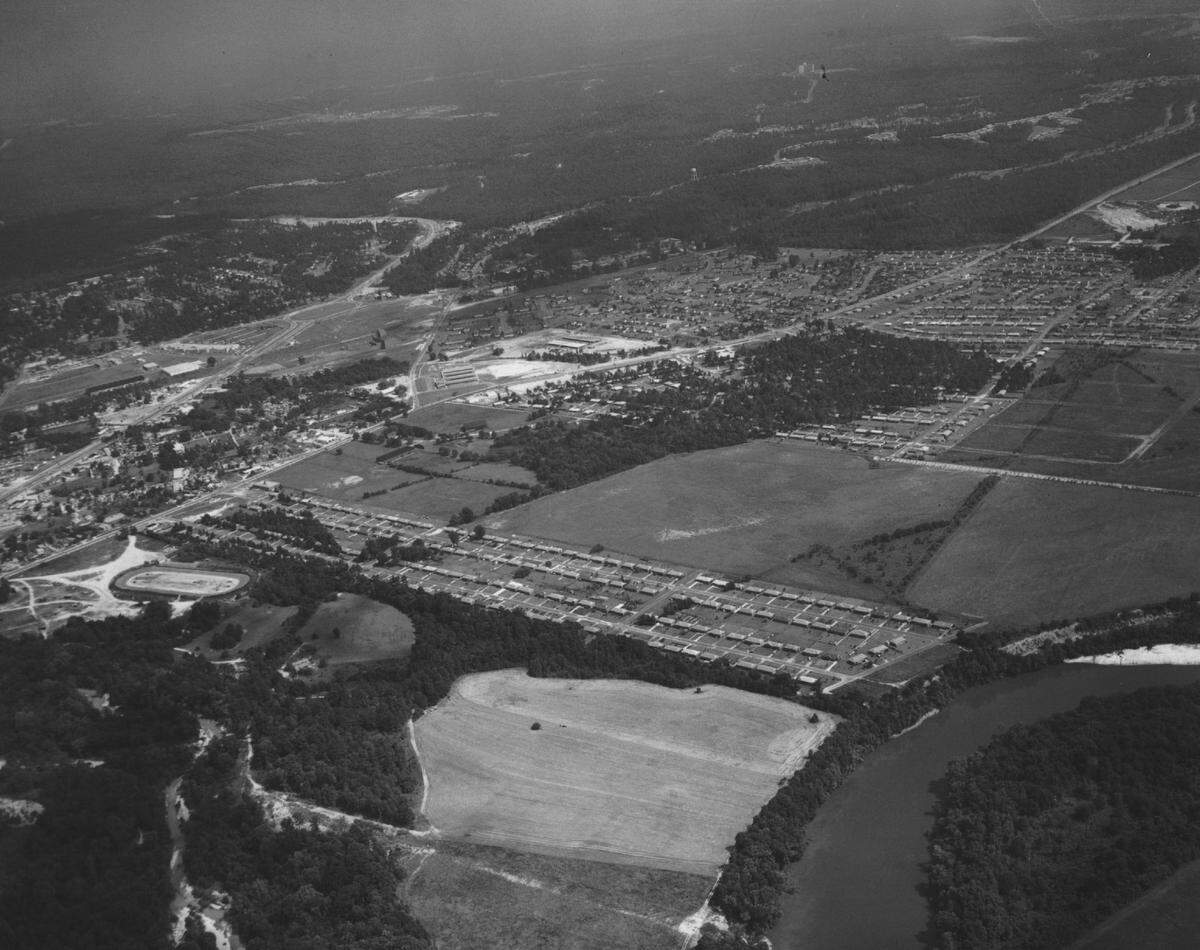
Wilson Lane had purchased a 300- to 400-acre plantation in the late 1950s and the land was suitable for development.
“Because it had been farmed, you didn’t have to move a lot of dirt,” Lane said.
The run on the homes as the 11th Air Assault Test Division then into the Vietnam deployments set the stage for a nearly assembly-line building in Oakland Park.
Larry Carter remembers it because he was a young kid helping his father, Bob Carter, by cutting grass on the homes that were under construction. Wilson Lane, Bob Carter Inc., Beach Builders and Gene Myers were the primary builders.
“I can remember that Gene Myers was going down one side of the street as fast as he could and my dad was going down the other side,” Larry Carter said.
Bob Carter Inc. records show the company built 75 houses along Luckie Street, Howe Avenue, Somerset, Peyton, Avondale and Emory.
“My dad had worked as a plaster estimator for Beach and he got his start building in Oakland Park,” Larry Carter said.
The two- and three-bedroom homes were selling for about $25,000 each and people were moving into them as quickly as they could be built.
“They all came in here and there was no place to live,” Lane said. “We rented a whole motel for people who bought a house for us to build from scratch. They could stay there three months and we would pay it for them while we built the house.”
Becoming family
Back in the 1960s as Fort Benning was preparing for war in Vietnam and then during the conflict, Oakland Park was a special place, said Pete Jones, a retired brigadier general who is now chief operating officer of the National Infantry Museum. Jones, whose father, Lincoln Jones III, was an Army officer, lived in two different houses on Luckie Street in Oakland Park as a child.
“Everybody on my block became family,” Jones said. “We were all military and we were all in the same situation. The women who were single moms while their husbands were gone were all my aunts and the men who were either retired or home for a school were my uncles.”
He tells a story to illustrate his point.
“My mom went to Hawaii to meet my dad for R&R, I stayed with our next-door neighbor,” Jones said.
There was a simple reason that officers and enlisted personnel sought homes in Oakland Park, Jones said.
“It was an extension of the post,” Jones said. “It was post living outside the post.”
The Jones family bought a new home on Luckie Street in 1967 and many other families did the same. They had rented on that street four years earlier when Lincoln Jones was attending a school at Fort Benning.
“As the war grew, many of the soldiers were individual replacements and they came to Fort Benning to live,” Jones said. “You only had a few choices. You could stay at the post where you were last assigned and sometimes you couldn’t do that or you could move to homes on the outskirts of posts like Fort Sill or Fort Benning.”
That period in 1963 when soldiers and their families were flooding into south Columbus will never be replicated, Lane said.
“People were scratching to find a place to live,” he said. “I had never seen it before and I know we will never will see it again. Everything was wide open, as hard as you could go, build as much as you could build and try and find something for those people who were coming here to live.”
This story was originally published October 20, 2018 at 12:00 AM.