
A Black soldier was lynched on Fort Benning 80 years ago. His name won’t be forgotten
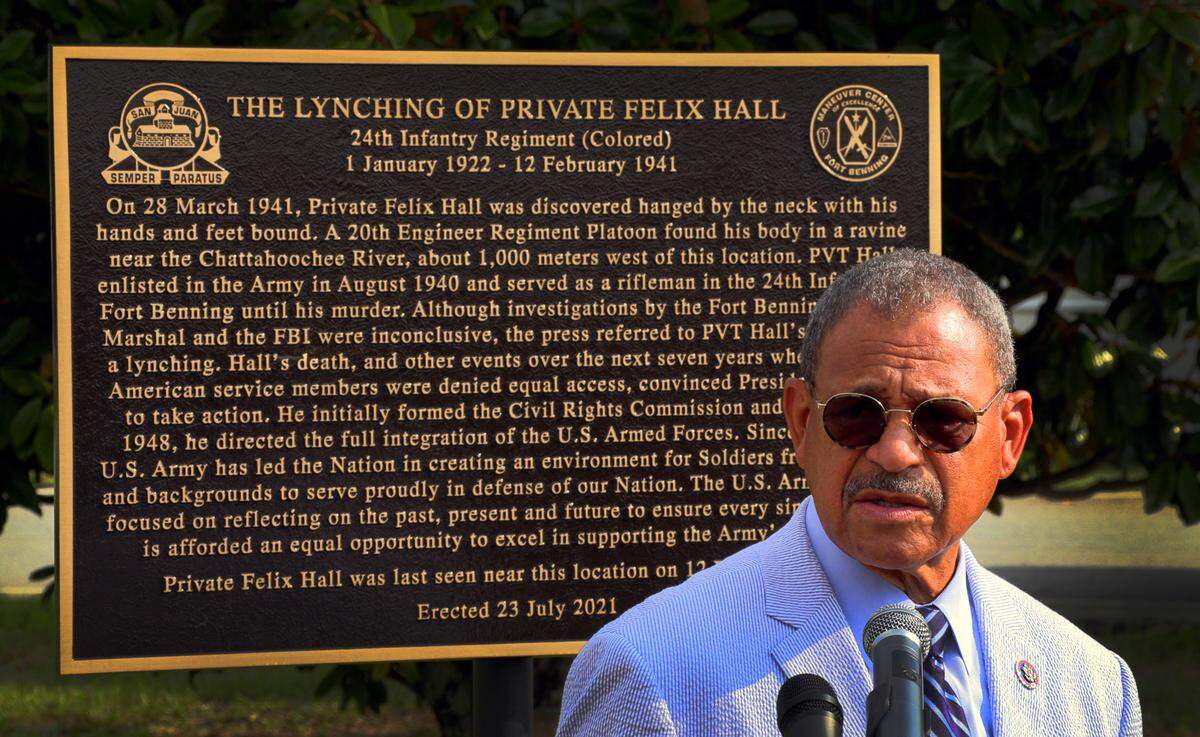
Eighty years after Pvt. Felix Hall was found hanging in a shallow ravine near the Chattahoochee River on Fort Benning with his hands and feet bound, military officials unveiled a historical marker near the last place Hall was seen alive, formally acknowledging his murder under the U.S. Army’s watch.
Hall’s 1941 killing is the only known lynching of an African American to have occurred on a U.S. military base, according to the Civil Rights and Restorative Justice Project at Northeastern University, which has researched the case.
His killers were never found, and those who could have played a role in the lynching are likely long dead. An FBI report available to the public remains significantly redacted. The case is cold.
The plaque makes no mention of a hate crime or racial terrorism. It says investigations by the Fort Benning Provost Marshal and the FBI were “inconclusive.” Instead, it was the press who “referred to Pvt. Hall’s murder as a lynching.”
A second granite marker will be placed near the site where Hall’s body was found. The plan is to connect the markers to Fort Benning’s historic trail.
Tuesday’s ceremony comes as the United States military continues to reckon with its past. The federally mandated name changing of military assets honoring Confederate soldiers is underway. Fort Benning is one of nine military installations receiving initial focus from the Naming Commission. Defense Secretary Lloyd Austin has pushed for increased diversity and inclusion since his appointment by President Joe Biden.
“With the issues of racial equity that have... really bubbled to the surface over the last couple of years, I think this is an appropriate time for us to really remember these guardrails and not to forget the failures of our past,” U.S. Rep. Sanford D. Bishop (D-GA) said during an interview following the ceremony. His district includes portions of Fort Benning. “I think this recognition is one step. A step forward in helping us to acknowledge the failures and to move forward.”
The lynching and the aftermath
Tuesday’s ceremony was attended by Bishop, Columbus Mayor Skip Henderson, commanding general of the United States Army Combined Arms Center Lt. Gen Theodore D. Martin, Chattahoochee County manager Laura Lee Bernstein and other public officials from the Columbus area.
During his remarks, Bishop told audience members about portions of Hall’s life and murder. The Washington Post published articles in 2016 and earlier this month that laid out the details of the case.
Hall volunteered to join the Army ahead of World War II, just a few months before his death. He was 18 when he left home in Millbrook, Alabama — a small city just north of Montgomery. He was assigned to Fort Benning where he would join the 24th Infantry Regiment, a segregated military regiment.
On Feb. 12, 1941, Hall went to work a shift at the post sawmill. After his shift, Hall told two friends he was going to the post exchange, the only one for Black soldiers on the installation. He never made it.
His body was found six weeks later by a 20th Engineer Regiment Platoon. His death initially sparked national outrage. Military officials told the public for months that Hall’s death may have been a suicide, but a military physician who examined the body two weeks after it was recovered ruled it a homicide. His final resting place is unknown.
“He was remembered by friends and family as a lively young man who cheerfully engaged those around him, regardless of race — something that should have been unremarkable,” Bishop said. “At that time, (it) was reviled by a society in which deep-seated bigotry was frequently visible.”
Suspects were identified and theories were posited by the FBI. Maybe Hall had come into contact with white women or peeped into the windows in one of the post’s white neighborhoods. Or perhaps he had trouble with his boss at the sawmill, the Atlanta Journal-Constitution reports, citing the FBI case report.
No resolution came. The Washington Post reports the FBI and the War Department ignored, failed to obtain, or did not follow up on critical information relating to the murder.
A retired social worker who grew up on base told the Washington Post in 2016 that her stepfather found and reported the body of a Black man hanging in the same location in the woods in early 1941. There is no mention of that report in the case file. There’s no record that anyone even went looking for Hall when he disappeared, the newspaper reported.
Hall’s murder was not the only time a young Black soldier from Fort Benning was killed. That same year, Pvt. Albert King was fatally shot by a white military policeman near the Army post. The policeman was found not guilty of manslaughter.
What the marker means
The marker credits Hall’s death and several events over the next few years with being the catalysts that eventually led President Harry Truman to desegregate the Army in 1948.
“Since then, we’ve made a lot of progress as a nation, but we can’t be fully satisfied until we have a generation that fully represents all elements of our population serving this country in uniform, that can look at this marker we will unveil and say to themselves ‘Never again in my country. Never again in my Army,’” Lt. Gen Martin told the crowd during the ceremony.
Bishop said the marker is 80 years overdue. It “restores” the dignity and respect owed to the late soldier. Yet, it would dishonor Hall’s memory to not acknowledge that bigotry and racism remain, the congressman said.
“We are training a new generation of soldiers who will be stronger for knowing about Pvt. Hall,” Bishop said. “This memorial preserves and raises awareness about our shared history.
“This memorial is a guidepost to avoid the faults of our past so we can create a more perfect union which shares its greatness with everyone so that we are truly one nation, under God, indivisible with liberty and justice for all.”
This story was originally published August 3, 2021 at 3:01 PM.