
50 years after the Battle of Ia Drang Valley, veterans share leadership lessons they learned with Fort Benning soldiers
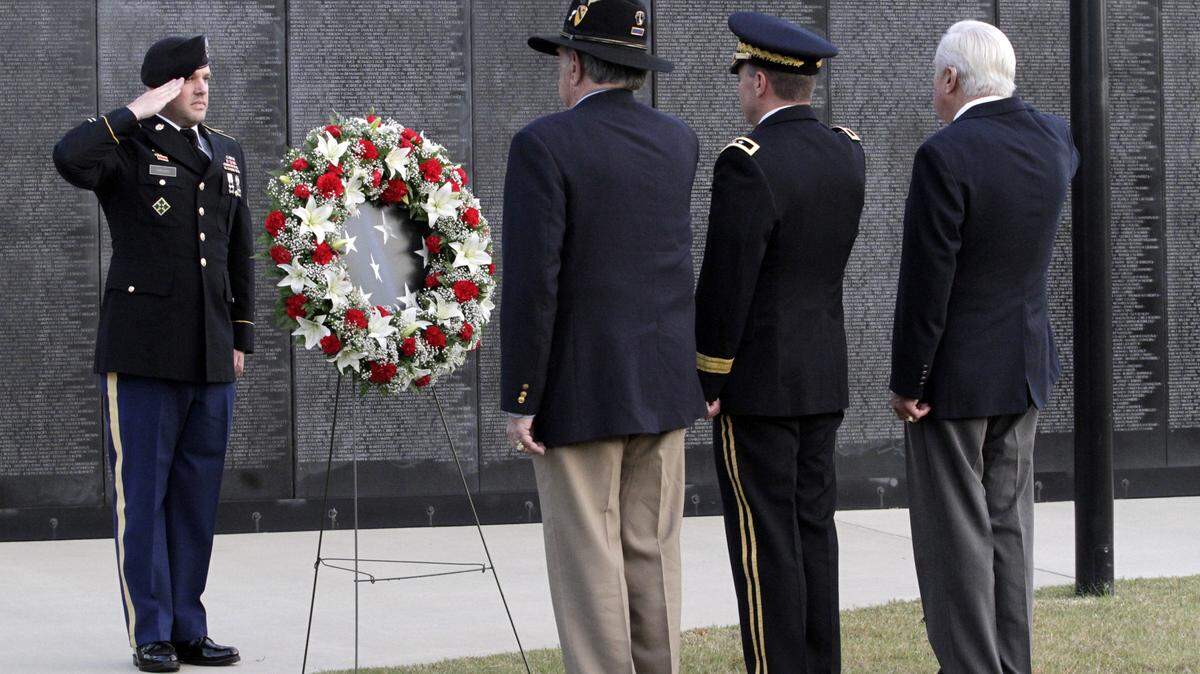
James T. Lawrence, a first lieutenant in the Battle of Ia Drang Valley, learned a lesson in leadership the hard way 50 years ago.
It was the first major battle of the Vietnam War, and Lawrence and his company were in the toughest spots -- stuck in an ambush at LZ Albany as the North Vietnamese unleashed on them.
"I know one thing, when you are training at Fort Benning, they are not shooting live rounds back at you," he said. "When you get in there and get in the fight, they are trying to kill you. And when you get there, you have to deal with fear and overcome fear. That is when your training kicks in."
Lawrence was one of eight veterans of the historic four-day battle who spent the better part of Tuesday sharing
the lessons they learned with about 2,000 soldiers at Fort Benning. It was the second in a three-program leadership series organized by Maj. Gen. Scott Miller, commander of the Maneuver Center of Excellence.
In October, Miller brought in soldiers from the Battle of Mogadishu, where he was the Delta Force commander on the ground. Early next year, Fort Benning will mark the 25th anniversary of the first Gulf War with a similar program.
Journalist Joe Galloway, who co-authored the book that became a major motion picture "We Were Soldiers Once and Young" with Gen. Hal Moore, spoke Tuesday night at a dinner marking the 50th anniversary of the battle.
Lawrence said his job that day as a recently promoted officer was to get his company out of the kill zone.
"My first thought was, 'I didn't want this job. I wished somebody else would step forward and take it,'" he said. "I only thought that for a second. But I got up and did my job."
Lawrence was wounded in that battle.
As Miller spoke to the troops to wrap up the program, he seized on Lawrence's words.
"I wouldn't have wanted to be in that command, either," Miller told the Fort Benning soldiers. "I would have wished that on somebody else. But that is our lot -- men and women."
Tuesday's program was divided between the two battles of Ia Drang, which took place Nov. 14-18, 1965. The battles involved two battalions of the 1st Cavalry Division. The initial battle involved seasoned and trained soldiers under the command of then-Col. Moore and Command Sgt. Maj. Basil Plumley. The second battle was with soldiers who were thrown together and resembled "a gaggle" instead of a fighting force. More than 200 U.S. soldiers were killed.
It came down to leadership, said retired Col. Raymond "Tony" Nadal, who was under Moore's command at LZ X-Ray. Moore, 93, is suffering from dementia and was unable to make the trip to Fort Benning from his Auburn, Ala., home.
"Hal Moore's intellect and knowledge of combat kept us alive," Nadal said. "One of the ways you lose is because your leaders think you are going to lose. There is no way we would have lost because there was no way in hell Hal Moore would have thought we were going to lose."
Lawrence Gwin, then a 24-year-old first lieutenant who was in the fight at LZ Albany, said it was a horrific situation, but one they had to fight their way through.
"Our guys fought like hell," Gwin said. "We killed a lot more of the North Vietnamese than they killed of us. The fact that we got caught with our pants down and at the back of the column, we still kicked ass at LZ Albany."
Lawrence, who was caught in the ambush, saw it this way.
"We were down for the count and they were coming in -- from cooks to colonels -- for the kill," he said. "But we fought back. I learned that day there is something special about the American warrior. Americans have something inside us and I don't know what it is. I don't know if it is arrogance or patriotism. But I know it is there because I saw it."
At times, the afternoon session was highly emotional as soldiers in the LZ Albany fight talked about courage and lack of leadership from the very top. Command Sgt. Maj. Timothy Metheny, the top enlisted soldier at Fort Benning, said it was a powerful program.
"I saw a lot of scar tissue getting ripped off," he said. "Part of the therapy is being able to talk about it now." Retired Maj. Joel E. Sugdinis, who was in the Albany battle, said it was "kill or be killed."
"We had to make some tough decisions," said Sugdinis, who called in napalm strikes to turn back the North Vietnamese. "It haunts me to this day knowing that I might have killed some of our men. It is tough being in command -- damn tough."
This story was originally published November 24, 2015 at 8:46 PM with the headline "50 years after the Battle of Ia Drang Valley, veterans share leadership lessons they learned with Fort Benning soldiers ."