
Not-scary hospital clowns come to Columbus to turn frowns upside-down
Oliver is not feeling well, you can tell.
The 3-year-old is sunk into the pillows of his hospital bed, a blue stuffed monster beside him as he holds a green ice pop to his mouth with his left hand.
His right arm is not free, with the tubes stuck into his veins securely taped to his tiny wrist.
From beneath his wrinkled brow, his eyes gaze up apprehensively at a couple of clowns.
This is no time to clown around, boisterously, so Dr. O.K. Dokey and Dr. Tiny try a soft approach to this tough crowd.
Dr. Dokey plays his ukelele, singing “Twinkle, Twinkle, Little Star.” Oliver listens, but does not brighten up.
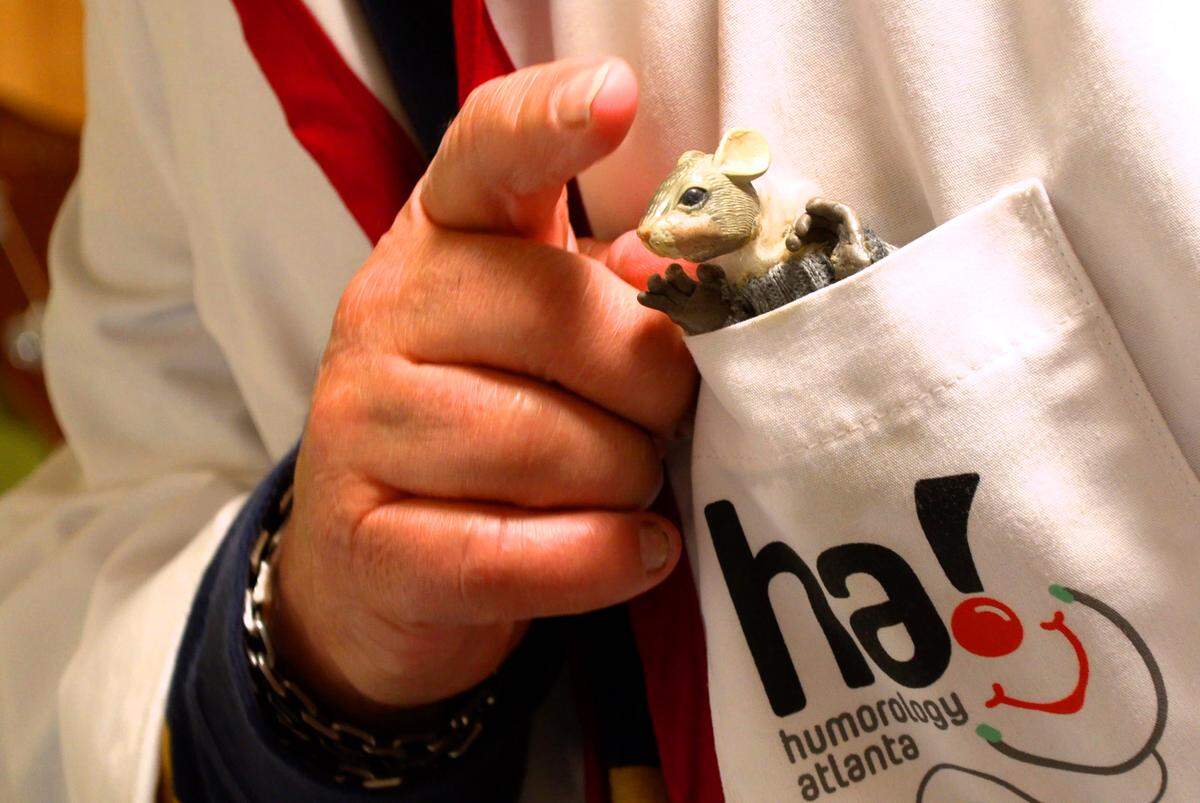
So Dr. Dokey tries another trick, reaching into his white coat to make a mouse puppet peer out of his top pocket, giving it a squeaky voice to introduce itself to the stuffed monster.
Finally, Oliver smiles.
As the clowns exit, Oliver’s mom follows them into the hall of Piedmont Columbus Regional Children’s Hospital, to thank them. “He was kind of afraid at first,” she says.
Oliver is not as receptive as 11-year-old “T.J.,” who offers to lay down a back beat for the two clowns to rap.
Starting with a little “Three-Stooges” slapstick to set the rhythm — one clown stomps the other’s foot, the other reflexively slaps the first in the belly — Dr. Tiny raps away. T.J. finds it hilarious.
It’s just another day making the rounds, for two Humorology Atlanta clowns.
Clowns in town
Online at www.humorologyatlanta.org, HA! is an Atlanta-based nonprofit deploying professional “Clown Doctors” to entertain patients and families at children’s hospitals, helping relieve their pain and stress.
Piedmont Columbus Regional invited the clowns down for a pilot program that could become standard.
Dr. Dokey and Dr. Tiny are not real doctors playing clowns, but they are real clowns playing doctors.
Dokey, the shorter one with a mustache and long hair, is Tim Settimi, 70, a longtime performer once named college entertainer of the year. The balder and taller one built like the soldier he used to be is Ron Anglin, 55, “Tiny” only by name.
Ask them about playing to kids in hospitals, and touching stories pour out like clowns from a tiny circus car.
Dr. Dokey remembers singing the twinkle-star song along with a little girl as her baby sister passed away.
Dr. Tiny recalls singing “Happy Birthday” to a 4-year-old, not because it was his birthday, but because his family knew he would not live to see it, three months later.
Clown scares
But that is not what I came to ask about. Hearing clowns were in town, I asked how they deal with one of American pop culture’s most persistent problems: Clown scares.
You may recall the Great Clown Scare of 2016, when people in a South Carolina town had reports of clowns hiding in the woods. Soon other cities had similar sightings.
Some authorities warned people not to dress as clowns that Halloween, because of all the hype.
Then the very next year, a movie based on Stephen King’s novel “It” came out, featuring Pennywise the evil clown, and suddenly everyone wanted to be a killer clown for Halloween.
How do clowns deal with this? Do they have to lie low during clown scares? Do children ever scream in terror when they walk into the room?
One thing the hospital clowns do to preclude that is a thing that they don’t do: They don’t face-paint.
Dr. Tiny takes off his red nose and hat, and he’s just Ron Anglin in a white coat: “It takes two seconds to be a normal human being again,” he says. “We don’t wear white makeup.”
Also they avoid gaudy costumes and extravagant wigs, and they don’t barge into hospital rooms. They must be invited.
If told to leave, Dr. Dokey may drop his flat brown hat, and do a little shtick of trying to pick it up as he kicks it away, reaching down.
“By the time I’ve got my hat and I’m headed for the door, they’re like ‘Where are you going?’” he says.
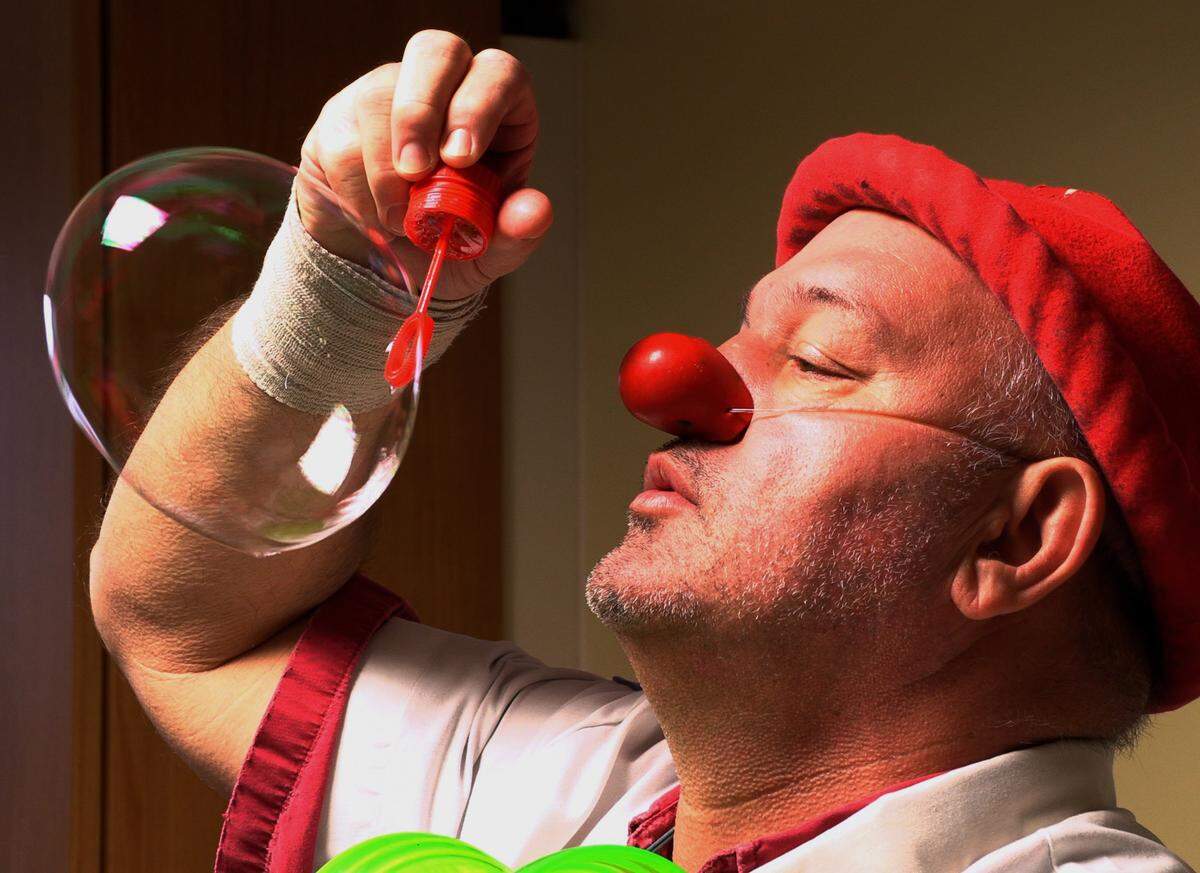
Blowing bubbles also puts patients at ease. Dr. Tiny can blow a bubble within a bubble, as a child stares in awe.
Working in pairs helps, because one may notice something the other does not. Sometimes a baby in a bassinet is on the floor right behind them, or an exhausted parent is asleep in a corner under a pile of clothes.
If the venue is unsuited to rap and ukulele, Dr. Dokey may deploy his personal pocket puppet mouse Andre, who can squeak softly up close.
Sometimes it’s not a child who’s scared of clowns. It’s an adult, with a good reason.
Dr. Dokey says a patient’s mother told him she was 5 when a circus clown put her on an elephant for a ride around the ring, but then the elephant lay on its side to give birth, pinning her leg for half an hour.
“I guess that would leave a pretty big scar,” he says.
So when they know they’re not connecting, they back off: “You have the right to say ‘no,’” he says.
“We’re the only ones a lot of times in the hospital environment that they can say ‘no’ to,” Dr. Tiny adds. “So I love getting kicked out of the room by a teenager, because you know, being a teenager is hard enough.”
Rejected or welcomed, they keep on carrying on, through clown scares and Pennywise Halloweens, never taking the holiday off.
“We work on Halloween,” Dr. Tiny says. “It’s just another day at the hospital.”