
Your Columbus Council, school board representatives could be changing. What to know
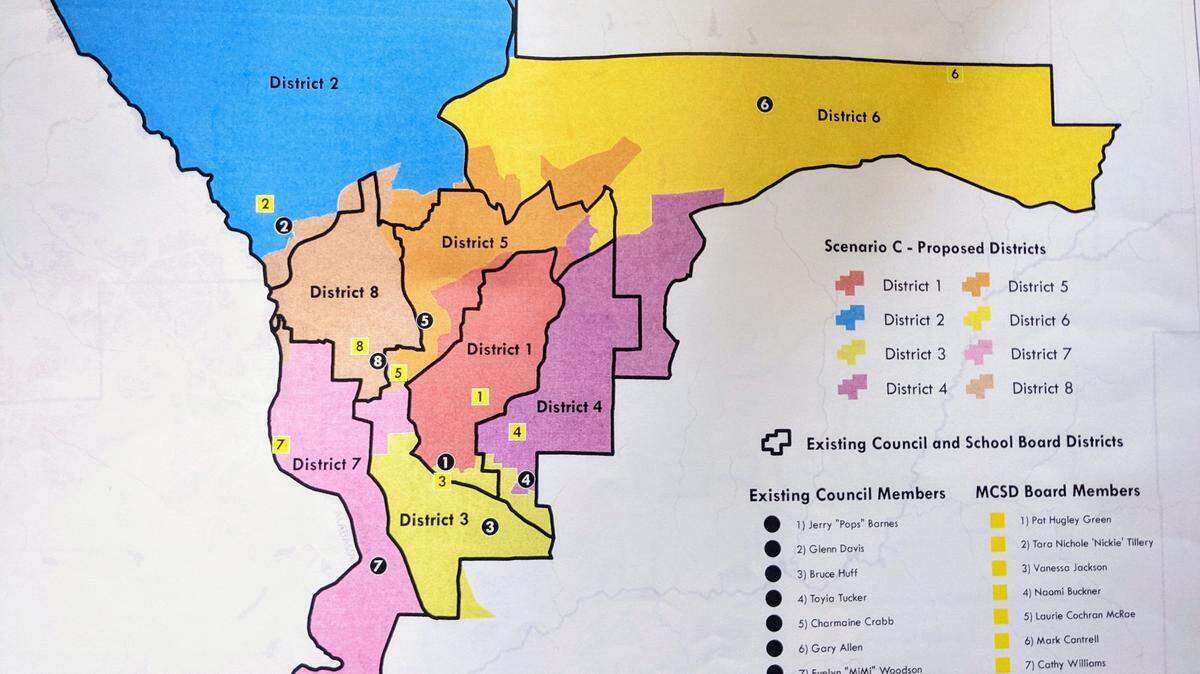
Some Columbus residents will soon have new council and school board representatives as a independent districting commission works to make the map align with new population numbers.
Columbus’ total population grew, topping 206,000 in the 2020 U.S. Census. New district boundaries will likely see six of the city’s eight districts cover more land while two of the northernmost areas have too many residents and must shrink.
The commission is tasked with making sure the boundaries comply with the U.S. and state constitutions, as well as other federal civil rights legislation such as the Voting Rights Act of 1965. Districts can’t be created to dilute minority population strength, and there has to be potential for minority representation on city council.
The new maps for the Columbus Council likely won’t be in effect the next time voters go to the polls, and commission representatives say speed isn’t their primary concern.
Here’s what residents need to know about the process and what comes next.
The biggest potential changes to the map
Excluding Fort Benning, Columbus’ population is just shy of 200,000, according to the 2020 U.S. Census. The Army post is excluded when drawing up council and school board districts because Fort Benning residents don’t vote in these local elections.
Each of the eight districts should have 24,977 residents. The commission’s ideal population range for each district is 24,727 and 25,227.
As a result, Districts 2 and 6 in the northern portion of the city must be smaller. That change creates a domino effect, making the other six districts larger.
The city planning department presented three different draft maps to the commission during its Thursday meeting. Commission members will use “Scenario C” as the basis for the new map and make tweaks to the draft in the coming weeks.
You can access the map at: https://bit.ly/3pQWaN5.
In the left corner of the map, you’ll see the “toggle layer list” icon. By clicking on this, you can choose which elements of the map to show. Currently displaced are the existing districts, the homes of council and school board representatives, and the newly drafted Scenario C districts.
That map is meant to:
Meet population requirements
Withstand state review
Keep incumbents in their current districts — a factor encouraged by the state
Follow major roads or water features to create smooth boundaries and not split subdivisions.
New map probably won’t be ready for primary deadline
It’s unlikely that Columbus Council boundaries will be redrawn and approved in time for the 2022 summer primary unless state officials push the election date back, representatives for the commission said during a Thursday meeting.
Under the current timeline, the commission would have to submit its report to the state reapportionment office and the Columbus Council in about a week for a new map to be used in the May 2022 primary, according to the city charter.
The Muscogee County School District is not bound by the same timeline and requirements. It could draw its own school board boundaries, but the district is working to have the same map as the Columbus Council.
Several factors contributed to the tight deadline.
U.S. Census results were released late due to the COVID-19 pandemic, and this is the first time redistricting has been done under an earlier summer primary date, said Muscogee County elections director Nancy Boren.
Speed is not the commission’s primary concern, commission chairman and Muscogee County Probate Court Judge Marc D’Antonio told the Ledger-Enquirer.
“Getting it right is the most important thing, and giving everyone notice and an opportunity to be heard,” he said. “Therefore, we’re going to take as much time as we need (to) get those two things done.”
What happens if the commission doesn’t meet the deadline?
If the commission wanted the new map for those elections, they’d have to act fast. If they don’t, the old boundaries would remain for the Columbus Council districts up for election in 2022 — Districts 1, 3, 5 and 7, Boren said.
The commission would have to submit its report to Columbus Council by Nov. 5 and the State Office of Legislative and Congressional Reapportionment by Nov. 9. The state has to approve the map before the city can adopt the districts.
Columbus Council would then have to approve the new maps by Nov. 16. The new maps must be approved six months before Election Day, according to the city charter.
District 3 Councilor Bruce Huff applauded the commission’s decision to slow the process down. Huff said he’d like to run under the existing council lines.
“We’ve been working for our constituents ... to get things accomplished, and it will be nice to give them the opportunity to re-elect us,” he said.
It’s still possible that the state could move the 2022 primary back.
Election workers from more than 120 of 159 counties signed on to a resolution seeking to move the summer primary from May to June. It was unanimously by the Georgia Association of Voter Registration and Elections Officials at their annual conference in late August, according to Georgia Public Broadcasting.
Moving the election might give the Columbus Districting Commission more time to craft a map.
Why do the maps change?
Columbus’ council and school board district change with the city’s population.
The city charter requires a 17-member districting commission to recommend a plan for the new council and school board districts. The report must be filed by February 26, 2022 — six months after 2020 U.S. Census data was released.
The report must include:
Contiguous and compact district boundaries
Boundary lines based on center lines of streets or other well defined boundaries.
A reasonable effort to have the same population in each district
A map and description of the districts
The Columbus Council must enact a redistricting ordinance within six months of receiving the commission’s report. If it doesn’t, the commission’s map is final.
What’s next?
The Columbus Districting Commission will hold a work session meeting Nov. 4 at 5:30 p.m.