The long-awaited race for the Georgia PSC begins with a crowded list of candidates.

For the first time in four years, the Georgia Public Service Commission will hold an election for two of the five commissioner seats this November.
But first, a record-breaking number of qualifying candidates will compete in the June 17 primary election to make it on the ballot in November. Candidates had to qualify by noon Thursday.
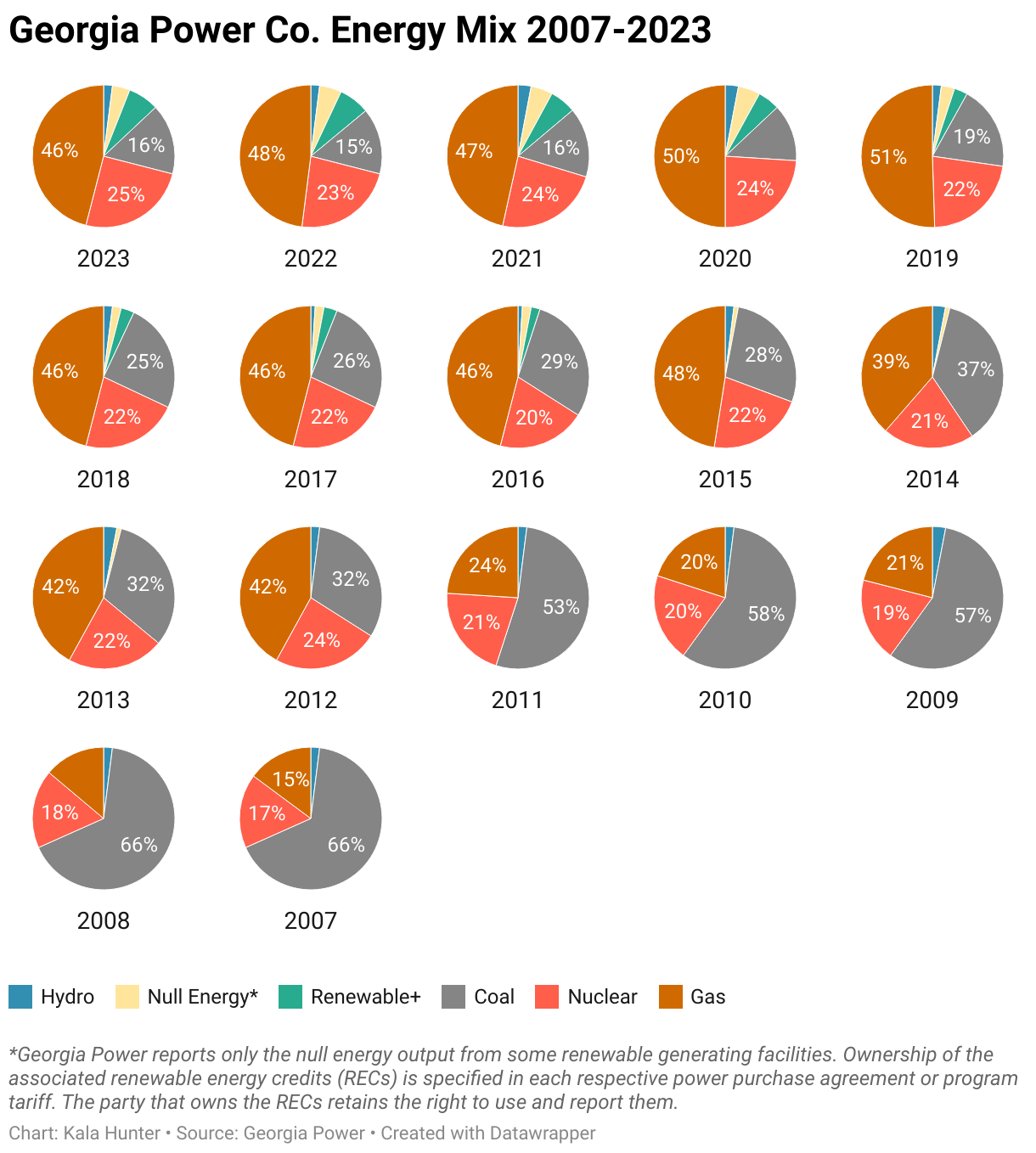
The commission is made up of energy regulators who review proposals from electric companies such as Georgia Power that detail how much the largest power company in the state plans to charge customers for their electric bill and how the power company will source their energy (solar, natural gas plants, coal power, batteries, hydropower and more). They hear out public comments and expert interveners every three years during Georgia Power’s Integrated Resource Plan alongside their other job duties.
They also hear from electric co-ops and telecom services throughout the Peach State to ensure Georgians have reliable access to these essential utility services.
“The PSC is really important because they are the only entity to have oversight over utility company plans and what Georgians pay for their energy,” said Brionte McCorkle, Georgia Conservation Voters executive director.
This week, six people decided they are up for the job, officially adding their name in the running against two Republican incumbents: Tim Echols of District 2 and Fitz Johnson of District 3.

A postponed election
Johnson and Echols were supposed to be up for election in 2022. But a lawsuit about voters’ rights postponed it. The 2020 lawsuit argued Black voters weren’t fairly accounted for due to the way the districts were set up. The accusers said it violated Section 2 of the Voting Rights Act. In November 2023, the 11th Circuit Court ruled in favor of Secretary of State Brad Raffensberger and against the group who filed the suit, saying the Voting Rights Act was not violated.
In March 2024, the group of Black plaintiffs, one of whom is McCorkle, tried to take the case to the Supreme Court. In June 2024, the Supreme Court declined to take the case.
Four Democrats are facing off in the primary to try to unseat Johnson in District 3: Daniel Blackman, Keisha Waites, Peter Hubbard and Robert Jones. This is the first time four Democrats have run for the PSC during primaries. Four Republicans once ran in the ‘90s, according to Robert Sinners, communications director for Georgia secretary of state.
It costs almost $4,000 to enter the race, according to the Secretary of State’s office. A commissioner’s salary is around $120,000 a year, public records show.
Republican Lee Muns and Democrat Alicia Johnson are running against Tim Echols for the District 2 seat. Alicia Johnson is running unopposed on the democratic side and will be the nominee this November.
Blackman running for 3rd time since 2014
This will be Blackman’s third run at the Public Service Commission. He lost to Republican Commissioner Lauren “Bubba” McDonald in 2014 by around 300,000 votes. Six years later he lost to McDonald again by about 150,000 votes, but neither got 50% of the vote and they went to a runoff. McDonald narrowly won that race by about 34,000 votes.
“I made a commitment not to go away from the on-the-ground issues from what was happening at the PSC,” Blackman said. “This issue is worth fighting for.”
Although Blackman lost in the 2021 runoff, the Columbus native took 34,000 votes more than McDonald in Muscogee County. He told Columbusites in his 2021 runoff speech he’s committed to lowering bills, fighting for environmental justice and expanding broadband in rural parts of the state.
And that hasn’t changed, according to his campaign statement Wednesday.
“Georgia’s Public Service Commission should work for the people – ensuring affordable, reliable, and clean energy for every household, regardless of ZIP code,” Blackman said. “We deserve leadership that prioritizes transparency, equity, and innovation. That’s the mission I intend to deliver on.”
Blackman lived in Columbus from 1988 to 1998 and grew up on post at Fort Benning. His dad was an Army ranger. He attended Shaw High School until he went on to Clark Atlanta University.
Since the last race with McDonald, Blackman has worked in the environmental space. He was the Region 4 administrator for the Environmental Protection Agency in Atlanta during President Joe Biden’s administration. Blackman called himself a “clean energy advocate” and created a social impact consultancy advancing climate resilience and a just transition for underserved communities with his foundation Renaissance94.
“Georgians are grappling with skyrocketing utility bills, rural broadband disparities, and health implications of outdated energy sources, and I’m the clear choice for program and accountability,” he said in his campaign announcement.
Skyrocketing bills, climate and accountability are on the ballot
Alicia Johnson, who lives in Savannah, part of District 2, has a background in business, strategic planning, grant writing and worked as a public information officer for a judicial circuit. She also serves on Bloomberg’s Sustainable Cities initiative, looking for solutions to climate change.
Johnson said while she hasn’t served on a public utility commission before, she has reviewed broadband issues, rising bills and lack of clean energy across the state.
“In our 159 counties we don’t have the broadband or affordable energy structure that supports the every day working Georgians who are feeling the strain of rising utility bills,” she said. “We need a PSC that works for the people, not just for the energy company. We need to look at expanding clean, reliable options, making solar energy accessible and affordable. This is not a partisan thing. We have the data. Investing in renewables creates jobs and reduces dependency on volatile fossil fuel markets.”
Alicia Johnson believes energy independence starts at home and for too long consumers shoulder the burden of rising utility rates and “questionable decision-making.”
Echols, who hasn’t had to run in an election since 2016 – a five year term that turned into a nine-year term because of the Voting Rights Act case – will face off against Alicia Johnson this November, should he win against his fellow qualifying Republican candidate, Lee Muns. Muns is a project manager who resides in Columbia County. Muns couldn’t be reached for comment for this story.
Echols told the Ledger-Enquirer under his watch, Georgia is aggressively transitioning to a cleaner grid. He said he helped create a net metering program in 2019, which allows customers with rooftop solar to add extra solar energy credits back to the credit and get paid for it. The program, known as a solar incentive by many experts, was removed in 2022 by the PSC.
“I have been a stalwart supporter of clean energy,” Echols said in an email. Echols pointed to his evangelical Christian faith when asked about climate change, saying, “I believe that God ultimately controls the destiny of the planet …God gave mankind dominion over the planet and we have an obligation to care for His Creation, including our air and water and soil.”
His biggest future concerns are any rise in electricity bills in 2025 and 2026.
Peter Hubbard, a clean energy expert who has intervened on the Georgia Power Integrated Resource Plan three times and is currently intervening a fourth time during the 2025 IRP process, decided he wants to take the next step after his concerns have fallen on deaf ears.
“Power bills are going up and there is no end in sight,” Hubbard said. “It also comes down to a lack of accountability. Those two things together are driving me to run for office.”
Hubbard has raised concerns about how far behind Georgia is in the clean energy transition. When talking to the commission he has focused on the state using more affordable renewables and batteries, and implementing demand side management systems.
“I see a continuation of corporate interests coming before the interest of Georgians,” he said. “I’m running to make the change that needs to happen to lower energy bills and advance clean energy.”
Hubbard acknowledged he is one of three others running against Fitz Johnson in the primaries, and initially wanted to run against Echols in District 2, he told the Ledger-Enquirer.
“I would have preferred to run against Echols but I had no choice because my hands are tied from the latest legal requirements,” he said, referring to a 2024 law that requires candidates to live in the district they want to run in.
Hubbard has run for office before. He ran for Georgia House District 90 in May 2022, losing to Saira Draper.
‘A crowded race’
Robert Jones wanted to run for Public Service Commission in 2022 and in 2024 against Tricia Pridemore, but both elections were canceled due to lawsuits being reviewed by the courts.
Jones has a diverse background in utility and communication regulation. He’s worked as a senior regulatory analyst for electricity companies in Oakland and Seattle, and worked for a regulated utility monopoly, AT&T, now Lumen technology.
“I’ve done communications and energy, and then I moved over to Microsoft and did data center sales,” he said. “I understand utility regulation and I understand the utility business.”
The eight-year Dekalb county resident and Georgia Power customer said over the last four to five years the current commission is not “innovating or adapting to energy policies that society needs.”
“I want to participate and help in terms of moving toward a better energy policy environment and deliver affordable rates in a more climate friendly environment, he said”
Since the pandemic, Jones has homeschooled his daughter, worked as a substitute high school teacher and done tech consulting for private credit firms.
“I really want to see Georgia become a leader in rooftop solar,” he said. “As a Public Service Commissioner I can leverage my skills to Georgians benefit.”
Blackman, Hubbard and Jones are all Georgia Power customers.
Keisha Waites will also face off against Jones, Hubbard and Blackman in the primary on June 17.
Waites was a former three-term state representative. She served District 60 in Clayton and Fulton counties from 2012 to 2017. She spearheaded efforts concerning anti-bullying, HIV testing initiatives and authored legislation (HB-54) to provide tuition assistance to children of law enforcement officers who have died.
She served on the Atlanta City Council starting in 2021 and resigned in March 2024. She planned to run for Fulton County Clerk, according to other media reports. Waites couldn’t be reached for comment for this story.
Fitz Johnson, who was nominated for the seat by Gov. Brian Kemp in 2021, did not respond to request for comment about running this year. Earlier this year in a sit down interview with the Ledger-Enquirer, Johnson laid out his priorities when it comes to being a commissioner.
“Our mission here is safety, reliability, reasonable cost…with those three things in mind, then we can start to look at how clean energy is,” Johnson said.
McCorkle called this race an opportunity to take stock of what’s happening at the commission.
She said Georgia Conservation Voters will announce endorsements by the middle of May.
“If you’re concerned about the environment, climate, that’s one reason why this Public Service Commission race is incredibly important,” McCorkle said. “They hold the keys to our energy feature in their hands, because they’re the only entity that can be a backstop against Georgia Power’s greed.”
This story was originally published April 4, 2025 at 11:38 AM.
CORRECTION: Brionte McCorkle’s name was spelled incorrectly and vote results were displayed inaccurately in a previous version of this story.