Columbus civic organizations detail plans for 2026 local election strategy
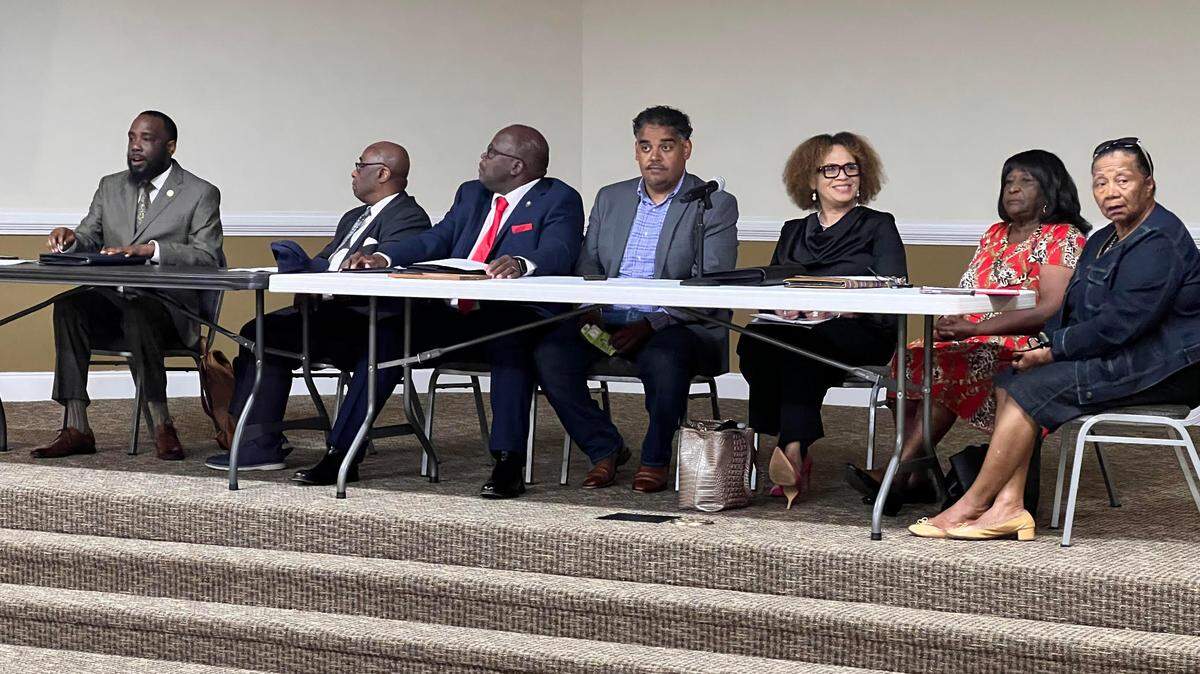
Columbus civic organizations gathered last week for a town hall meeting to discuss plans for the coalitions to unite and consolidate Black voters behind candidates ahead of the 2026 local elections in Muscogee County.
Leaders from organizations, including the Columbus branch of the NAACP and the Columbus Interdenominational Ministerial Alliance, led the meeting April 17 in the Page-Doleman Complex at Holsey Chapel CME Church.
The meeting followed multiple news conferences condemning the Columbus Council’s appointment of Councilor John Anker to the citywide District 9 seat the same day former Councilor Judy Thomas resigned.
But the town hall was meant to focus on the coalition’s plans for the next election rather than expressing opinions about elected officials, national NAACP board member and the Georgia state administrator Ed DuBose told the Ledger-Enquirer.
During the town hall meeting, leaders from multiple organizations laid out plans for their movement, named Columbus, GA, United, to vet, prepare and campaign for a single “unity” candidate for each seat up for election.
“We are really looking at shifting paradigms,” the Rev. Johnny Flakes III of Fourth Street Missionary Baptist Church said during the meeting. “We’re looking at shifting the process and establishing clear-cut paths to providing the best candidates that Columbus deserves to serve residents of this city.”
Elections for mayor and Columbus Council seats for Districts 1, 5, 7 and 9 are in May 2026.
Vetting and training candidates
Members of the coalition who were involved in the recent news conferences understood that they had to create an organization that would include everybody, Flakes said.
These conversations led to the creation of Columbus, GA, United.
“The goal is to prevent vote splitting, preserve and protect our political power,” Flakes said. “Black power that does not exclude anybody else.”
Their plan is to consolidate community support behind a single viable candidate in races where multiple Black candidates will split the vote, he said.
The first step in achieving this is to create a vetting committee consisting of 7-10 members representing faith leaders, youth organizers, elders, advocates, political strategists and neighborhood representatives.
This committee would review candidate credentials, records and community support. They would interview prospective candidates and analyze their viability using data and strategy.
The committee also would host public forums where candidates would answer key issue-based questions, demonstrate their policy knowledge and public speaking ability and share their campaign vision.
“Someone in the room might be like, ‘Who’s controlling the show?’” DuBose said. “The people. The power always belongs to the people.”
As part of this process, the coalition also will develop candidate scorecards, DuBose said. This is important for more than just vetting candidates, he said.
The community has allowed people to step into a role, DuBose said, and then they don’t grade them. This has created a situation where candidates can vote against key issues multiple times without it being “graded.”
“When the election time came around, you came to our church, picked up a baby and sang ‘Lift Every Voice and Sing,’” DuBose said. “And then you got a free ride because we didn’t follow your campaign. We didn’t follow what you said you would do for us. We were fooled by your appearance at our church anniversary.”
Candidates who go through this process will be asked to pledge to step down and not continue to run as a “spoiler candidate” if they are not selected, DuBose said.
As part of the process, Columbus, GA, United will have potential candidates attend workshops preparing them to run for office.
The coalition hopes to complete outreach to potential candidates and orientation by June and have the vetting committee formed by July. Then candidate interviews and public forums will take place from August through September. By October, the committee is expected to be ready to make its recommendations, and the 2026 campaign will be launched between November and December.
A centralized communication strategy
Centralizing messaging and voter information is a key component of Columbus, GA, United’s strategy.
The Urban League of the River Valley will be in charge of messaging for the coalition, Dorothy “Dot” Bass said during the meeting.
“Clarity and consistency are key,” she said. “A single trusted source for voter information helps eliminate confusion, prevents misinformation and builds collective confidence in the electoral process.”
Centralizing voter education will help streamline communication across the partners, Bass said, and will help support a rapid response if a polling location changes or a runoff is announced.
Organizations in the coalition would send their information to the Urban League, which then would disseminate the information.
Voter mobilization
Another large part of Columbus, GA, United’s strategy is to focus on voter mobilization. The coalition knows there are voter turnout disparities among African Americans, community organizer Marquese Averett said during the meeting.
“We know that our opposition is strategic, they are coordinated, and they are well-funded,” Averett said. “We must be just as intentional. We also know, when all people vote in full force, we change who gets to make decisions on housing, policing, schools and economic development.”
The coalition will go to places that have “mattered the most” in the community, like churches, barber shops and salons, he said. They also will reach out to communities of all demographics, Averett said, because every group cares about issues like affordable housing, jobs and safer communities.
They also will focus on mobilizing young people early.
“It’s not good enough to wait until two or three weeks before the election and say we need to go find some young folks,” Averett said. “We have to make sure that they are included from the very beginning because their issues matter.”
Columbus, GA, United could represent what civil rights leader Jesse Jackson referred to as a “rainbow coalition,” he said.
“I often say that doing nothing isn’t a revolutionary act,” Averett said. “Sitting on the sideline doesn’t take any courage. In order for us to make this happen, we have to mobilize voters and get people out to vote.”