Columbus Council approves more exploration into a site for new Muscogee jail
.jpg "The Muscogee County Jail is at 700 E. 10th St. in Columbus.")
The Columbus Council voted Tuesday to allow for a design consultant to start the schematic design process for a potential new Muscogee County Jail on 11th Avenue. This would provide more information on the logistics and pricing of using the city-owned property as the site for the facility.
Columbus Director of Code and Inspections Ryan Pruett provided the council with an update on the site selection for a new jail during the Aug. 12 meeting, recommending the 601 and 602 11th Ave. location as an option that would best fit the Muscogee County Sheriff’s Office’s needs.
Shane Clark, an architect with SLAM Collaborative, explained that ensuring the new potential site is within a mile of the courthouse is critical, based on feedback they received from Muscogee County Sheriff Greg Countryman.
The 11th Avenue property is just south of Cusseta Road and within a mile of the courthouse, he said.
“What makes this a unique site is that it’s a city-owned property,” Clark said. “So there’s no acquisition costs involved.”
It is previously an industrial site, he said, so there are some contamination issues. The site also has some minor flood zone issues, Clark said.
Henry Painter, senior project executive at Gilbane Building Company, presented an estimated construction budget of $398 million for the jail at this site.
Part of this cost is relocating pre-engineered metal buildings to another site, some demolition and addressing the contamination in the soil, Painter said. The cost is subject to change as they receive more information from the schematic design.
There is an environmental study ongoing at the site, Clark said, which should be completed by early September.
The resolution council approved during its Aug. 26 meeting allows SLAM Collaborative and Gilbane Building Company to proceed with the schematic design services only up to the current amount of the contract.
Painter’s estimate from the Aug. 12 meeting was based on conceptual plans, Pruett said during the Aug. 26 meeting.
“If we proceed here, we spend the rest of the design contracts studying this location and further developing this location,” he said. “We would end up with about 25% complete plans. 100% would be construction documents that you could build off of. This is still very conceptual, still very early.”
The resolution passed by a voice vote, with only Council John Anker of citywide District 9 voting no.
Inside the potential new jail
This new jail would house about 1,600 beds and support spaces associated with that, said Doug Shaw, a corrections expert with Jericho Design Group. The current jail has about 1,069 beds, Pruett said. Plans for a future expansion of the new jail, he said, would raise the number of beds from 1,600 to 2,000
“The majority of the building is really the housing units themselves,” Shaw said. “The support areas are not as big.”
Another important part of the project is the focus on mental health and mental health options, he said.
While most of the beds are general population, he said, some are single cells for individuals who need to be separated because of mental health issues.
The design team developed diagrams for a two-story option and a three-story option for the jail, Clark said.
Deterioration of the Muscogee County Jail
The infrastructure of the Muscogee County Jail is aging and deteriorating, Columbus Public Works director Drale Short told the council in a presentation earlier this month.
One of the first issues identified in the jail was the compromised roof structure, she said, which was causing leaks and insulation failure. An assessment was done, Short said, and a contractor, Skyline Construction Services, is scheduled to begin the roof replacement and repair in September.
Another issue in the jail is mold. MBL Environmental was contracted to perform mold remediation, HVAC deep cleaning and air quality testing. Moisture monitoring and sealing will be ongoing, along with the roof replacement, to address the mold problems, Short said.
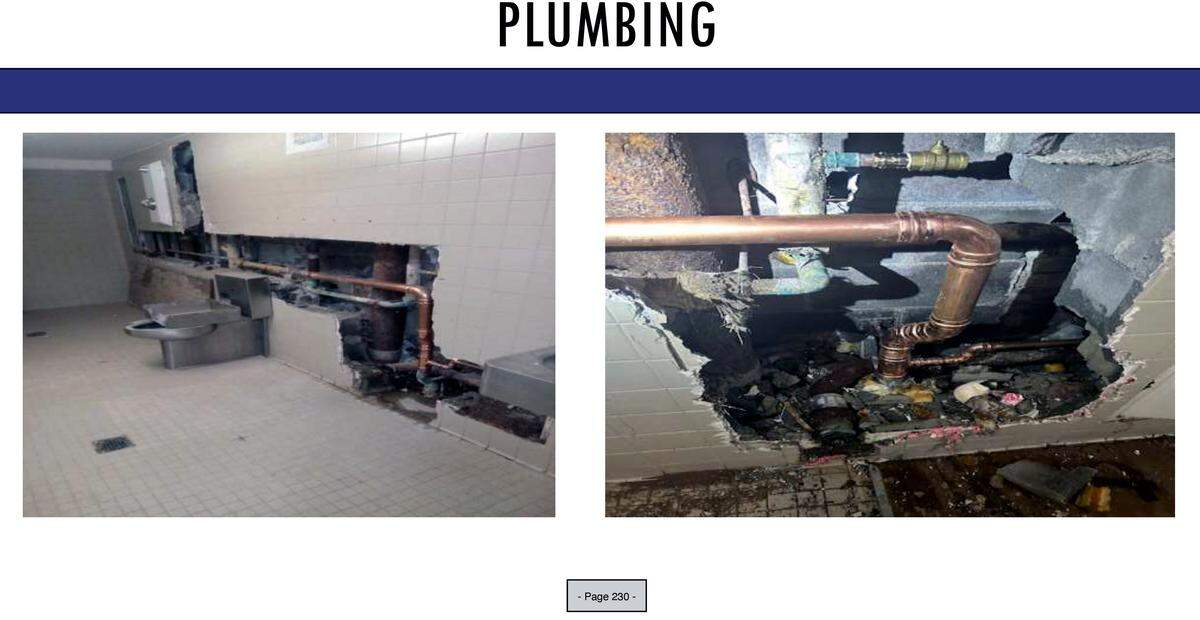
Plumbing in the jail also is a problem because copper pipes that were installed with pipe hangers made from a different type of metal during construction are causing corrosion.
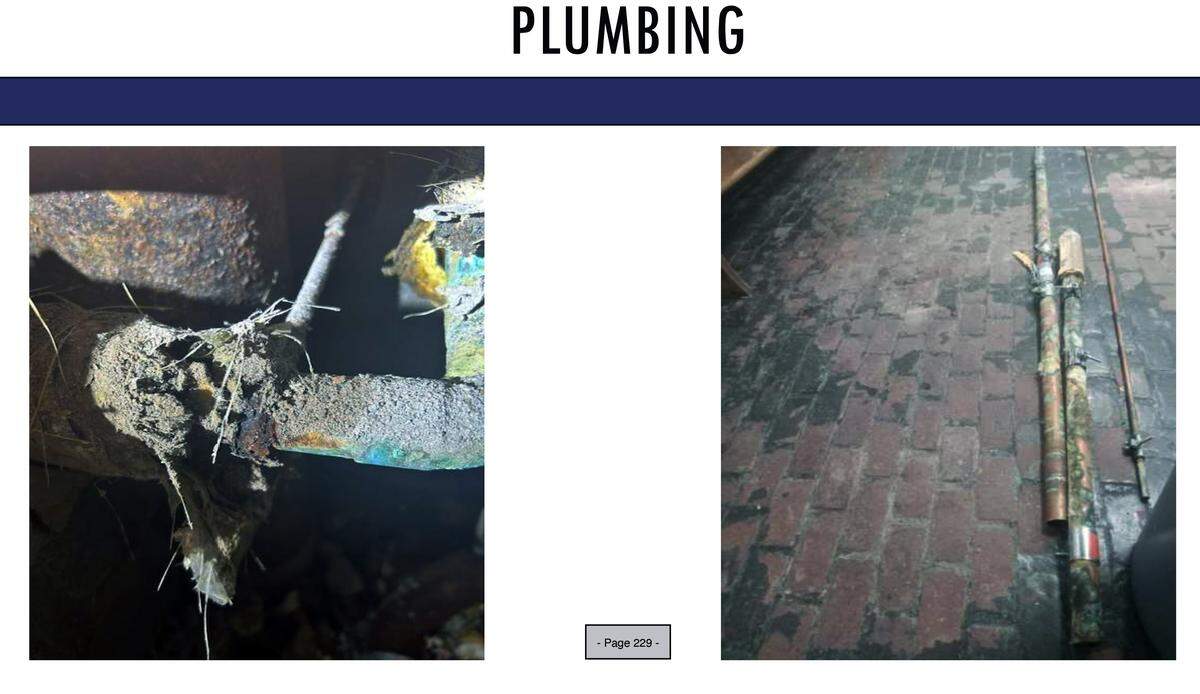
This has led to persistent water intrusion in housing units and common areas and plumbing infrastructure failures throughout the jail, increasing the risk of mold, air quality concerns and electrical hazards.
“We deal with this on a daily basis,” Short said.
The pipes are being monitored and replaced as needed, she said.
As of the Aug. 12 meeting, the city has spent about $1.94 million on the roof, plumbing and mold remediation.
The exterior facade of the jail also has problems, Short said, with pieces of brick and masonry detaching, creating falling debris hazards. Long-term water infiltration, thermal expansion and a lack of anchoring integrity is causing the deterioration, she said.
“It’s an immediate risk to staff, inmates, contractors and visitors from this falling debris going into the jail,” Short said.
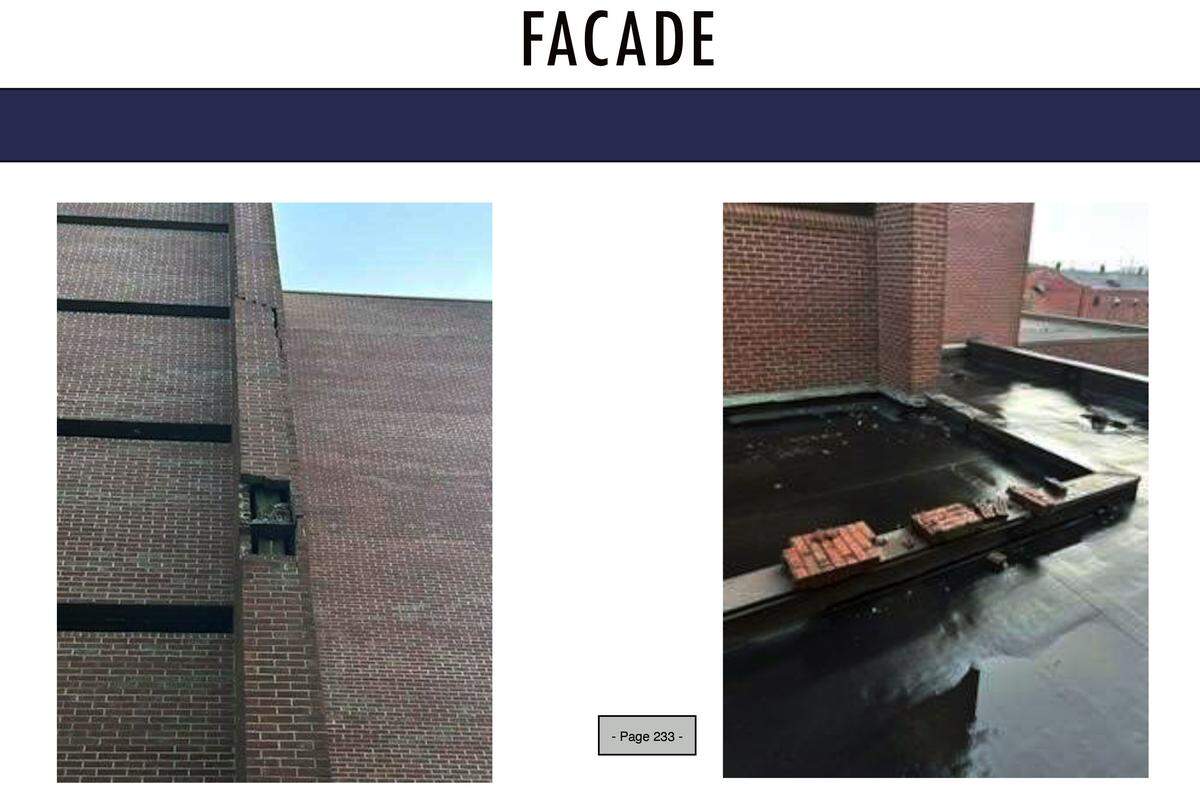
This problem also means the jail is not in compliance with structural safety and building codes. The structure could become compromised and damage the new roof and HVAC equipment, she said.
An emergency barrier will be installed to prevent pedestrian access, she said.
During the Aug. 12 meeting. Anker and Short characterized the strategies to address these issues as a “band-aid.”
“We don’t have foreseeable estimates (on how long the fixes will last),” Short said, answering Anker’s question about how long the strategies will work. “We are addressing everything as it pops up. But a band-aid is a band-aid. It only lasts for as long as its adhesive sticks.”