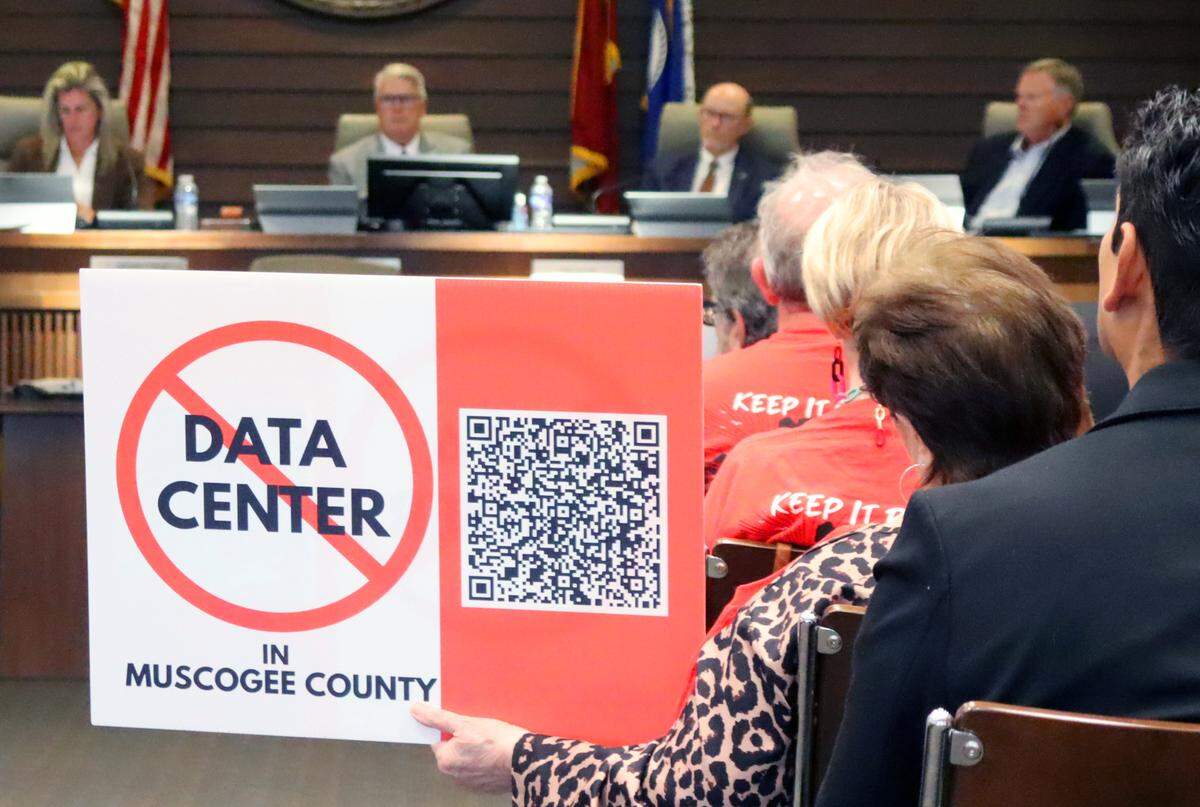
Who rewrote Columbus’ data center ordinance? This committee did — and here’s the proposal
An unofficial committee of Columbus business leaders, residents and subject-matter experts gathered to weigh in on one of the biggest debates in the city: What rules should govern hyperscale data centers.
The group proposed amendments to the proposed technology overlay ordinance, a document that, if the Columbus Council approves, will regulate data center projects in the consolidated jurisdiction of Columbus and Muscogee County. A proposed hyperscale data center called Project Ruby is targeted for 865 acres in northeast Muscogee County.
Now, the committee’s recommendations have become the foundation of city policy.
During its meeting Tuesday night, the Columbus Council voted to replace the Columbus Planning Advisory Commission’s proposed technology overlay ordinance with a revised draft developed by the committee.
Steve Craft, a retired public defender and member of the committee, reflected on the importance of the committee’s efforts in an interview with the Ledger-Enquirer.
“It was a significant first step toward educating both the council and the public — and putting a stronger ordinance out there to address public concerns,” Craft said.
How did this committee happen?
Jansen Tidmore, president and CEO of the Greater Chamber of Commerce, organized the committee after the PAC delayed its recommendation for the ordinance in March. He told the Ledger-Enquirer his group comprised half chamber members and half industry professionals engaged in the data center debate, whom he “never met before this.”
“They had either sent council members emails or spoken up in the public meetings,” Tidmore said. “The key was that we managed to create an atmosphere for healthy dissent — [the committee] to create the baseline for which this community can have the right conversation when and if a project comes our way.”
The 16 committee members weren’t paid for their participation in these discussions, he said.
The committee met seven times this spring. Tidmore said. The meetings were lasted from 90 minutes to two hours, he said, filled with extensive conversation about how to address key areas of concern with the data center ordinance, including water use, power demand and land use.
“In those meetings, we had a wide range of viewpoints,” he said. “We went deep, and we went on a micro level.”
The group’s goal wasn’t to present a fully “pro” or “anti” stance on the data center issue, Tidmore said. Instead, the core question guiding the committee was, he said, “What regulations should be in place for data center projects?”
“There were topics and points within those topics that not everybody agreed on,” Craft said. “Everybody was very plainspoken about why they felt one way or the other.”
Tidmore and Craft said the group’s work is finished but the members are unlikely to disappear from the conversation.
“I think every single person around that table is passionate and has a desire to continue to follow data centers in any kind of official capacity,” Tidmore said. “We’ve left that on the table, but there’s no future meeting scheduled for this group. I see it as a closed chapter right now, but there could be an ask of us to drum it up and do more, and I just have to take that construct.”
What’s in the report?
The committee’s report is a 30-page document that answers frequently asked questions, summarizes key concerns and proposes amendments to the technology overlay ordinance. It also contains a draft of the ordinance, rewritten with their suggestions.
The group produced a list of changes for the technology ordinance, split by topic area. Here is what they recommended to the council:
Scope and definitions
- Add an explicit definition of “Hyperscale Data Center Campus” — single contiguous tract of 75 acres or more— and limit the overlay’s application to facilities meeting that definition.
- Clarify in the purpose section that smaller data processing facilities continue to be permitted by right in GC, SAC, LMI, and HMI districts under the existing zoning code. The overlay is not the vehicle for them.
- Codify that the 75-acre minimum applies to a single contiguous tract under common ownership or control; assemblage of non-contiguous or multiple platted parcels do not satisfy the requirement.
Water and sewer
- Keep the cooling restriction, but reframe it as a prohibition on open-loop evaporative systems, rather than a mandate of a specific closed-loop technology that may be outdated in a few years.
- Reference the existing city Sewer Use Ordinance and industrial pretreatment program explicitly, so a developer cannot argue around requirements that already apply.
- Address potential septic-to-sewer connection obligations for nearby residents through the development agreement, not the overlay.
- Confirm in the overlay that the developer is responsible for all on-site water and sewer infrastructure, including primary and backup feeds, lift stations and easement acquisition.
Energy
- Keep the utility availability letter requirement and clarify that it covers electric, water, sewer and natural gas — issued only after each affected utility has completed system impact studies and confirmed service in writing.
- Use this document and the council work session to publicly explain the Georgia Public Service Commission protects residential rates from large-load infrastructure costs and that franchise fees flow back to the city’s general fund.
Noise
- Specify property line — not building line — as the measurement point.
- Maintain dBA caps at 65 daytime / 55 nighttime at residential property lines, with 70/65 dBA at non-residential property lines.
- Add dBC (low-frequency) caps based on the acoustic modeling study with a baseline +10 of dBA.
- Change time windows. Instead of from 8 a.m. to 6 p.m. and from 6 p.m. to 8 a.m., they should be from 7 a.m. to 10 p.m. and from 10 p.m. to 7 a.m., which better matches household sleep patterns.
- Require pre-construction acoustic modeling, prepared by a qualified acoustical engineer, submitted with the building permit application, so noise problems are designed before equipment is procured.
- Treat backup generator testing as a separate category: weekday daytime testing only, with 72-hour advance written notification to property owners within 1,000 feet (similar to quarry blasting notifications). Emergency operation is exempt.
- Add escalation beyond the $1,000-per-day fine — civil action including injunctive relief and certificate-of-occupancy revocation — for repeat or willful violations.
Setbacks, buffers and design
- Replace any prescriptive 500-foot setback floor with a performance standard: meet the noise cap at the property line, design accordingly, with a 200-foot baseline buffer adjacent to residential property and vegetative screening that serves visual and acoustic purposes.
- Require a planting plan as part of the development agreement, so buffer composition is reviewable rather than left to interpretation.
- Keep the 75-foot building height limit, the dark-sky lighting standards and the HVAC screening requirements as drafted.
- Retain front-facade orientation toward arterial streets where applicable to maintain neighborhood character.
Process, scope and overlay applicability
- Make explicit that adding the technology overlay to a property follows the full rezoning process — sign posting, 300-foot notification, PAC hearing, two council readings — even though Chapter 10.2 already governs this.
- Require a development agreement for every overlay approval, and enumerate the minimum contents of the agreement (acoustic study, cooling specs, buffer composition, phasing, expansion conditions and additional cost obligations where applicable).
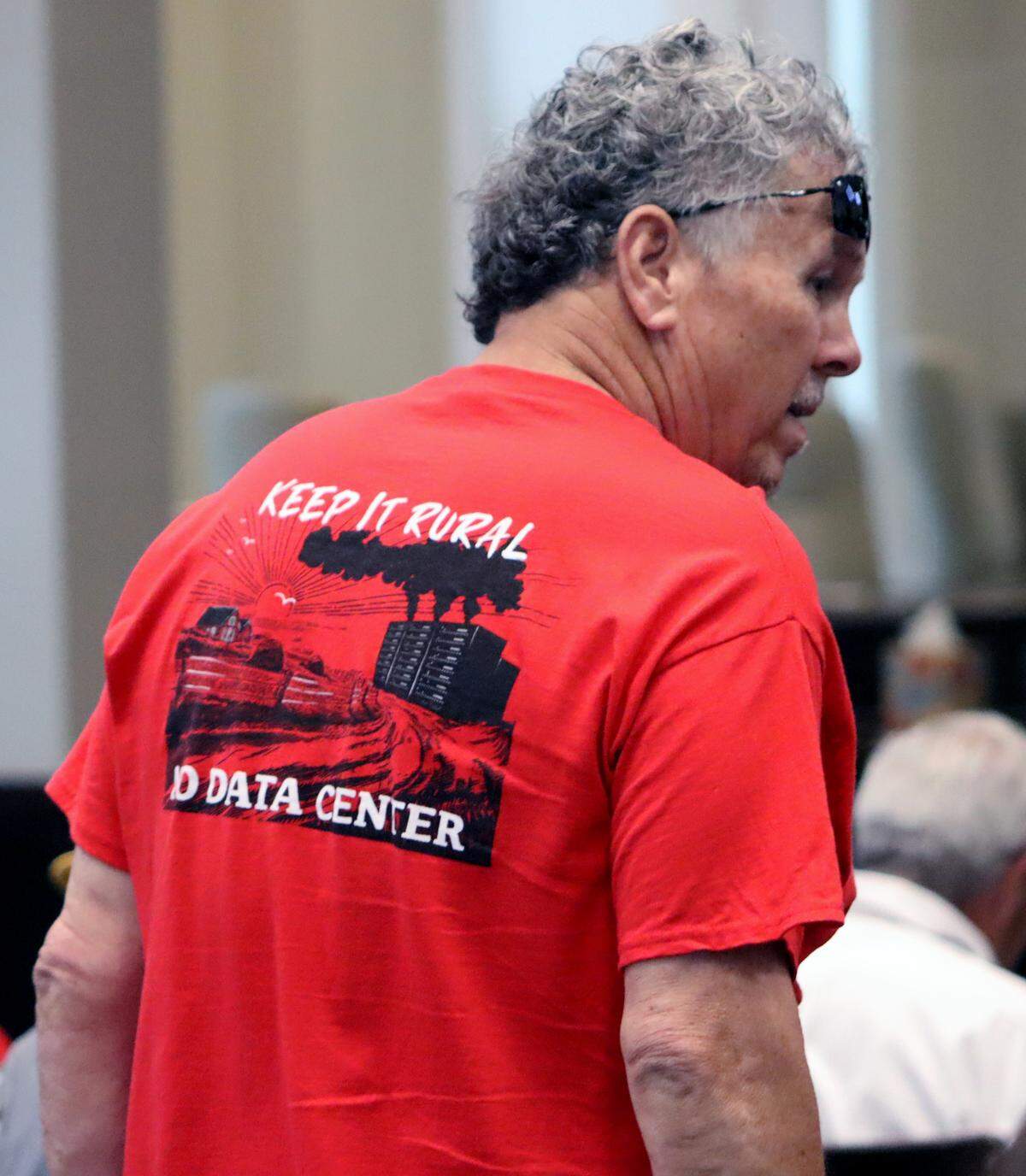
Tidmore said committee members were still torn on the amount of regulation. That was part of their goal.
“When we ended … there are [members] that probably would have liked to see more policy in there, and there are ones that would like to see less,” he said. “The room collectively said, ‘OK, we probably landed where we’re supposed to.’ This is a likely good compromise because neither side is happy.’”
The council voted Tuesday night to delay the first reading until June 9.