
Brood X is coming: Millions of cicadas to re-emerge in parts of Georgia this spring
After 17 years underground, billions of Brood X cicadas will burst forth from the soil this spring.
Large swaths of the Midwest and East Coast, including parts of the South, are bracing for the cyclical return of the periodical cicadas, which emerge once every 13 to 17 years. Brood X is considered one of the largest and widely distributed of the group and was last seen in 2004, according to University of Connecticut researchers.
“It’s not something you can ignore,” John Cooley, a biologist at the university, told Time. “When they come out it’ll be millions per acre.”
Maps show most of Brood X will emerge in the Washington, D.C. area and surrounding states including Virginia, West Virginia Maryland and Pennsylvania. Experts say the DC-metro area alone could see trillions of the flying insects known for their black bodies, bright red eyes, translucent wings — and cacophonous buzzing.
“It will be hard to walk outside without stepping on them,” Floyd Shockley, entomologist at the Smithsonian’s National Museum on Natural History, told Smithsonian Magazine. “They will be singing all day from approximately 10am to 5pm, every single day. It will be a constant buzz for three long weeks.”
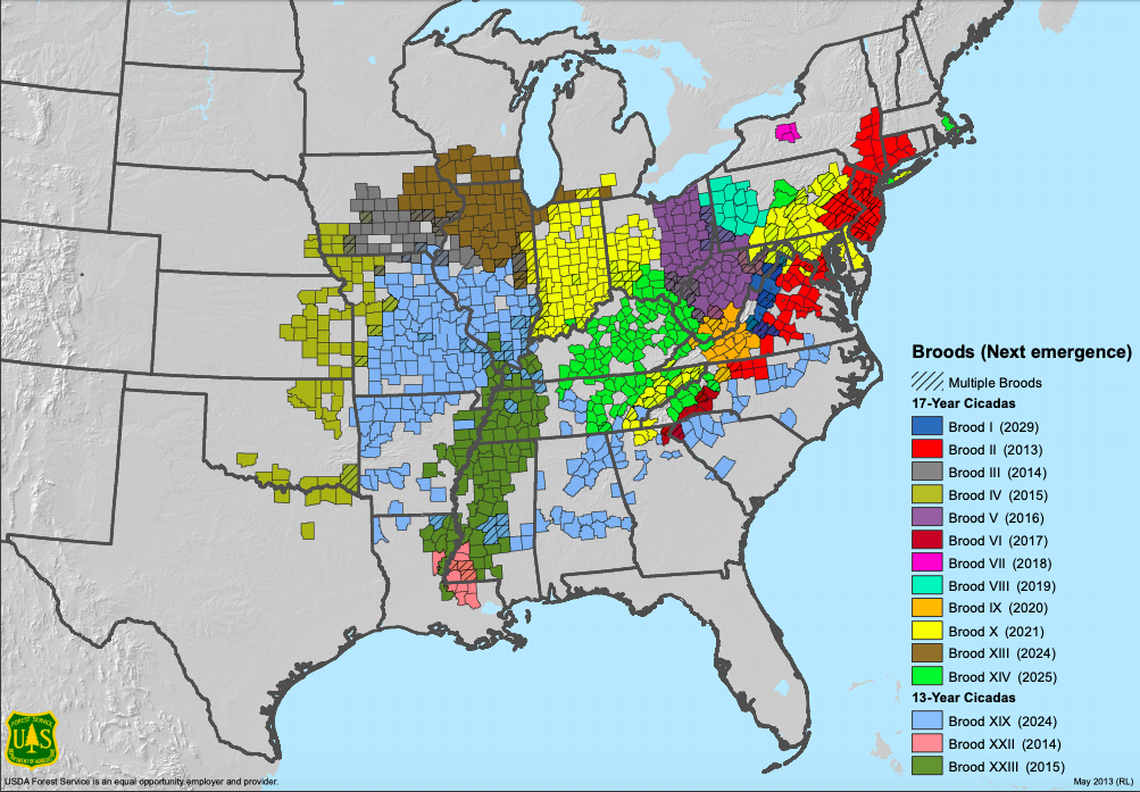
Parts of the South will also see the return of Brood X beginning in late April and early May. In Georgia, the brood is expected to emerge in only a handful of northern counties including Union, White and Gilmer counties, according to the website Cicada Mania.
Young cicadas, or so-called nymphs, spend much of their lives underground until it’s time to re-emerge. Their life cycles begin with the females laying eggs in “pencil-size” tree twigs and shrubbery, USA Today reported. The eggs hatch six to 10 weeks later, falling from the twigs before burrowing below the soil.
The nymphs spend the next 17 years feeding from tree roots and shrubs until the soil temperature warms to 65 degrees for them to erupt from the ground — simultaneously, according to the outlet. The now-mature cicadas will then shed their outer most skin and begin the mating process, which is often accompanied by lots of loud buzzing.
The “seemingly endless vibrations” are part of the males’ efforts to attract a potential partner “with an echoing chorus that must be louder than their competition,” according to researchers at the University of Georgia’s College of Agricultural and Environmental Sciences.
The “mating song” can hit up to 90 decibels, or about as loud as a lawnmower.
Even with the noise, experts say Georgians may have a tough time tracking down Brood X this season.
“We are estimating that they are only going to emerge in about 10 counties and in the very northeastern part of the state,” said Nancy Hinkle, professor of veterinary entomology at UGA. “Even then, there may only be a few spots where they can really be noticed.”
The event is often over just as quickly as it started. Male cicadas die off two to four weeks after emerging, and the cycle resets.
Brood X won’t spread its wings again until 2038. However, one 13-year cicada brood is expected to emerge in parts of Georgia in the next few years.
In 2024, Brood XIX could span several Georgia counties including Fulton, Cherokee, Troup, Catoosa, Walker and Floyd, according to cicada tracking data from the U.S. Forest Service.
This story was originally published April 15, 2021 at 7:16 PM with the headline "Brood X is coming: Millions of cicadas to re-emerge in parts of Georgia this spring."