Snake behavior is changing in Georgia with hotter temperatures. How bites could increase
Snakes are adapting to habitat and climate change from urbanization and increasing temperature spikes in the spring and summer. Both changes are leading to higher odds of snake bites for Georgians.
Of the 45 species of snakes in Georgia, seven are venomous. Georgia ranks second in the country in amphibian and reptile diversity.
As urban areas sprawl and extend into what was once snake habitat, it is more likely people and snakes will come in contact with one another. Whether in a backyard, while hiking on a trail, or hunting throughout the state, there are plenty of opportunities to come into contact with a snake in Georgia.
Researchers at Emory University recently released a study that found increasingly warmer springs and summer temperatures are making snakes more active.
“The more warm days we have the more venomous snakes are active, and more people are active, so there are more contact days,” Larry Wilson a herpetologist at Emory University said.
Noah Scovronick, a public health professor and researcher at Emory, and Wilson examined the number of snake bite emergency department visits in Georgia between 2014-2020 to understand the relationship between higher temperature days and snake behavior. They surmised there is a 6% increase in snakebites for every 1 degree Celsius increase in maximum temperature.
For instance, if yesterday’s high was around 84 degrees F (29 C) followed by 93.2 degrees F (34 C) today, the study argues there is a 32% increase in the likelihood of a snake bite, due to the short-term temperature spike that encourages snakes to be more active.
.jpg "eastern diamondback Rattlesnake GA Decatur co (2A).jpg")
Snakes are cold-blooded. They heat themselves from the ambient environment around them. When they leave their brumation period (similar to hibernation) in the spring and become more active, they want comfortable temperatures that aren’t too hot, sort of like humans.
Overall, there are more bites in the summertime, but springtime weather variables matter more because there can be warmer weather days that have a more dramatic increase and snakes are in their reproductive phase.
During the seven-year timeline, there were 5,094 emergency department visits in Georgia. Only 2% of snake bites occurred in the winter and they were most common in northern and coastal Georgia.
Do not fear death by a snake bite
Only five out of 7,000-8,000 people die from a snake bite, according to the Centers for Disease Control and Prevention.
Children have to worry most as they have less body mass than an adult, which is what matters when it comes to venom spreading.
If you get bit you should immediately go to the hospital and take a photo of the snake, if you can.
Wilson encourages people to educate themselves on snake behavior and avoid snakes by not walking in places where you can’t see the ground unless you have boots on.
“You don’t want to walk where you can’t see the bottom, like areas with thick English Ivy,” Wilson said.
Snakes are reacting to protect themselves.
.jpg "cottonmouth SC Jasper co (3A).jpg")
“A snake bite is almost always from someone stepping on them or getting too close to them,” Wilson said. “ In most cases, they are hoping they aren’t seen.”
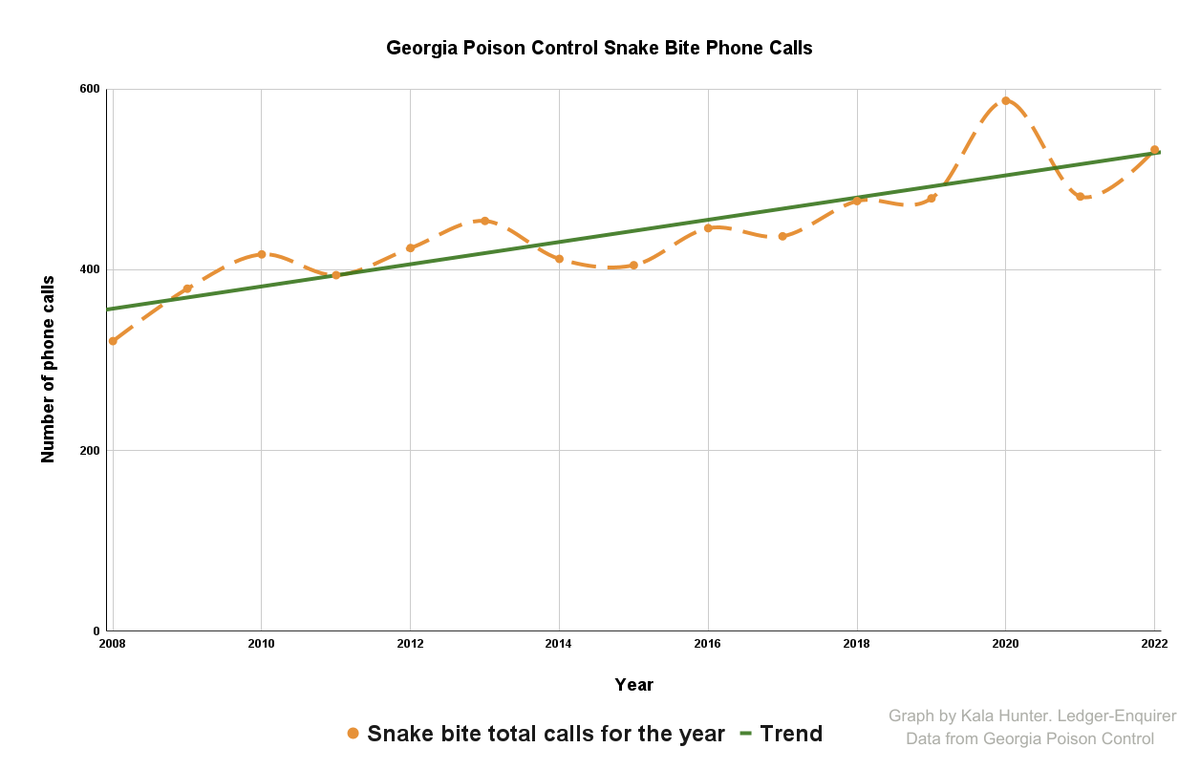
Georgia Poison Control received 587 calls about snake bite poisoning in 2020, and 533 in 2022. There has been an upward trend in calls since 2008.
An actionable solution is educating the population about snake behavior and snake habitat and creating awareness about the changes in snakes behavior.
“If you’re aware of where snakes live and when they are active you are less likely to come across a snake,” Scovronick said.
This story was originally published July 27, 2023 at 10:17 AM.