
This year’s party conventions shaping to be anything but conventional
Well, we can finally drop “presumed nominee” as part of Joe Biden’s title. He’s officially acquired sufficient delegates to become Democrats’ presidential nominee on his third try. The question though is, where and how?
The COVID-19 virus from you-know-where has so totally screwed up American life these last few months, sending millions into unemployment, surging the national debt by trillions more, snuffing academic years, weddings, travel and countless family plans.
The same location question applies to the party of Lincoln whose nominee Donald Trump chafed at the social-distancing restrictions set by North Carolina’s Democratic governor and Charlotte’s Democratic mayor. So, Trump says he’s taking his show elsewhere. At least part of it.
We could have a virtual or socially-distanced business session in Charlotte and Trump’s acceptance speech with a cheering throng in a more open state.
Such impacts are big deals for American politics and our nation’s 59th quadrennial presidential selection. These next few weeks will likely reveal the most drastic lasting or temporary changes ever in how we officially select White House contenders in this unpredictable election year when a majority of Americans tell pollsters they’ll definitely not vote for a second Trump term, and a majority also believe he’ll be reelected.
As someone who’s observed these strange events for decades as a student, a politics junkie, a reporter and an actual participant both behind-the-scenes and out-front as a delegate, I would argue that redesigning a convention tradition cloaked in 19th century cobwebs is not necessarily a bad thing.
The Founding Fathers distrusted political parties, fearing they would over time come to take better care of themselves than the people they professed to represent. If you can imagine such a thing.
But those old powdered-wigs had pretty much died off by 1832 when Democrats decided to meet in Baltimore to nominate Andrew Jackson for his second term with the only real business being his pick for vice president, Martin Van Buren.
In early conventions, the party bigs, mainly congressional caucuses, did the hard bargaining of candidate selection rife with backroom deals, cigar smoke and spittoons. In 1860, as the infant Republican Party gathered in Chicago, that country bumpkin Abraham Lincoln was in third place.
Four years later, as the bloody Civil War dragged on, Lincoln proposed a unique idea to the GOP convention in Baltimore: a national unity ticket with Tennessee’s Andrew Johnson, the only Southern Democratic senator to stand with the Union. It worked.
As the young nation evolved, convention sites moved across the country for political exposure. (Chicago’s been the most popular.) Radio entered conventions in 1924. As a hint of the impact television would have on politics ever after, the first conventions on live national TV were both parties in 1952, both from Chicago’s International Amphitheatre for the convenience of technology.
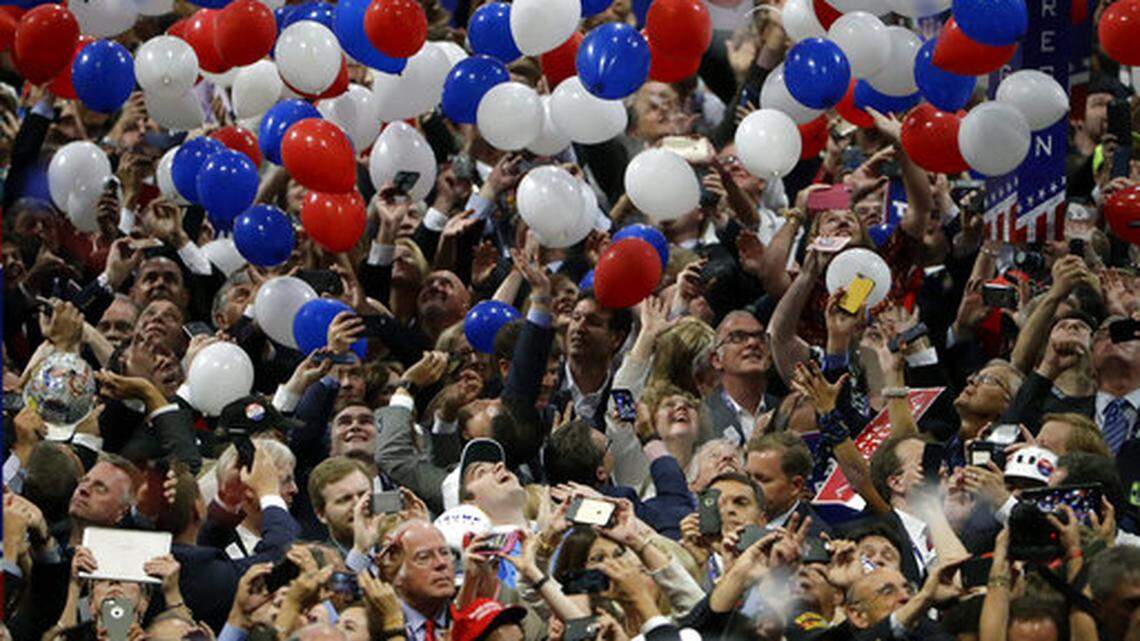
True, since then these political gatherings have become four speech-filled nights (and afternoons) of carefully-scripted political theater (think Sarah Palin’s 2008 acceptance speech), attempted entertainment (Clint Eastwood talking to an empty chair in 2012) and image-making (those faux Greek columns to give newcomer Barack Obama cosmetic gravitas for his 2008 acceptance speech).
But there’s more to these Leap Year assemblies than show biz. For some 50,000 delegates, alternates, family and party faithful in town, the conventions have been a historic opportunity to participate in democracy’s intricate workings. Heading into the long autumn campaign slog, in effect, they are a pep rally for them and for millions of others watching on TV and now online.
They are a coveted economic boost to the host city. They are also a desperate reason for cable and networks to attract audiences at a hot, humid time when viewers’ minds are typically elsewhere. In the days before Sesame Street, my father used the roll call of states to tutor the alphabet and geography. (Who knew so many states began with “M”?)
But the coronavirus has thrown all that into doubt, especially since in modern times the nominee’s name is already known. Biden, who’s not exactly Mr. Excitement, has suggested his convention all be done virtually online. Maybe that will catch on in future cycles too.
Texas state Democrats tried that the other day from various hotel rooms near Austin. It worked and even drew some donations. But no sense of shared experience. And eerily, no cheering or applause.
Trump, a former executive producer at NBC, wants a full-blown traditional convention including seats packed with cheering faithful, which — oh, look! — would transmit an important image of a return to national normalcy to close out a pandemic that seemed to doom his reelection at one point. Job numbers are already improving.
House Speaker Nancy Pelosi has suggested using staggered seating throughout a vast stadium. Which might make sense anywhere but Milwaukee’s uncovered Miller Field during that city’s rainiest month of the year. “Convention called on account of weather,” a media metaphor made in Republican Heaven.
Trump has offers from GOP governors in Georgia and Florida to replace Charlotte as host. But these carefully-choreographed extravaganzas normally take two years of planning, negotiating and months of wiring and elaborate interior set construction. Republicans have under 11 weeks, Democrats one fewer.
Then, of course, the unexpected can strike. Think of the tear-gassed chaos and violence as anti-war activists and the police response disrupted Democrats’ 1968 Chicago gathering, my first national convention.
Four years later in a downtown St. Louis hotel, I was covering the national convention of the People’s Party as it set about nominating Dr. Benjamin Spock, then a prominent Vietnam War opponent and pediatrician who authored history’s best-selling child-rearing guide.
Suddenly, as one afternoon’s political proceedings droned on, all of the delegates’ children got up and walked out of the banquet room in bored protest.
Dr. Spock followed his own indulgent child-rearing advice. He ordered trays of sandwiches and cupcakes from room service and dispatched aides to acquire every available comic book for blocks around. It worked.
This story was originally published June 9, 2020 at 1:04 PM with the headline "This year’s party conventions shaping to be anything but conventional."