
Despite low score, GymDogs believe in uneven bars progress: ‘There’s no problem on bars’
Sabrina Vega’s eyes locked in on the uneven bars apparatus Friday night as nerves percolated through her. Over 10,000 sets of eyes anticipated the Georgia senior and fan favorite accomplishing a personal feat.
Such a moment hasn’t happened in seven years. Vega hasn’t performed uneven bars in front of a packed arena since 2012 as an elite gymnast. She scored a 9.650 in the GymDogs’ season-opening win at the Critique Classic Invitational, but a hotel ballroom setting didn’t nearly match that of Stegeman Coliseum.
Vega has desired to compete uneven bars since she stepped on campus at Georgia. She envisioned her senior campaign being one without reservation, and knew of plans to be an all-arounder as the season began.
Vega jumped onto the bar with intentions of dazzling the crowd as she does on every other event, but those nerves stayed. In the middle of the routine, assistant coach Josh Overton quickly called for a mat to be placed under Vega. He saw it coming. Vega missed her release point on the layout Geinger and belly flopped to the mat with a loud thud. She chalked her hands with an unpleasant facial expression, hopped back onto the apparatus and fell again on the pak salto.
“Do you want to finish?” Overton asked.
“Is that even a question?” Vega replied. “Yes, I want to finish. I’m just not going to walk off.”
She finished her routine, walked away disappointed at a 8.500 score but had to move onto the next event. Her head coach, Courtney Kupets Carter, gave an encouraging command: “You leave it with your grips, right there, on the ground. Get rid of it.”
Through two meets, Vega’s circumstances encapsulate the GymDogs’ fight with posting a strong score on uneven bars. Georgia’s (3-1, 0-1 SEC) loss to LSU, 196.725-196.100, could’ve told a different tale if the GymDogs didn’t have to count a fall on the event — a 9.050 from sophomore Marissa Oakley after a miscue being the recorded score.
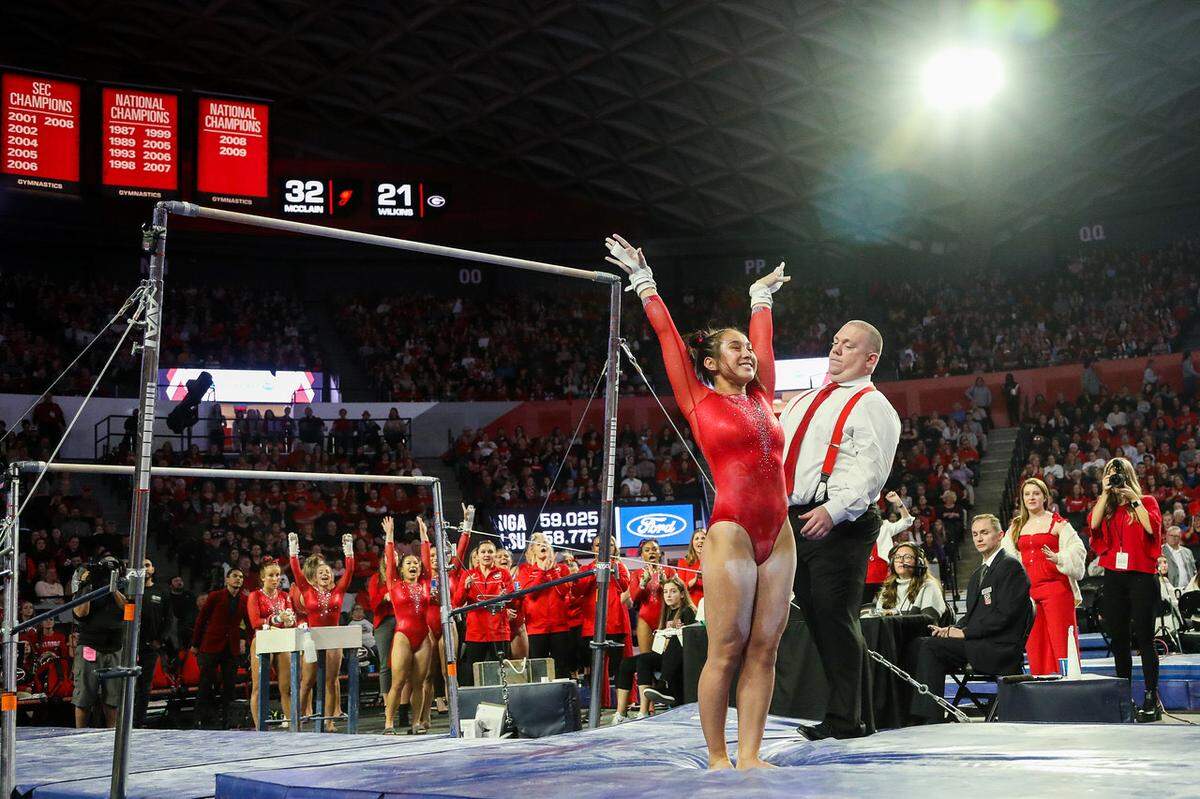
Georgia had an acceptable start to the event with four-consecutive finishes of 9.700 or higher, and working toward a significant progression from a 48.150 on Jan. 3. After the miscues to finish the rotation, however, Georgia walked away with a 48.050 on the event and quickly regrouped before a strong finish on beam and floor.
Kupets Carter remains confident and quickly dismissed that a shaky start on uneven bars will create a trend throughout the season. A pair of meets with scores as low as 48.150 and 48.050, however, is a rare occurrence for the GymDogs. Such a total hasn’t been touched since at least 2009 — which is as far as available media guides date back on the team website — with only a handful of scores dipping below a 49.000. Prior to this season, the previous low on uneven bars under Kupets Carter came against Oklahoma (48.250) in the second meet of last season.
“There’s no problem on bars,” Kupets Carter said. “We will get there. We’re not there yet, obviously, but practice through time will help this team get exactly where we need to be. A few meets down the road, it will be a far, distant thought that we had a problem on bars.”
Georgia has faced a few obstacles ahead of the season in rounding out a bar lineup that previously had depth. At the end of the 2019 season, this event emerged as a strength. The GymDogs finished their year with a 49.575 at national championships and had five-consecutive events with uneven bars scores of 49.250 or higher.
Slowly, momentum faded and depth thinned as Georgia faced some important absences in the lineup.
Alexa Al-Hameed, who was named to the SEC All-Freshman team, scored a 9.900 in four of five meets to end the season and recorded a career-best 9.950 against Kentucky as a bar specialist. On Oct. 28, 2019, Al-Hameed announced her decision to leave the program. She hasn’t revealed specifics of the departure, but told The Telegraph that she “didn’t leave on bad terms.”
Emily Schild, a constant in the bar lineup over her first two seasons, underwent season-ending surgery for an MCL tear and had two screws placed into the bone below her knee. She spent months in a full-legged brace and crutches, but has continued training at the event during practice. Kupets Carter has said Schild is “close” to working back into the lineup.
Rachel Dickson suffered a crushing blow with a season-ending torn Achilles only two days before the opening meet. She underwent surgery Friday for the Achilles and a broken ankle. Dickson told The Telegraph that a complex surgery was successful and she has a positive mentality through recovery. Dickson averaged a 9.631 on the event last season.
Those events forced some shuffling to occur. Freshman Loulie Hattaway contends for a spot in the lineup (scored a 9.750 in the Critique Classic Invitational) while fellow first-year gymnasts Amanda Cashman and Haley De Jong could be in the lineup for the long haul. Georgia currently has six or seven gymnasts ready to compete the event, but Kupets Carter would ideally like as many as nine.
“There are definitely a lot of room for improvement, and it’s definitely hard losing those three,” said Lukacs, who has been progressively finding confidence on the bars with mentorship from Overton. “We have no option but to step it up, especially in honor of Ray (Dickson) too. We have to go over those minor corrections that we can do and make each moment count — in training and on the competition floor.”
Nonetheless, Georgia’s lack of concern stems from a mindset of gradual improvement. Its focus rests on building a team dynamic and canceling the uncontrollables. Kupets Carter said her gymnasts’ strong work ethic is going to get Georgia “where we need to be” on the apparatus. The GymDogs also hone in on being aggressive, and are OK with some mistakes coming with it.
Aside from uneven bars, Georgia had a strong debut against LSU. It started strong on vault with two scores of 9.900, capped with the always-exhilarating double Yurchenko by Lukacs. The beam rotation featured three scores of 9.875 or higher.
To finish the meet, Georgia showed out on the event it can shine brightest: floor exercise. Three scores of 9.500, including freshman Soraya Hawthorne receiving a 10.0 from one judge, brought Stegeman Coliseum to a roar. Vega strutted her style in fitting fashion to end the meet and give the GymDogs momentum.
“There are so many positives, and that’s what we’ve tried to focus with them on,” Kupets Carter said. “They’re confident, they trust each other.”
For Georgia, it’s about moving past mistakes rather than allowing them to linger, just as Vega did. Kupets Carter knows there’s a long season ahead, too, and repeated “There’s no problem on bars” to this reporter as a reminder of her perspective.
“Believe in us,” Vega said. “We’ve got it.”
This story was originally published January 11, 2020 at 1:16 PM with the headline "Despite low score, GymDogs believe in uneven bars progress: ‘There’s no problem on bars’."