
‘A huge step forward’: Analyzing the results and approach of the 2020 GymDogs season
The sudden halt to the University of Georgia’s sports seasons caused lives to be uprooted and routines to be changed due to the COVID-19 spread that has the country on pause. This story is part of a series surrounding the effects of the cancellation on Georgia gymnastics.
Sometimes, the most-significant meets of the season aren’t the ones where Georgia receives the highest score. Those competitions where adversity hits and the GymDogs experience a learning curve, however, carry the heaviest weight.
Sophomore Rachel Baumann remembers the tri-meet on Feb. 14 when Georgia faced a series of injuries in the days (and even moments) leading up to competition. Georgia cracked the coveted 197.000 score barrier that evening, and it gave a jolt of confidence to the team.
There were the lower scores, too, that still had the GymDogs believing in themselves. A handful of meets — mostly on the road — didn’t bring ideal results. It could’ve been a result of falls, injuries or a bad break from the judges. Nonetheless, Georgia defined its season on how it always awaited another opportunity with aggressiveness and togetherness.
“Everybody has that desire and passion to get those big scores,” departing senior Sabrina Vega said. “When you don’t get them, it’s frustrating. We have to remember that we aren’t here only for the scores. There’s a bigger learning curve when the girls are proud.”
Georgia’s season came to an abrupt end with the COVID-19 pandemic, and the GymDogs’ final meet came in Tuscaloosa, Alabama on March 7. Georgia finished 12th nationally with a National Qualifying Score (NQS) of 196.900, but stumbled to a finish with two scores of 196.500 or below against Florida and Alabama. But as the GymDogs did throughout the season, they were determined to persevere and earn a place in the postseason.
That didn’t happen, but Georgia drew plenty of positives with deep reflection as a team. An analysis of the season’s ups-and-downs help put an adversity-laden season into perspective.
“We hadn’t hit that full-on stride yet, but we were getting closer and closer to that,” head coach Courtney Kupets Carter said. “We were excited for an exciting postseason, so those unknowns and what-ifs are frustrating.”
A different measure of success
Scores didn’t matter. Kupets Carter had long-term goals — such as advancing to the top-four at national championships — but the path to reaching that peak mattered more.
Georgia had its share of youth and gradual progressions were necessary. A season-opening 195.100 score (a rather-low result for an SEC program) turned out to be one of the GymDogs’ greatest benefits. That led to the season-high 197.425 against Auburn, but also showed Georgia how to power through the lower scores like a 196.300 at the Metroplex Challenge and a 196.050 at Alabama to close a shortened campaign.
“We made it about what you can actively do to get better,” Kupets Carter said. “They really did accomplish a lot of things. This team helped the program take a huge step forward. They fought no matter what happened.”
Georgia centered its season around the “controllables,” a term that nearly seemed cliche by March because of the importance that the GymDogs placed on it. Mental preparation became important early on. The transfer from strong performances in the training gym to the competition floor followed. As the season came to an end, Georgia focused on finding consistency while injuries forced a host of lineup changes.
At each stage, team unity emerged as the biggest priority. Georgia felt like it achieved that, and Kupets Carter believed scores would follow. But it never became about numbers.
“We always pulled through. Adding all of those small things up is what made this year so memorable,” sophomore Rachael Lukacs said. “We didn’t let anything stop us. No matter what.”
Finding an answer for uneven bars struggles
Georgia had a glaring weak link — uneven bars. The gymnasts and coaches knew it. Those following the team wondered about it. The critics weren’t hesitant to speak about it. Once the GymDogs posted historically-low totals to open the season — 48.050 and 48.150 — the reasons became obvious.
Georgia couldn’t easily patch the voids left by a lack of depth midway through the season. Rachel Dickson’s season-ending injury added to a large group of bars contributors lost from 2019: Sydney Snead, Emily Schild (competed in one meet Feb. 14 while recovering from knee surgery) and SEC All-Freshman honoree Alexa Al-Hameed (left team after 2019). Freshman Amanda Cashman was removed from the lineup after an Achilles tear in mid-February, and Marissa Oakley’s participation fluctuated due to a nagging shoulder injury.
Nonetheless, Georgia powered through and had some bright spots. A string of four-consecutive finishes above 49.000 served as a leaping point toward returning to the ideal scores toward the end of 2019.
“We didn’t let bars struggles defeat us. We kept working and pushing,” Lukacs said. “I feel like that’s what made us closer. You relied on each other more. We were all in because we had no option.”
Georgia moves into the offseason trying to build a deeper rotation on uneven bars. Dickson has the option to accept a medical redshirt and return for a fifth season, but her decision is unclear at this time. Georgia also has a group of three 2020-21 signees — Nhyla Bryant, Victoria Nguyen and Katie Finnegan — who could serve as reinforcements.
Most-improved performers
Baumann: If there were performances that fell short of Baumann’s goal, the frustration could be seen in subtle ways (lowering her head after a routine or needing a brief pep talk from Kupets Carter after the Arkansas meet). She wanted more, and knew that another level of success could be achieved individually. By the time Georgia reached the final stretch of SEC competition, Baumann found her stride and another level of consistency.
She finished with a NQS of 9.895 on balance beam — Baumann’s best event — and took home the flowers on Valentine’s Day with a meet-high and career-high score of 9.950. Baumann started the season as an alternate on vault, but cracked the lineup multiple times due to injuries. Her opportunities to display personality on the floor brought shining moments, too, with every score at 9.800 or above and a career-high 9.925 against Auburn.
“I came to believe in myself this season,” Baumann said. “I felt like I had a lot more confidence than last year. It’s only going to grow, and I’m going to push myself to be better.”
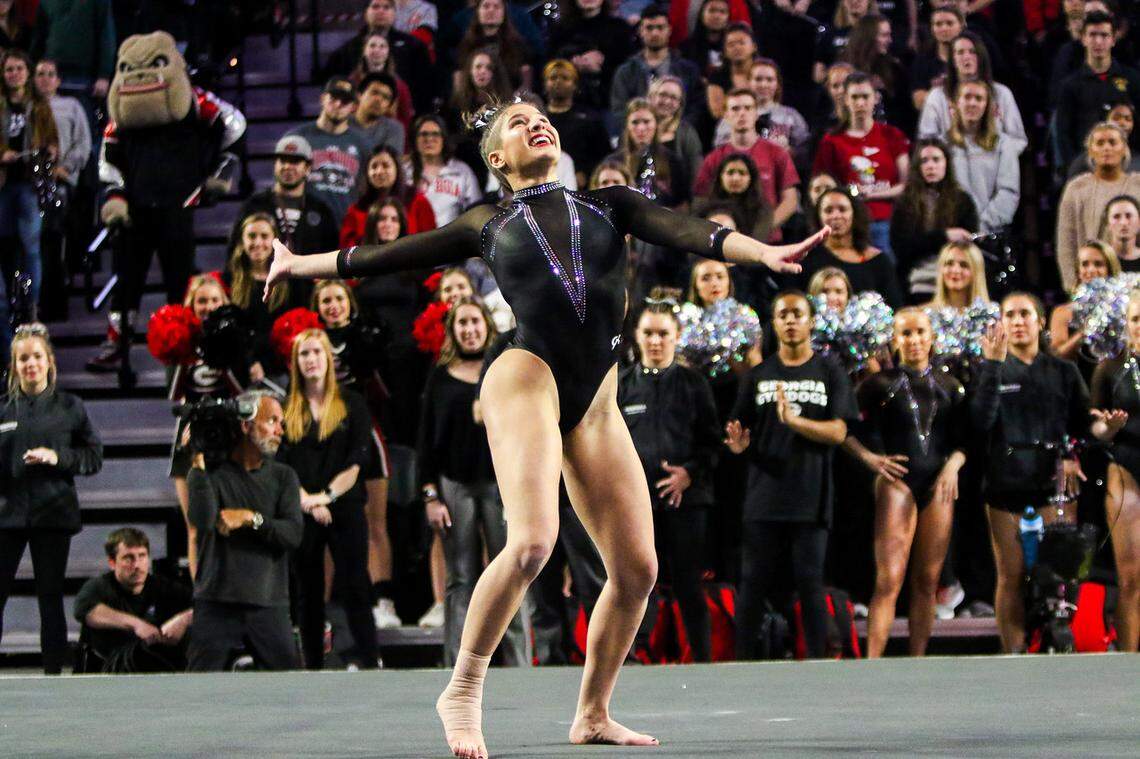
Alyssa Perez-Lugones: The sophomore floor specialist’s coming-out party needed three ingredients: a clean bill of health, a vote of confidence from the coaches and a secured spot atop the lineup. The result gave Georgia a jolt of energy it needed on its best event in 2020. Perez-Lugones brought the energy and drew the attention of a large crowd and her teammates.
On multiple occasions, Perez-Lugones dropped her score, but that served to be the ideal scenario. She set the stage for five GymDog teammates to post higher scores, with Vega rounding it out with a chance at a 10.0 nearly each week. Perez-Lugones finished the season with five-consecutive scores of 9.800 and a career-high 9.875 against Auburn.
Megan Roberts: Some credit to Roberts’ drastic jump in results (and personality) could be given to her Canadian best friend, freshman Haley de Jong. Roberts broke out of her “shell” and emerged to another level on uneven bars. Due to Georgia’s lack of depth on the apparatus, the GymDogs needed a consistent leader and Roberts answered the call.
Her performances on uneven bars included a career-high 9.925 against Iowa State, and every score to follow was 9.850 or above. Roberts also competed on three events at the Arkansas meet and scored a 9.800 on vault and floor along with the usual 9.850 on bars.
This story was originally published April 10, 2020 at 10:02 AM with the headline "‘A huge step forward’: Analyzing the results and approach of the 2020 GymDogs season."