
How red card became most controversial moment of Kansas City’s World Cup matches
Argentina’s 3-1 victory over Switzerland gave the World Cup its best goal of the tournament to date, and one of its most controversial moments yet.
A VAR review and subsequent second yellow card doled out to Switzerland’s Breel Embolo changed the direction of Saturday’s quarterfinal matchup just two minutes after Switzerland equalized. The Swiss were by and large the better team in the second half until the red card.
“It’s a disaster,” said Switzerland midfielder Remo Freuler. “I don’t know what this referee is doing here.”
Dan Ndoye’s 67th minute equalizer canceled out the opener from Argentina’s Alexis Mac Allister. Midfielder and Switzerland captain Granit Xhaka said of Mac Allister’s goal, “You saw just Switzerland,” and the team little by little was taking more risks and finding success against the reigning World Cup winners.
“We had more energy,” Xhaka said. “We had more belief as well. The red card changed everything.”
Switzerland striker Embolo seemingly earned a foul, and a yellow card was issued to Argentina midfielder Leandro Paredes. But quickly, referee Joao Pedro Silva Pinheiro was called to the monitor by his video assistant referee.
Pinheiro was asked to review the play for “mistaken identity.” Typically, this type of review is used to ensure the yellow card was given to the correct player among teammates — not adjudicating whether the call was wrong itself.
However, an amendment to IFAB law prior to the World Cup has opened the window for referees to review whether a player from “either team” was penalized incorrectly. This type of review was first seen in the opening 4-1 victory for the United States, when a foul and yellow card to American defender Tim Ream was reviewed and overturned, resulting in a yellow card for simulation to Miguel Almiron.
On Saturday night, that amendment came back into focus, and Pinheiro returned from the monitor and announced that the call had been overturned. Embolo received a second yellow card and was sent off, leaving Switzerland down to ten players.
Embolo picked up his first yellow card in the 44th minute for clearing out Paredes after the ball was gone. He walked off the field in tears after the red card, visibly frustrated.
“If you have to lose because of the one decision from the referee, it’s painful,” Xhaka said. “It’s difficult to accept now after the game.”
Xhaka went as far to say the referees “killed” the game, as this is not a decision that has been a part of the review protocols since VAR was introduced in professional soccer in 2017.
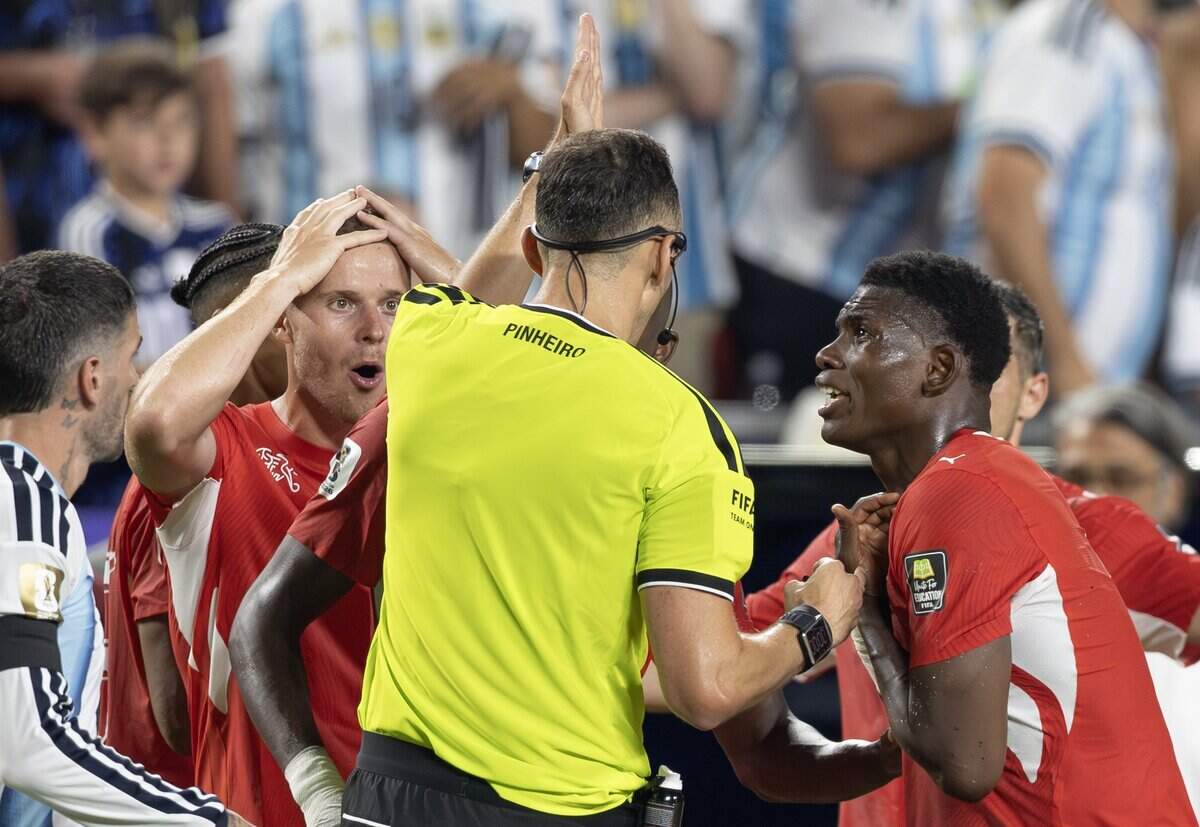
“This is my opinion,” Xhaka said. “I don’t know what else he can do, just don’t kill the game.”
Switzerland then was left to defend for its lives for the next 20 minutes plus stoppage time, plus eventual extra time. In total, Switzerland played down a player for 62 minutes. It was after 53 minutes down a man (the 115th minute) when Julian Alvarez delivered a stunning effort to put Argentina in front for good.
Previous controversy surrounding Argentina
Argentina’s run to the semifinals has not been without controversy. A goal by Egypt forward Mostafa Ziko was ruled out in the 58th minute after a VAR review. The foul certainly happened, but fans complained that it was far from the goal — which is not a factor considered in video review.
Mohamed Salah was then tripped in the box late in the second half in a fashion similar to the foul that ruled out Ziko’s goal, and the play was not called a foul live nor changed by VAR. In addition, Lionel Messi escaped a potential red card in Argentina’s opener against Algeria after his challenge on Aissa Mandi that made rounds on social media.
Argentina players were subject to questions of referee favoritism before the game, and the prevailing sentiment online has been ripe with controversy.
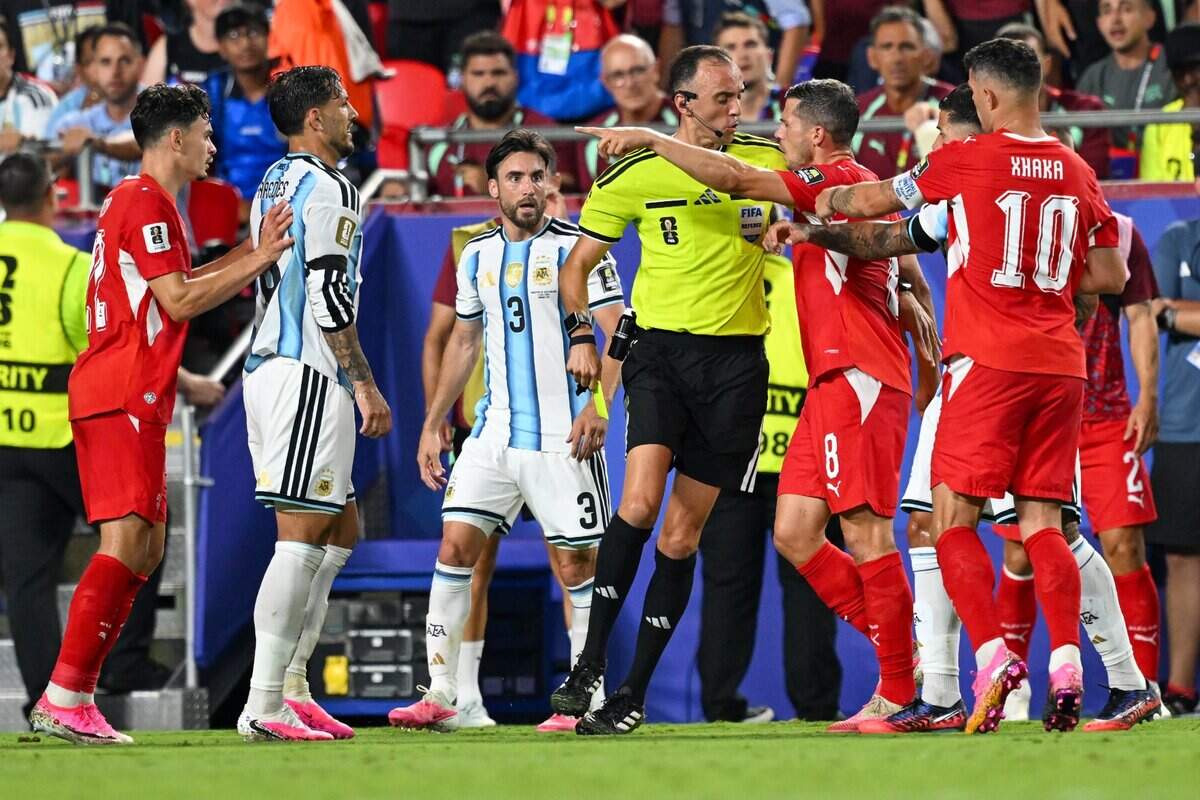
When pressed if Argentina was receiving favorable referee decisions, Switzerland head coach Murat Yakin denied that claim
“We had a fair and open match,” Yakin said. “Both teams played football. Football wasn’t the winner today. We were punished by a mistake. It was a decisive moment that determined the outcome of the match.”
Daniel Sperry covers soccer for The Star. He can be reached at sperry.danielkc@gmail.com.
This story was originally published July 12, 2026 at 11:23 AM with the headline "How red card became most controversial moment of Kansas City’s World Cup matches."