
Former Columbus DA Mark Jones’ misconduct trial ends in plea deal. Here’s what happened
A week after jury selection, ex-Columbus District Attorney Mark Jones’ misconduct trial has ended in a plea bargain and his resignation.
Jones decided Monday to plead guilty to counts 1, 6, 7 and 9 of his indictment, in exchange for a sentence of five years in prison with one to serve, plus a $1,000 fine. He also agreed to resign from office, and submitted a handwritten resignation letter to Gov. Brian Kemp.
Jones asked to turn himself in this coming Friday, but Judge Katherine Lumsden refused and had him taken into custody. Deputies escorted Jones from the courtroom at 10:31 a.m.
Before sentencing Jones, Lumsden noted that he didn’t commit the offenses typical of some corruption cases, in that he did not seek to enrich himself at the public’s expense.
“You didn’t line your own pockets. You didn’t do some of the things that normally are involved when we think of public corruption,” the judge said. “But I think you got so caught up in being the DA that you forgot about the people you ran to represent.”
She made particular note of Jones’ drunken encounter with a Columbus homicide detective downtown, where Jones harangued the officer for charging the suspect in a fatal shooting with involuntary manslaughter instead of murder. The incident was recorded on another officer’s body camera.
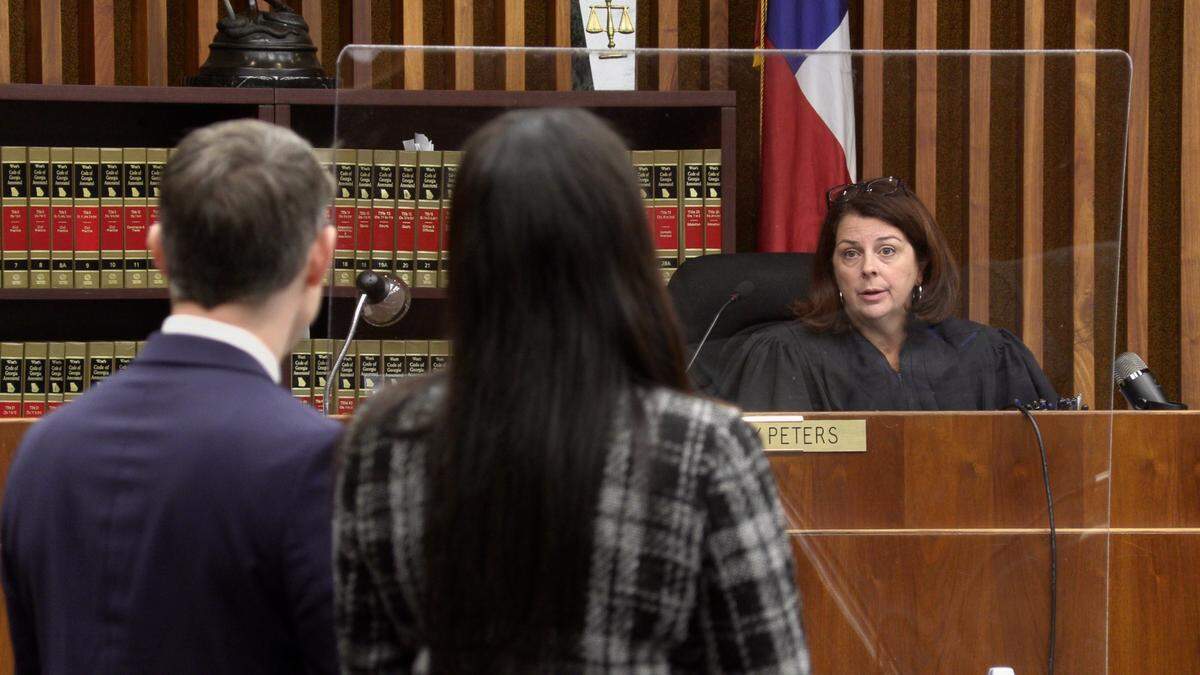
“When I watched that body cam video, all I could think was, ‘This does not make people trust the system,’” Lumsden told Jones, adding that the pursuit of justice does not mean winning at any cost: “If it becomes that, then we have much bigger problems than the criminal justice system has already, and we can’t afford to let that happen.”
Before Jones’ plea, the jury of seven women and five men was deciding whether he was guilty or innocent on nine felony charges alleging he tried to influence witnesses, to persuade a detective to commit perjury, and to bribe staff prosecutors.
Here are the nine charges he faced:
- Influencing witnesses by telling a police detective to lie under oath.
- Attempting to suborn perjury in connection with the same incident.
- Violating his oath of office by committing the offenses above.
- Bribery by offering then-Chief Assistant District Attorney Sheneka Terry $1,000 for murder convictions.
- Bribery by offering Assistant District Attorney Kimberly Schwartz $1,000 to announce she was ready for trial in a murder case.
- Attempted violation of an oath of office, by trying to get Terry to accept $1,000.
- Attempted violation of an oath of office, by trying to get Schwartz to accept $1,000.
- Influencing witnesses by pressuring a homicide victim’s nephew to defer testifying in a hearing.
- Violating his oath by not assisting the nephew in navigating the court system.
On Friday, after about six hours of deliberation, the jury said it had reached a unanimous decision on three of the nine charges, and jurors asked for more time to weigh the others. It returned at 9 a.m. Monday, and in about an hour, the jury said it had a unanimous verdict on five charges, but Jones had decided to cut the trial short with a plea deal.
According to juror Iesha James, who spoke with reporters after the plea, jurors Friday had verdicts of guilty on courts 4, 8 and 6, and on Monday they voted unanimously to find Jones guilty on counts 5 and 7.
The plea bargain followed three days of testimony from multiple prosecution witnesses, but Jones’ attorney Katonga Wright elected to call no witnesses in his defense, saying Jones by law did not have to prove his innocence. Jones declined to testify.
Among the witnesses was police Cpl. Sherman Hayes, whom an apparently drunken Jones confronted July 16 outside a downtown bar called The Hooch, where Jones had been drinking. Jones was recorded on police body camera haranguing Hayes for charging the suspect in a fatal shooting with involuntary manslaughter instead of murder.
Jones told Hayes that the victim, Sara Holtrop, was cheating on Elijah Farral, the suspect charged with shooting her in the back as she lay asleep on a couch. Farral told police he and others had been playing with a gun, and he meant only to “scare” Holtrop with the weapon when it went off.
Jones claimed Farral had a motive to shoot Holtrop, believing she had been unfaithful to him, but Hayes said he found no evidence that the two had a romantic relationship. When Jones told Hayes that Holtrop was cheating, he added, “You should testify to that.”
Jones’ first three charges were related to his conversation with Hayes.
Both Terry and Schwartz told the court about Jones’ offering them $1,000 to win murder cases, with each testifying she took an oath to accept only the compensation due. Terry said she told Jones that it was illegal to offer such an incentive, yet he continued to do so. This evidence was the basis for charging Jones with two counts of bribery and two of attempting to get the prosecutors to violate their oath of office.
Also testifying was Chris Bailey, the nephew of Danny Jones, a Columbus man fatally injured during a fight over children playing basketball in the street on Charter Oaks Circle in north Columbus. Bailey and his family were frustrated when the primary suspect in that case was indicted for involuntary manslaughter, with the result that his bond was reduced and he was released from jail. The family had not been notified of these developments, apparently in violation of Georgia’s Crime Victims Bill of Rights.
When Bailey was dissatisfied with how the district attorney’s office handled his complaints, he filed a motion on his own, asking to be heard in court, to express their concerns. That prompted Jones to call Bailey, who recorded their 30-minute conversation.
Jones on that call told Bailey that his motion made it look like the family was in conflict with the DA’s office, and that the suspect in his uncle’s death could be re-indicted for murder. But if Bailey was unhappy with this, Jones could refer the case to a special prosecutor, he said, though he was the best one to handle it. “I’m the best friend you’ve got, bro’,” he told Bailey.
This was the basis for Jones’ final two counts of influencing witnesses and violating his oath.
This story was originally published November 15, 2021 at 10:18 AM with the headline "Former Columbus DA Mark Jones’ misconduct trial ends in plea deal. Here’s what happened."