
New report on Columbus missing business license revenue sparks conflict and accusations
Columbus Council once more got a report on a backlog in collecting city business and alcohol license taxes, and once more got conflicting estimates of how much money’s involved.
Charlie Peeler, a federal prosecutor now with the law firm Troutman Pepper that was hired to do a deep dive on the financial debate, put the range of the city’s potential revenue loss at $20.1 million to $26.9 million, in the time span of Jan. 1, 2016 through September 2023.
In December, the city’s internal auditor told council the finance department’s revenue division since 2019 had failed to collect up to $45.1 million.
Deputy City Manager Pam Hodge told council then that the backlog involved only about $2.5 million that the city still aimed to collect as it caught up on processing payments and citing delinquent operators. The city did not update that figure Tuesday.
The city’s finance department disputed Peeler’s estimate, arguing it is based on a flawed average of what a typical business pays in gross receipts tax, when renewing a license, and it includes businesses that have closed or moved out of Muscogee County.
Nearly 70% of businesses in 2022 had gross receipts of less than $100,000, and 80% of those paid less than $321 in taxes, based on a rate of $3.21 per $1,000 in receipts, said Finance Director Angelica Alexander.
She said that using averages to calculate the backlog is misleading.
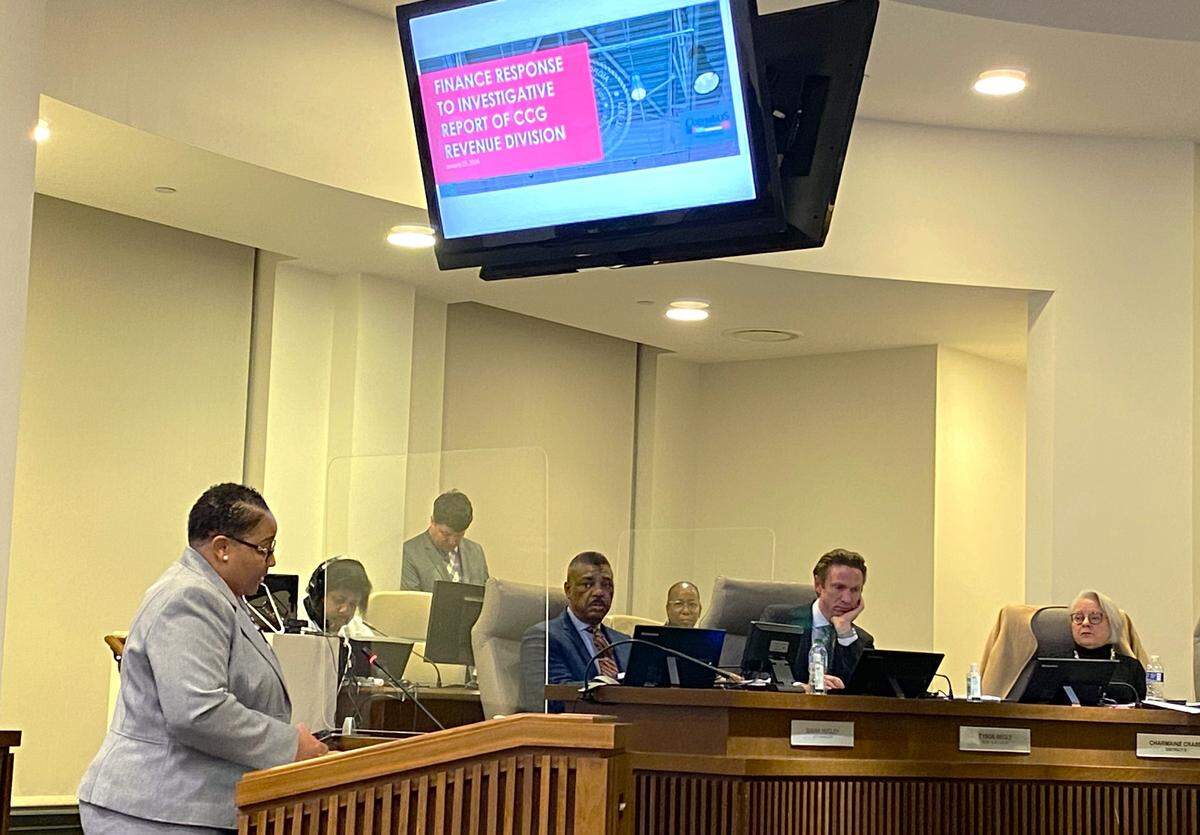
Tuesday’s dueling presentations marked the second time councilors got disparate estimates of the backlog’s impact, which city administrators blamed on staffing shortages, COVID-19, and computer software issues.
In December, the city’s internal auditor told council the finance department’s revenue division since 2019 had failed to collect up to $45.1 million.
The taxes businesses pay when renewing licenses generates millions in revenue each year, with administrators previously giving council this breakdown in collections:
- 2019: $15,080,345.
- 2020: $15,508,938.
- 2021: $15,982,421.
- 2022: $16,448,269.
- 2023: $18,857,803.
Council requested an internal audit of the finance department on July 25, and hired Troutman Pepper to investigate the revenue division after whistleblower reports that the office had piled up paperwork, mail and checks that could be mishandled or destroyed.
Peeler said his probe found 1,000 pieces of unopened mail, but no evidence of shredding or theft.
Were documents shredded?
After Peeler’s briefing, District 2 Councilor Glenn Davis asked Hodge, Alexander and City Manager Isaiah Hugley whether any documents had been shredded. All said no, but Hodge added that Synovus bank, which operates a so-called “lockbox” service for automatically depositing payments to the city, sent the finance department some old checks by mistake, and those had to be shredded.
That mistake in processing deposits has been corrected, she said.
Hodge said councilors were questioning the integrity of her and her staff by perpetuating suspicions they had mishandled funds. She said Peeler’s report counted as delinquent not only businesses that had closed or moved away, but some with owners who had died.
She said the revenue division had narrowed the list of delinquent businesses to 3,557 accounts with no license renewals for the years 2020, 2021, 2022 and 2023,, and it was working to collect on those.
Davis told Hodge and other administrators he had to look out for the taxpayers first. “I’m not here to make friends,” he said, adding, “I’m so sorry this happened to the finance department, but it is what it is.... It’s just unfortunate that it got to this point,” he added.
City Attorney Clifton Fay said the government cannot collect debts more than four years old, under a statute of limitations. Davis said that means nothing can be recouped from 2019 or 2020, when the backlog started.
“It’s gone. You can’t get that money back,” he said.
Hugley said the city had caught up on earlier collections, before 2020.
Peeler told councilors his examination, using the forensic accounting firm Acuitas Inc., went back to 2016 to get a review of accounts before the COVID pandemic and afterward, to gauge its impact.
He said the backlog in collecting license taxes “snowballed” because it was not quickly addressed.
“It should have been detected earlier. It should have been reported earlier,” he said.
Responding to the finance department’s criticism of his report, Peeler said he used the figures its staff gave him. “They provided us with the information that they had,” he said. “We had to rely on that information.”
Some data was unavailable because the revenue division still relies heavily on hard-copy records, he said.
Alexander told councilors she hoped to be able to offer online business license renewals by the second quarter of this year. Asked about sending out 2024 renewal notices immediately, she said it required stuffing and mailing around 7,000 envelopes, as the revenue division does not have a mailing service now.
She gave these updated numbers for licenses issued:
- 7,910 for 2020
- 7,999 for 2021
- 7,579 for 2022
- 7,498 for 2023.
The revenue division has referred the 3,557 delinquent license accounts Hodge cited to special enforcement for collection, she said, giving this breakdown of those:
- 181 renewals were pending processing.
- 1,429 businesses had closed.
- 1,571 were not in Muscogee County.
- 376 were issued citations.
This story was originally published January 24, 2024 at 10:20 AM.