The health department is conducting a COVID survey in Columbus this week. What to know
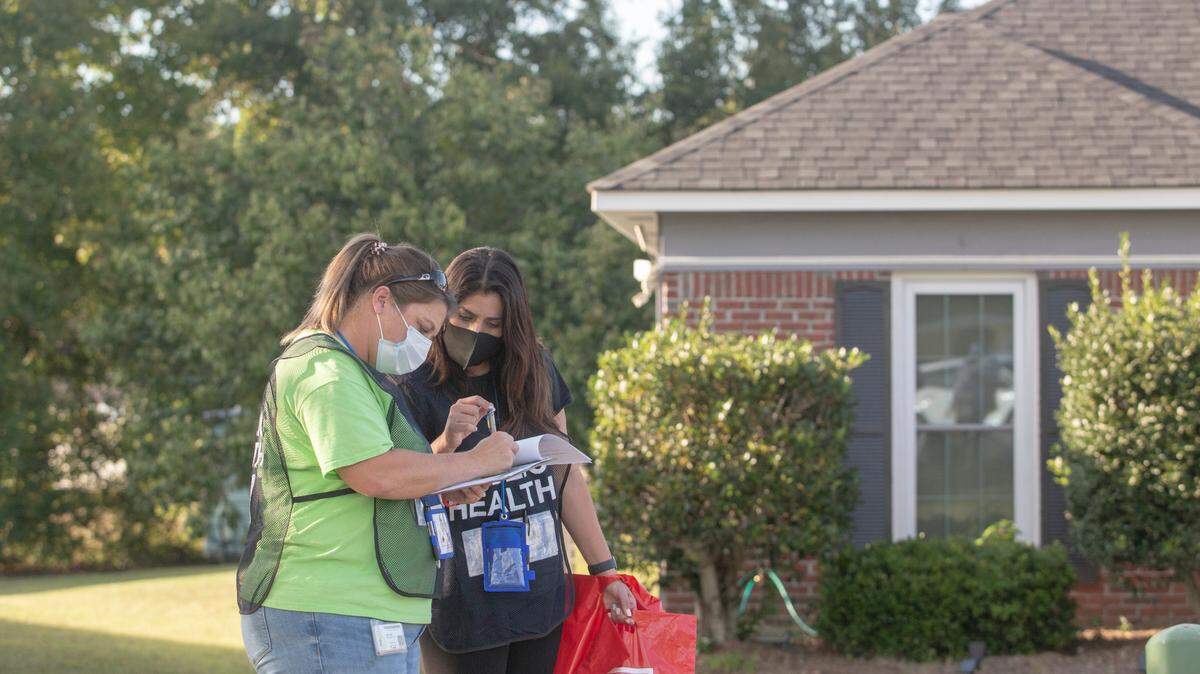
The Columbus Health Department, in partnership with the Center for Health Disparities at Columbus State University, is surveying local neighborhoods to assess how the community feels about COVID-19 and the vaccine.
The group took to the streets on Tuesday to begin randomly surveying residents who live in the 31903 and 31907 zip codes, the two lowest vaccinated areas in the city. Health department officials reported that volunteers surveyed about 100 households Tuesday, and expect to reach a similar number of homes on Thursday.
The door-to-door survey tracked vaccine rates using census data from the city. As of Sept. 29, only 1.81% of residents who live in the census tract that falls under in the 31907 zip code have received at least one dose of the vaccine and 1.45% are fully vaccinated, according to the Georgia Department of Public Health. In the tracts that cover 31903, about 23-25% of residents have received at least one dose of the vaccine, and 19-21% are fully vaccinated.
The survey will allow the health department to collect information about why people are not getting vaccinated and help to provide information that will motivate people to get the vaccine, Dr. Asante’ Hilts, the program manager for the West Central Health District, said.
“A lot of people right now are focused on boosters and third doses,” Hilts said. “But we’re really focused on people who haven’t been vaccinated at all because we want people to be safe.”
Communities that have the lowest vaccination rates are some that suffer the most from COVID-19 and its effects, she said.
The team is using a CDC method called the Community Assessment for Public Health Emergency Response (CASPER), which has three main goals:
Rapidly obtain information about a community’s needs
Produce population-based estimates for decision-makers
Assess new or changing needs
The households chosen for the survey are chosen using a randomization methodology. Dr. Dawn Nguyen-Truong, director of the Center for Health Disparities and Community-Based Research at Columbus State University, presented the idea of conducting a CASPER survey to the health department during a meeting and officials were immediately on-board with the idea.
“They had all the resources that we did not,” Nguyen-Truong said. “And we had the people to cover grounds.”
This is not the first time the health department has conducted a CASPER survey in Columbus. The survey was conducted by the CDC many years ago to assess community needs during an emergency, Hilts said, and has previously been used in Columbus to collect information about Hepatitis A and prepare for a weather emergency.
“CASPER has been around for a while,” she said. “But we had never done a CASPER in Columbus that was registered with the CDC.”
Hilts’ goal when she began with the health department three years ago was to make sure that CASPER becomes a part of the department’s routine because it brings a lot of community partnerships, she said. These include working with law enforcement and partners like CSU.
Volunteers were provided with vests displaying that they were with the health department, surveys they are meant to read out to residents verbatim and goody bags that include COVID-19 information and hand sanitizer to give residents that complete the survey.
The hesitant and the ‘believers’
Two people surveyed both expressed appreciation about the health department going out into the community to hear the concerns directly from the people who live there.
One resident, Tyquan Williams, was standing outside his home with a couple of neighbors when he agreed to take part in the survey. He explained that he was hesitant to get the vaccine, but his girlfriend, who is a nurse, received the first dose due to her job.
“I just feel like it’s not enough research on it,” he said. “It’s too soon.”
He explained that he receives most of his information about COVID-19 and the vaccine every day from the news and the health department. Down the street from Williams, George Crayton, who has worked at the Columbus Foundry for over 30 years, said he is a “believer” in the vaccine.
“We’ve been taking vaccines ever since we were in school,” Crayton said. “We’re not going anywhere until God says it’s time for us to go.”
Crayton said he would like to see more people take the vaccine because they’re putting others at risk if they’re not vaccinated and aren’t socially distancing. He said he’s spoken with others who are hesitant about the vaccines but disagrees with those using fear tactics to convince others to get vaccinated.
“I believe people should let people make up their own mind,” he said. “Stop trying to persuade them to do so.”
Results from the survey should be available about 36 hours after it is completed on Thursday, Nguyen-Truong said. The group plans to present the findings to the general public and officials, she continued, and provide the necessary resources the community needs based on the results of the survey.
“Whether it’s educational resources or accessibility to getting the vaccine,” she said. “Whatever it may be, we will be able to identify that through the results.”