Columbus employers face ‘worst experience’ in hiring even as unemployment drops
Despite a drop in Georgia’s unemployment rate, Columbus businesses are struggling to hire new employees as workers shift industries or drop out of the labor force during the COVID-19 pandemic.
Between November 2020 and November 2021, there have been around 192,000 job openings in Georgia, according to the Georgia Department of Labor, Workforce Statistics and Economic Research.
Georgia’s unemployment rate currently sits at 2.8%, the lowest rate in recorded history, according to the Georgia Department of Labor. The latest unemployment rate in Columbus follows the same pattern at 2.7%.
Getting the word out
Chalmers Workforce Solutions, a staffing and recruitment agency in Columbus, has gained more clients and increased its business over the past year because so many places are hiring, Vice President Nicole Crofutt said. However, the lack of candidates to fill positions is hurting the agency, she said.
“We have people applying and we are conducting interviews like we have always conducted. However, the term ‘ghosting’ seems to be becoming more common,” she said.
The number of people coming to the agency to apply for jobs has significantly decreased by “three to one” since the pandemic began, she said. The agency would host multiple job fairs in one day and people would line up at the door to apply.
“Now, we’re lucky to fill up one job fair,” Crofutt said.
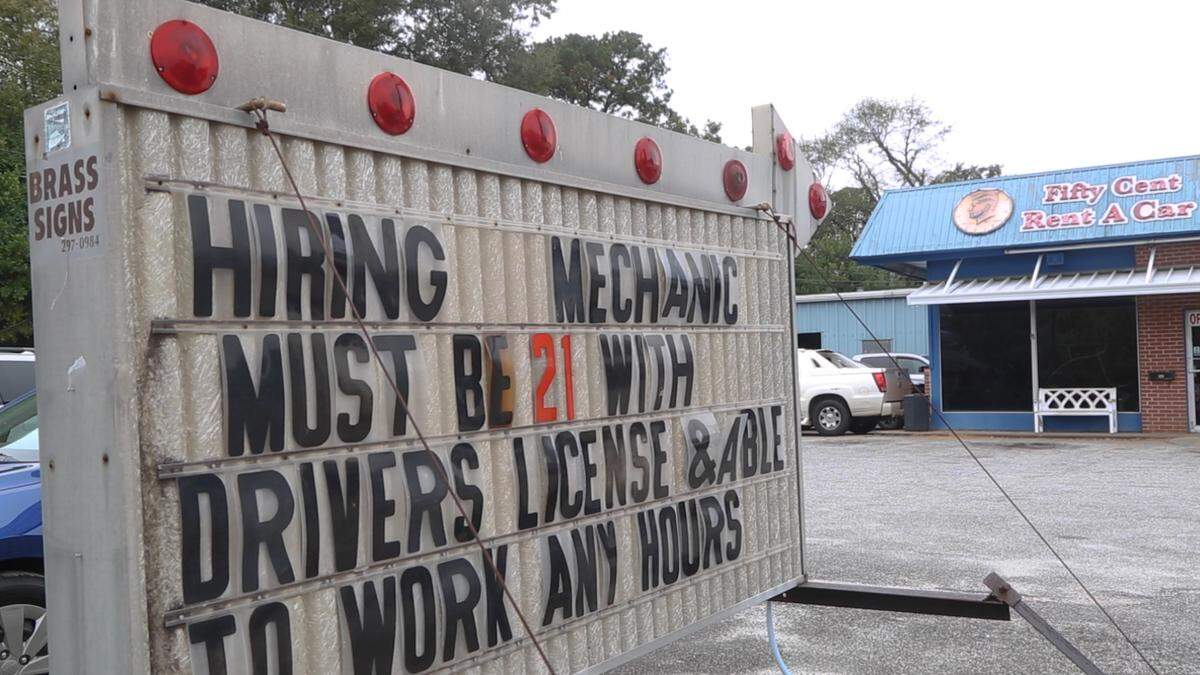
Harold White, owner of White’s Automotive Center and Fifty Cent Rent A Car, said he’s experienced similar challenges.

“(Hiring now) has absolutely been the worst experience that I’ve had the whole time I’ve been in business,” White said.
The past five or six years have proven difficult, but the years during the pandemic stand out as the worst, he said. The shop can run ads for an entire month and not have a single person come apply, and about half of the people White has hired in the past 18 months have not shown up for the job.
“We have cases where…they don’t even leave a phone number,” White said. “So, I can’t call them back.”
Getting the word out about available positions is a challenge for small businesses across Columbus.
Whitewater Express initially relied on word of mouth and an online presence to find applicants for open positions, manager Luis Tabares said. In the last year, however, applications slowed and the business realized it needed to pivot.
“That’s when we really got into this boots-on-the-ground push,” he said. “And we really started going to all the local colleges, (Columbus State University) included.”
White struggled with recruiting online. Sites like Zip Recruiter are expensive, he said, and he doesn’t see much of a difference when he posts ads there than when he places a sign outside the business.
Before the pandemic, Georgia’s labor force participation rate (the percentage of people over the age of 16 working or actively searching) hovered at 62.9%. It reached a record low in Sept. 2020 at 59.4%.
The participation rate has yet to return to pre-pandemic levels, and sits at 61.5%, as of Nov. 2021. Muscogee County had 79,105 people in the labor force in Feb. 2020, and as of Nov. 2021, there are 76,759 people in the labor force.
Unemployable
There are a number of reasons preventing people from returning to work, Crofutt said. Some people are fearful of returning because of the virus, some have childcare issues and others would rather work from home.
One in three workers would not want to work for an employer that required them to be onsite full time, according to Prudential’s 2021 Pulse of the American Worker Survey. The idea of working remotely has become an important employee benefit, with 73% of workers saying employers should continue to offer and expand remote-work options even after the pandemic is over, according to the survey.
Another roadblock to finding labor in Columbus is literacy, Crofutt and White said.
“With the lower unemployment rate, you have to consider that half of those people who are unemployed, are unemployable, meaning they don’t have the skill sets,” Crofutt said. “They don’t have a high school diploma or they just don’t want to work.”
White said he’s seen people take an application, go out to their cars and give it to their wives to fill out.
“I feel bad for them all,” he said. “But in today’s industries, if you can’t read the information on the screen, then you’re not doing anything.”
If a candidate is unqualified to find work, Chalmers Workforce Solutions provides them with resources to obtain a GED, find interview-appropriate clothing and access food pantries, Crofutt said. If the person is a veteran, they’re directed to the Veterans Center.
“We have discussed the problem with a lot of our clients,” she said. “And some of our clients have dropped the whole, ‘they have to have a high school diploma.’”
Businesses have relaxed their requirements in other ways as well, Crofutt said, including drug and background screenings along with their education screening to get candidates in the door. However, the agency uses a basic reading and math test to ensure candidates do have the skills, despite not having a degree, to conduct the job they’re being offered, she said.
“I don’t want to put anybody in a job that may not read very well,” she said. “If they have a good baseline, where I know they can read enough to understand, then we can offer that position to them.”
‘It’s almost impossible to fill’
One in five workers changed their line of work entirely in the past year, the Prudential survey says, and the second most common reason for this was to get better compensation.
Many of the businesses Crofutt works with have increased their wages to be market competitive, she said. She’s had clients increase their pay from $9 an hour to $12.
“If they are paying below $12 an hour, it’s almost impossible to fill,” she said.
Whitewater Express chose to increase their wages based on experience level, Tabares said. People who are just starting out will maintain a solid pay scale throughout their first season, he said, and then once they get into the second season or more, the pay increases.
Increasing wages can be hard for small businesses that have direct corporate competitors, White said. He has upped his minimum wage, but those kind of pay increases can more easily be spread out across large companies like Midas or Meineke, he said.

“A lot of their corporate offices are in larger cities that have a higher (cost) of living,” he said. “So employees might get paid more there.”
Although he can’t offer as much pay as other corporations or what may be offered in other cities, White said the positions he can offer have value in other ways. Working at White’s Automotive can teach people skills that may allow them to build careers to support their families, he said.
Employers who are trying to find labor should pay attention to the market and find ways to keep an edge over competitors, Crofutt said. Factors to consider include the culture of the workplace, benefits, work-life balance and pay, she said.
For those who are looking for a job, Crofutt said, candidates should show up dressed to impress.
“Go back to the old school way of thinking where you need to show up on time or before time,” she said. “I promise, if you are dressed to impress, you’re going to outshine the person that’s next to you.”
This story was originally published January 13, 2022 at 11:14 AM.