Okefenokee mining site purchased for $60M. Land buyers credit public advocacy
_Stacy%20Funderburke.jpg "Alligators at the Okefenokee Wildlife Refuge.")
AI-generated summary reviewed by our newsroom.
- Twin Pines Minerals sold 7,764 acres near Okefenokee Swamp for $60M in 2025.
- Public pressure and philanthropy halted mining plans and secured land protection.
- Conservation groups aim for permanent safeguards along Okefenokee's eastern border.
A six-year saga between a mining company, the Georgia Environmental Protection Division, and countless hours of litigation between environmental lawyers and nonprofits came to an end on Friday in a $60 million dollar purchase by The Conservation Fund.
After securing the deal to halt a mine right on the edge of Georgia’s Okefenokee Swamp, The Conservation Fund said public pressure played a huge role in scoring a win for land conservation.
“There’s no doubt, we would have never gotten to this point without just a huge outcry across the state from people just saying Okefenokee is too important,” Stacy Funderburke, vice president of the central Southeast region of The Conservation Fund, said. “The voices of so many Georgians are the reason that we were able to step up and get this done. We would never have been able to do it without that.”
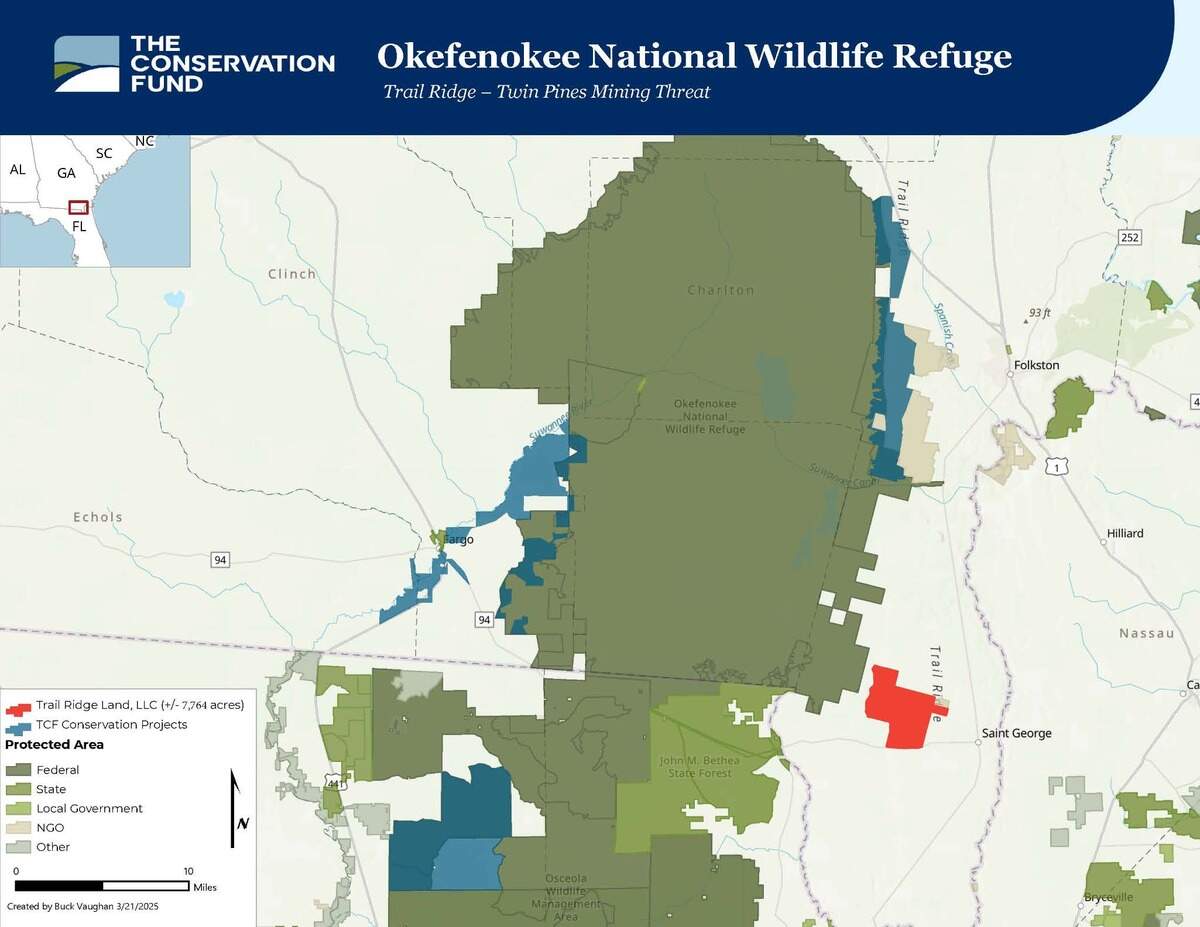
The 7,764 acres of land just 400 feet away from the Okefenokee Wildlife Refuge near the Georgia-Florida border is where the landowner, Twin Pines Minerals LLC, intended to mine titanium dioxide and zirconium.
Okefenokee Wildlife Refuge is a beloved blackwater swamp — the largest in North America at 350,000 acres of wilderness — where alligators, cranes and other wildlife can be spotted by kayak or walking trails. The refuge garners over 800,000 visitors per year and nearly $100 million is spent across the three surrounding counties.
Efforts to halt the mine have come in the form of petitions, several GOP House bills in 2023 and 2024, and hundreds of thousands of public comments to the EPD denouncing the mining operations that would harm water levels and worsen environmental issues, according to the Southern Environmental Law Center.
“There are over 80 scientists whose models show there is a significant risk to water if Twin Pines is granted a permit to operate,” Bill Sapp, senior environmental lawyer at the Southern Environmental Law Center, told the Ledger-Enquirer in December. “Twin Pines hasn’t been able to meet the burden of proof that the proposed mine will not impact the refuge.”
Twin Pines would have removed 1.4 million gallons of water per day to mine the resources it needs, potentially drying out peat moss, contributing to drought and fires.
_Stacy%20Funderburke.jpg "Blue Heron Taking Flight_Okefenokee_GA_(c)_Stacy Funderburke.jpg")
The latest efforts to bring mining operations to reality were when the Georgia EPD issued a draft permit last February, despite public objections.
“No environmental permit application in Georgia history has drawn as much opposition as the Twin Pines Minerals mine,” a news release from the Southern Environmental Law Center said. “Concerned citizens from across Georgia and the country expressed their opposition to the mine by filing more than 250,000 comments with the Corps of Engineers and the state of Georgia.”
In January, the U.S. Fish and Wildlife Service began the process to expand the acquisition boundaries of the swamp. It was part of an effort to potentially purchase the Twin Pines land.
Now the 7,800 acres are further protected after The Conservation Fund made the purchase with the help of philanthropic groups to forge a deal that Twin Pines couldn’t say no to. The group said this purchase allows them to succeed in “safeguarding the adjacent half-million-acre wildlife refuge.”
Why now? Funderburke said the negotiations have been going on the last six to nine months, and started shortly after the draft permit was issued in February. The group wanted a deal closed before the actual EPD permit was issued.
“Once the draft permit was issued last year, it became increasingly certain that a conservation buyout of some sort was really the last exit ramp from this,” he said. “The mining on that site poses an existential threat to the entire Okefenokee Swamp, given how sensitive the water table is and the location.
“It felt like we were racing against the clock to see if we could find another deal before the permit was issued and before they embarked on mining because it’s a decades-long commitment to mining–that’s what we were up against.”
The influence of public advocacy
Funderburke said public advocacy and public pressure were “definitive” in getting this done.
Jenette Gayer, director of Environment Georgia, told the Ledger-Enquirer over email theat the input from Georgians all over the state helped get to this point. Megan Huynhm, senior attorney with SELC in Georgia, said the special outcome would not have been possible without a powerful coalition and regular Georgians willing to stand up and defend a place as beloved as the Okefenokee.
In February 2024, Creation Keepers from St. Thomas Episcopal church requested that Columbus add its name to the list of cities that passed a resolution calling for protection of the Okefenokee. Columbus did not add its name, but 19 other cities through the Peach State created resolutions, according to SELC.
On Friday, Sen. Jon Ossoff called this purchase “great news for all Georgians and our beloved national treasure.”
As far as what’s next for the nearly 8,000 acres near the swamp, Funderburke hopes for a permanent conservation outcome. But it will take time, and the group might have a decision on precisely what it looks like toward the end of the year.
“We always will look for a bigger conservation outcome on the whole property, but it’s not yet certain where it will end up, as far as ownership, but our goal will be a permanent conservation outcome,” Funderburke said. “There’s opportunities for some longleaf pine restoration, enhancing the conservation value of that property as a whole, given where it’s located, and that buffer up against the refuge.”
What’s next for the Okefenokee?
Funderburke told the Ledger-Enquirer it wasn’t easy to get a significant buyout, and the group leveraged philanthropy for part of the transaction.
He said the first phase of the transaction closed on Friday, which was about 40% of the $60 million in funds. The remainder will close at the end of July.
The Holdfast Collective, which is a philanthropic arm of Patagonia and the Cox Foundation, were key supporters in The Conservation Fund purchase. The list of other supporters will grow when it goes public next month when the other half of the deal closes.

Gayer is celebrating, but she said the fight isn’t over.
“We need to continue to pursue permanent protections for the entire Eastern boundary of the Okefenokee and make sure the strip mine never threatens this precious place again,” she said in an email. “This was not the first proposed mine to threaten the Swamp and there is reason to believe it won’t be the last.”
In the 1990s DuPont wanted to mine along the eastern boundary.
Gayer said Gov. Brian Kemp could negotiate a deal to purchase the remaining mineral rights along the rest of Trail Ridge (the Eastern Boundary), pass and sign House Bill 561 or work with the USFWS to expand the park along Trail Ridge.
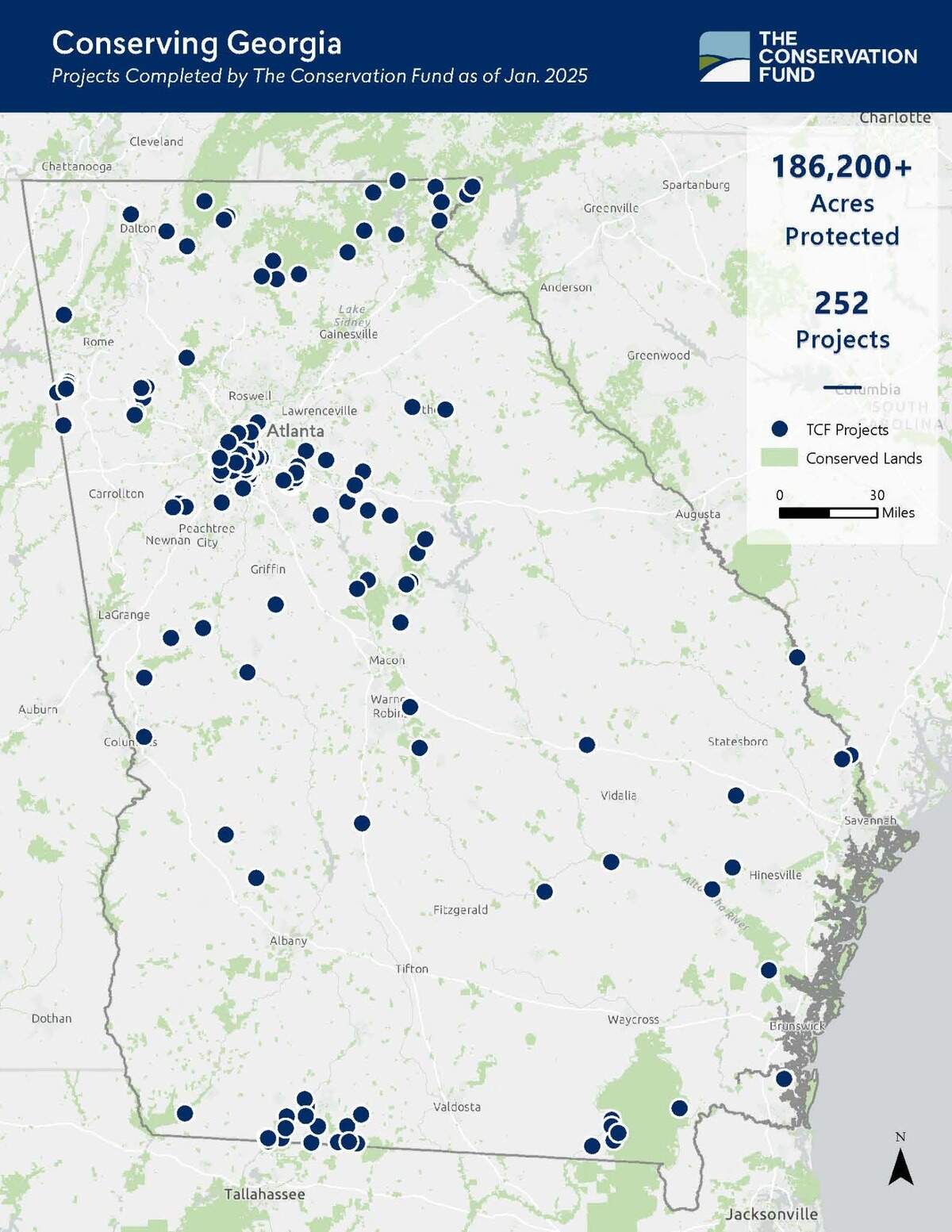
Before this transaction, The Conservation Fund had 188,000 acres in Georgia, and they’ve been working in the state since 1985, according to Funderburke. He doesn’t think that level of support will go away.
“Public lands are bipartisan, not an urban or rural issue alone,” he said. “Public lands garner huge support amongst individuals across the country. This is just evidence of that. And the truth is we’re going to have to work to secure more public dollars for land acquisition and also continue to be as creative as possible, in leveraging philanthropy and other creative routes to make sure that we protect lands that need to be protected around the country. So I don’t think that is going away.”