State of emergency declared for Winter Storm Fern in GA. Is climate change to blame?
The ice storm heading for Georgia, now named Winter Storm Fern, has captured the attention of the National Weather Service, Georgia Power, Gov. Brian Kemp and millions of Georgians across the state as it is set to bring inches of snow and ice to the northern part of the state Saturday afternoon.
Thursday morning, Kemp declared a state of emergency lasting until Jan. 28, activating the Georgia Emergency Management Agency and a potential activation, if needed, of 250 Georgia National Guard Troops.
The latest models show Winter Storm Fern is forecasted to affect 150 million Americans, stretching from Texas to the Carolinas, according to AccuWeather, and several millions of those are here in the Peach State.
The National Weather Service issued a winter storm watch for 128 counties, where up to 2 inches of snow could fall.
Where will the storm hit? Could it help the drought?
Columbus is unlikely to get a hit of winter weather, like it did last weekend.
Columbus is more likely going to dodge the worst. But, Lindsey Marlo, a meteorologist with the NWS, said to keep checking conditions.
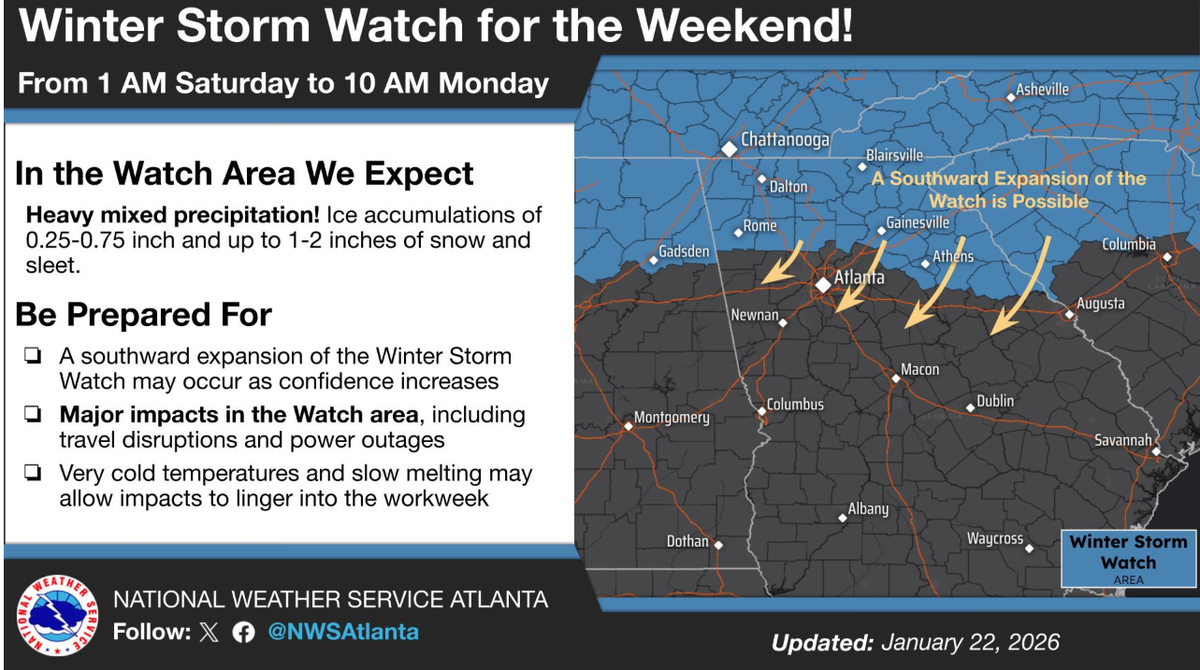
“Columbus remains on the periphery on any potential winter weather or freezing precipitation,” Marlo said. “Most of the impacts will hug closer to I-20 corridor across portions of east-central Georgia.”
One positive from the storm is the state has been in a drought for months and this storm could help some of the northern parts of the state, if it snows.
“The more snow they get on the ground, the more that will absorb into the ground over time, which will help the drought,” said Paul Pastelok a senior meteorologist at Accuweather.
Is this storm amplified by a marine heat wave/climate change?
Three main converging factors are driving this arctic storm so far south, poised to layer the Peach State in ice, potentially disrupt travel and impact the power grid.
A marine heat wave from the northern Pacific, a warm and strong high-pressure system near Alaska and moisture from the Gulf.
The ocean temperatures in the northern Pacific are several degrees above normal and have been for the past year, according to Pastelok, and that drives intense air masses to come south.
“The water temperatures in northern Pacific have been extremely … off, above average across the north-central Pacific, and that has some impact on the intensity of air masses,” he said. “The marine heat wave has been there since last year, and when you see that kind of difference or change in what it should be for this time of the year, it fools around with upper-level patterns. That changes the jet-stream pattern, which drives our weather systems.”
.png "2026-01-11-sst-anomaly (2).png")
“Water temperatures in the Pacific are running 2-5°F above normal,” Andrew Pershing, director of attribution science for Climate Central, told the Ledger-Enquirer. “We can say that climate change has made these temperatures 10 to 100 times more likely. The unusual blob of warm water is likely playing a role in setting the position of the jet stream and the overall path of the storm.”
It’s a similar story in the Gulf of Mexico, which President Donald Trump renamed the Gulf of America by executive order last year.
“The storm is going to pull moisture from the Gulf of Mexico,” Pershing said. “The waters there are also running 2-5°F above normal and have been strongly influenced by climate change (up to 100x more likely). The warm water pushes more water vapor into the system, increasing the potential for more rain/ice/snow.”
There is also a high-pressure system above Alaska, and the warm air from the ocean is pushing that down toward the South.
“A higher pressure system is bringing some warmer weather to western Alaska, but it’s sending down all this tremendous cold from the polar region all the way straight down through the middle of the nation and into the Southeast,” Pastelok said.
Pastelok cautioned attributing single events to climate change. He suggests the marine heat wave is still up for debate, but he is positive about the consistency and frequency.
“I think there’s, there’s still some more to learn, and just kind of looking at one event is, and seeing ice so far south, people blame it on climate change, and you really can’t do that without doing the research,” he said. “Marine heat waves are a climate change debate, and seeing those kind of waters being that far above average in the Northern Pacific during the heart of the winter season without being disrupted, is a major factor, and probably, again, a factor of climate change as well.”
One thing Pastelok is confident in, it’s the consistency.
“It’s the consistency and frequency of these setups that may be more related to the climate change factor than, you know, just one event,” he said.
Can Georgia Power keep the power going?
Winter Storm Elliot, just over three-and-a-half years ago caused 90,500 MW of unplanned outages and failures, according to a Federal Energy Regulatory Committee analysis.
The analysis showed that 47% of the outages were at natural gas units due to mechanical/electrical issues, freezing issues and fuel issues. This affected mainly Tennessee Valley Authority customers, including five counties in northern Georgia.
Georgia Power has issued a news release with tips about how to stay safe and said it is doing all it can to prepare for the wintry weather.
“The company is preparing with crews across the state engaged and ready to safely and quickly respond to potential damage from the storm,” the news release says.
Atlanta Gas Light Media Director DeAllous Smith gave the Ledger-Enquirer the following tips:
- If you experience a power outage, don’t use a gas oven to heat your home because fumes can accumulate.
- Make sure smoke detectors and carbon monoxide detectors are working and have extra batteries on hand.
- Make sure natural-gas meters are free from snow, ice or debris.
- Use caution to remove snow and gently sweep it away with a broom, not a shovel or snowblowers.
- Don’t try to identify leaks themselves.
- If you smell gas, don’t use any appliances. :eave the area immediately.
- The 24-hour emergency response line is 1-877-427-4321.
Georgians can expect tree damage and power outages to be likely, according to the governor’s office.
This story was originally published January 22, 2026 at 12:20 PM.