Liberty and ATL gas rates skyrocket in six years. Why costs are going up in GA
.png "Liberty Utilities and Atlanta Gas Light have incrementally increased gas rates since 2019.")
Flames warming pans on a kitchen stove, hot water for showers or laundry, or heat to warm a home in Georgia are powered by natural gas for 2.43 million Georgians.
Two companies distribute gas in Georgia: Liberty Utilities (serving Columbus and Gainesville) and Atlanta Gas Light customers (serving Macon to Atlanta and everywhere in between).
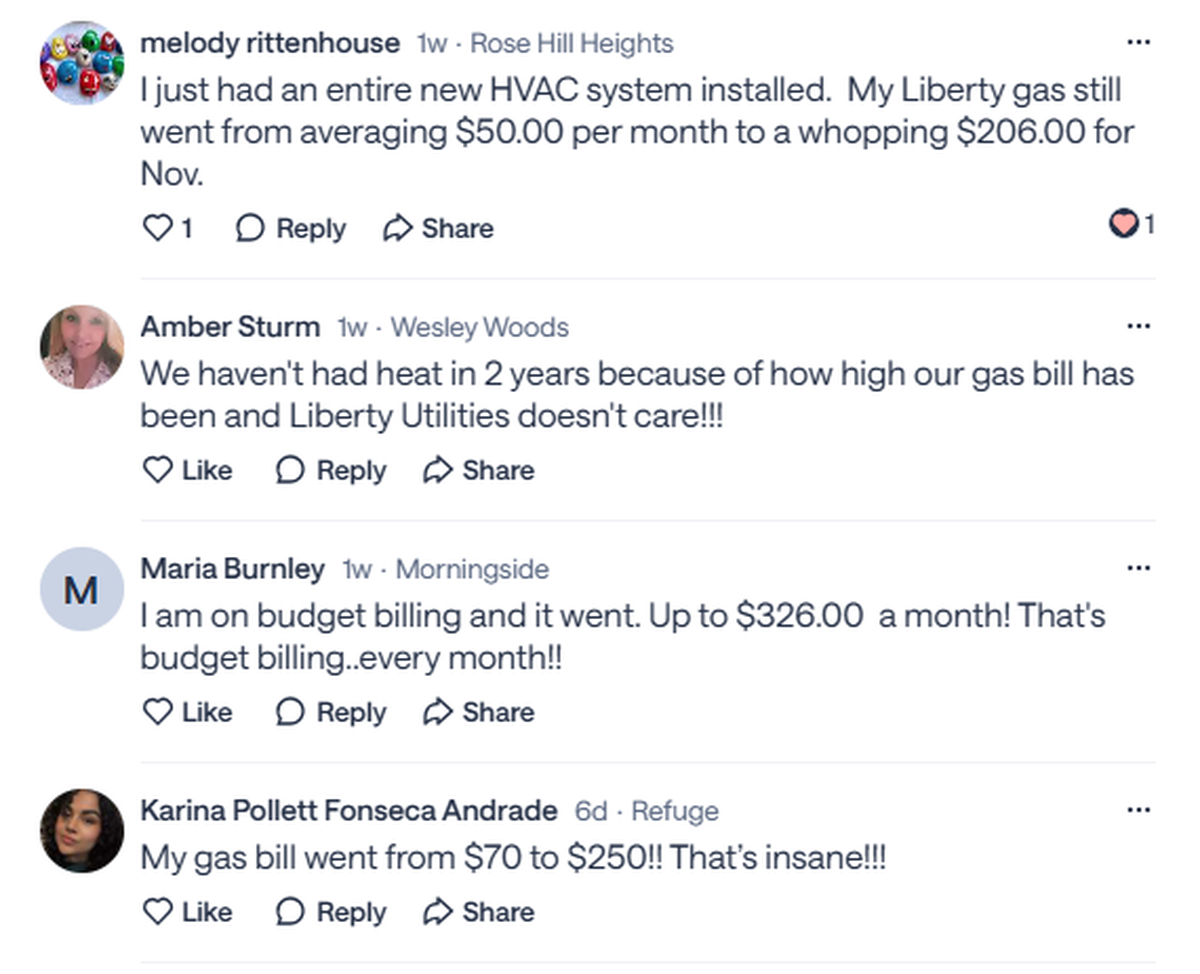
Gas bills are hitting new all-time highs. During heavy gas heating months like December and January, customers are seeing bills above $200.
Gloria Carey, an 81-year-old Columbus resident, received her December bill from Liberty this month for $213.91 ($187 before tax). It shocked her — especially because she uses gas for only her fireplace and hot water. She has electric heat through Georgia Power to warm and power her three-bedroom, two-bath home.
“I had to use both electric and (gas) fireplace heat because it was so cold, last month,” she told the Ledger-Enquirer. “Now, (in January) I’m not using my fireplace, just little space heaters.”
Carey works two days a week at T.J. Maxx to earn disposable income in addition to her Social Security. She feels the gas bill burden.
“The thing is,” she said, “I wonder … why did it increase so much?”
Liberty and AGL must come before the Georgia Public Service Commission to request rate changes and explain why those changes are needed. In the past six years, the PSC has granted incremental rate increases to both distribution companies, according to several filings in the Liberty and AGL dockets.
Pipeline maintenance, brand-new pipeline expansion projects and gas storage facilities are some of the construction costs the companies have argued they must offset by charging customers more, Liberty and AGL explain in testimonies.
For customers, that is showing up in their delivery portion of the bill.
Carey and other Liberty customers are paying 60% more to have the gas delivered to their home than they would have in 2019.
Using calculations from the 2019 rates, including a customer fee of $27.21 in 2019 (which increased to $33.92 in 2026) and the delivery fee calculated by the rate of centum (100) cubic feet (.404 CCF in 2019 to .645 CCF in 2026), Carey’s bill would have been $125 before tax rather than $187 before tax. She used 161 CCF during her December billing period. She would have paid $62 less six years ago if she used the same amount of 161 CCF.
Carey gets a senior discount, so the customer fee is waived.
The Public Interest Research Group (PIRG), a Colorado-based consumer economic and environmental policy advocate with state chapters, found construction costs and delivery fees on average make up 80% of a bill for Georgians. This includes an average between AGL, Liberty, municipalities and electric membership cooperatives (EMCs) that the Energy Information Agency collects.
Per the EIA., the average cost to heat a home in Georgia was $114 in 2024 and $43 in 1984. PIRG Utility Watchdog associate Madeline Messer noted these numbers are on par with national inflation, which has tripled prices since 1987.
‘We see these construction costs and delivery fees to recoup the cost of the construction coming out of pipe replacement programs,” she said. “Utilities have been able to jack up the bill for replacing their pipes without consumers noticing or having too much hardship because gas prices have been so low that it kind of evened out.”
Gas prices were $3.94 per thousand cubic feet of gas used in 2024 versus 1984, when they were $4.27, according to Messer, who reported data from EIA.
“Because construction costs have risen, rising gas prices are actually just revealing to us how much we’re paying for delivery,” she said.
Who advocates for Liberty and AGL customers?
The Georgia PSC has seen Liberty and AGL come before the commission asking for either a cost recovery or a rate increase every year since 2019. Each year, they approved the request. Ahead of those approvals, rate requests are analyzed by PSC staff for several months until the case reaches an agreement.
“I don’t know of any case where requests by AGL or Liberty were approved without significant changes,” Tom Krause, public Information Officer for the PSC, said in an email.
Former Public Service Commissioner Robert Baker, now an energy regulatory lawyer, said the hearing room is empty during the gas distribution company proceedings.
“Nobody shows up — nobody,” he said. “The only people that are there are commissioners, the staff and Liberty. It’s like a phantom hearing. They have a one-day hearing and vote on it the next day. It’s a joke. It’s a huge joke.”
The Southern Environmental Law Center and the Sierra Club have been active in the resource planning meetings for Georgia Power and the company rate cases for the past decade. They represent groups like Georgia Interfaith Power and Light, the Southface Institute and the Southern Alliance for Clean Energy, advocating for environmentally sound decisions that don’t hurt customer wallets or harm the environment during these lengthy and complex hearings.
But no legal team has intervened.
Georgia Interfaith Power and Light, represented by SELC in many Georgia Power hearings, told the Ledger-Enquirer they are focused elsewhere.
“At this time, our public advocacy at the PSC is mostly focused around data centers, clean energy and energy capacity expansion in the state, where we can contribute the most clarity and impact,” Jay Horton, communications manager for GIPL said in an email. Southern Alliance for Clean Energy said something similar when asked why they don’t intervene.
“Our focus has been climate pollution from the electricity sector,” said Maggie Shober, research director for SACE. “There are many sectors that contribute to pollution that is bad for environmental health and adds climate pollution. SACE cannot cover them all.
“Gas distribution systems and direct use of fossil fuels by buildings is a different kind of expertise and advocacy than what SACE has on hand. SACE does do advocacy against the use of gas as a fossil fuel. Advocacy within a gas distribution utility rate case is very different from advocating against the building of a new pipeline or power plant.”
Georgia Power’s parent company, the Southern Company, has owned Atlanta Gas Light since 2016.
Mainly, gas marketers intervene, according to Baker. There are 14 gas marketers for AGL. The marketers do not have any regulatory oversight, like the pipeline distribution companies have with the PSC.
“Gas hearings (for AGL and Liberty) are much less contentious than electric hearings,” Krause said. “Although interested parties are allowed to become intervenors (just like in IRPs), generally, the only parties who intervene are the gas marketers.”
AGL rates and bills are trickier to understand than Liberty.
“It’s really difficult to put a finger on AGL to explain how the charges get on your bill,” Baker said. “AGL doesn’t really want people to understand what is going on. They don’t want people to understand. It’s intentional to make it as vague as possible. It’s complicated for a reason.”
Rather than showing a volume (delivery) charge in CCF, the way Liberty shows this, AGL rates use a customer charge and a Dedicated Design Day Capacity (DDDC) rate, and one of the 14 marketers adds in their charges to the bill. The base rate consists of two components: the fixed customer charge and the DDDC charge.
From 2019 through the approved rates for 2026, the monthly fixed customer charge will have increased by approximately 41%, and the per-unit DDDC capacity charge has increased by 103%. Gas charges are separate and vary depending on a rate determined by one of the 14 marketers the customer uses.
Hidden environmental costs
Methane gas (natural gas) is burdensome to human and environmental health. It has a higher global warming footprint than carbon dioxide, adding to the greenhouse effect, according to the U.S. Environmental Protection Agency. During transit through pipelines, gas can leak. It also can leak in homes through stoves or furnaces.
Messer said one of the ways to reduce bills is by making homes more efficient, but continuing to use gas energy doesn’t curb the environmental health issue.
According to a study in Boston and published in 2022, methane gas can leak up to 21 hazardous air pollutants, including benzene, a carcinogen, in gas delivered to households.
Groups such as Rewiring America advocate for electrifying homes to decrease planet-warming emissions, breathe cleaner air and save money.
Messer said pushing Public Service Commissioners to reduce rates and implement policies like preferring non-pipeline alternatives is one way consumers can get involved.
On Dec. 17, the Georgia PSC voted to approve a residential rate increase for Liberty customers, starting March 1. That rate will increase from $31.91 to $34.58, and the delivery rate will increase from 60 cents per CCF to 64 cents CCF.
Baker said one of the reasons he thinks no one shows up to intervene is because “they don’t know.”
“I think everyone understands it’s futile to challenge the gas market and the gas companies,” he said, “because whatever the staff and gas companies agree on is going to get approved.”
This story was originally published January 29, 2026 at 5:00 AM.