
An ‘impossible’ situation for GA farmers. Drought could mean water restrictions
Georgia leaders often tout their pride for the state’s business and farming environments when citing these two statistics: the Peach State is the No. 1 state to do business, and its No. 1 industry is agriculture.
Now, that industry — comprising around 40,000 farms, according to the 2022 USDA census — is in dire straits from economic volatility, like the price of diesel and fertilizer, compounded by one of the worst droughts in the state’s history.
As of April 22, a quarter of the state is in exceptional drought, the highest classification, per the U.S. Drought Monitor, and over two-thirds is in extreme drought conditions. Extreme drought conditions have lingered since October in southwest Georgia, where the most extreme affects are being felt from poor growing quality and out-of-control wildfires.
Chris Goodman, 55, who started farming at 10 years old, has 1,600 acres in Tift County. He grows peanuts, corn, snap peas, sod and citrus.
“I don’t ever remember it being this dry,” he told the Ledger-Enquirer. “We have some creeks where we can pump water out of them if we need to, and even they don’t have water. We’ve always been able to go to the creek to get water.”
However, Goodman said he is one of the lucky ones because he has access to deep wells to pump water. They filled one of his 40-acre ponds to irrigate his crops back in December.
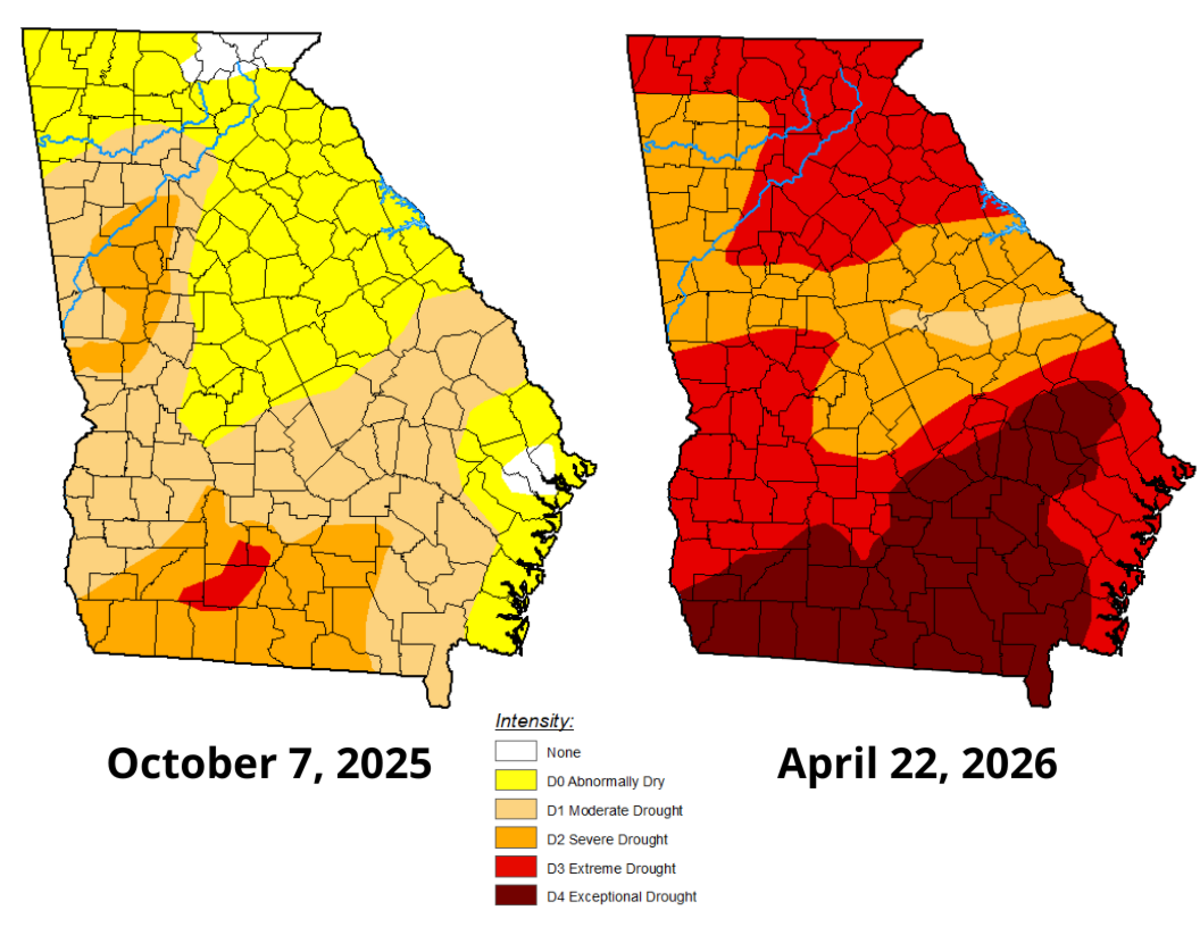
“I’ve got deep wells everywhere, which most people don’t. Most people are looking at dry ponds,” he said. “Deep wells aren’t pumping what they were. A well that was pumping 550 gallons per minute last year only pumps about 400 gallons per minute now, which can happen in the summer but never in the spring.”
Dry-land farming
Most Georgia growers, 84%, according to the 2022 census, don’t irrigate and farm on “dry land”, relying solely on rain.
Three counties west of Goodman, Amber Perkinson, 41, has a 15-acre homestead in Colquitt, Miller County. She decided to take her years of working in the agriculture industry and start her own operation last year. Muddy Dog Acres has chickens, ducks, horses, barn cats, bees and five cows.
Her boyfriend in Colquitt, Josh Creel, has a 165-acre plot for row cropping. Last year, they tried to grow 36-acres of peanuts, but they failed because of “no rain”, she said.
Perkinson opted for five breeder cows last year, thinking it was a safer bet to create a meat herd over time. But soon, she said, hay might not be available.
She is one of the roughly 33,000 dry-land farmers in Georgia feeling the acute impacts of the exceptional drought. She has five bails of hay and is concerned her hay producer is going to run out. Dry farming is cheaper, according to Perkinson, just $100 an acre instead of $300 an acre for irrigated land.
This year, the couple isn’t attempting to grow anything on the 165-acre farm because of the drought and the financial burden of farming.
“It’s just about impossible; it doesn’t math out,” she said. “A few years ago, you got paid $650 for a ton of peanuts. Now, it’s $400 for a ton, but input cost has doubled. You are spending money to farm.”
The cost of input is something Jack Davis, a relations manager at Southwest Georgia Farm Credit in Brantley, about 110 miles south of Columbus, is very familiar with the input costs of farming.
“The problem right now is fertilizer,” he said. “With the whole war in Iran going on, it went from, $560 a ton, to $860 a ton. Some people have electric irrigation. But for those who don’t, you have to pump water out and use diesel more. Diesel prices went from $2.60 a gallon to $4. Those increases, and with the drought, they’re having to run the irrigations more.”
Some farmers are opting not to plant peanuts at all, Davis said, and others managed to get corn in the ground.
“It’s already a stretched market,” he said. “Then you add the drought. You can’t get your seed in the ground on time, especially for some of your later crops, like peanuts, cotton. You have to have water. The soil is hard as a rock.”
Will water restrictions begin?
In north Georgia, the drought is visible at Lake Lanier. Normally, this time of year, the lake level averages around 1,701 feet, but it is at 1,065 feet now.
Chris Manganiello, water policy director for the Chattahoochee Riverkeeper, said the water levels are worse than the 2007-2011 drought.
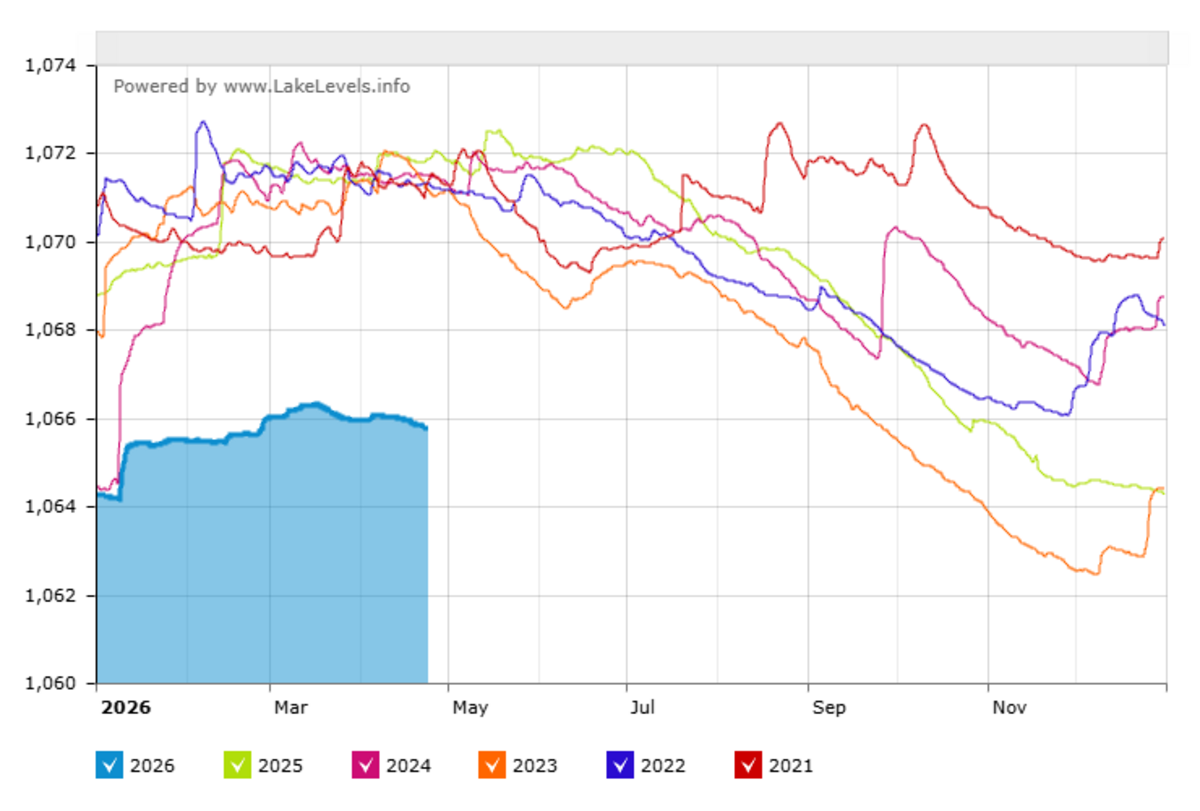
“Stream levels are lower right now than they were in 2007 and 2011, which are considered the worst droughts we’ve had in the state since record keeping began,” he told the Ledger-Enquirer. “Some streams in the Chattahoochee and some in the Flint — almost all streams — are below ‘07-’11 levels. Lake Lanier’s level is below what it was in ‘07.”
The Georgia Environmental Protection Division is considering a response to the severe drought., which Manganiello said is “prudent.”
The agency began collecting feedback April 17 from public water systems and municipalities and ended the feedback period April 24, Georgia EPD communications director Sara Lips said in an email.
Level 1 response is a public information campaign that emphasizes conservation efforts. Level 2 and 3 include water restrictions that could mean two day per week water restrictions and other prohibitions on specific types of outdoor water use.
“People who live in cities right now should care about the fact that there is a drought,” Manganiello said. “We will have to start thinking about how we use water inside and outside our homes. The more widespread, the more it has an impact on food prices.”
However, residents with a food garden in their yard will not be subject to restrictions, according to Pam Knox, a crop soil scientist at the University of Georgia.
“You are probably going see prices go up because food will get more expensive because it’s hard to produce,” she said. In the 20 years she has worked and studied crop science in Georgia, Knox said, she hasn’t seen a drought this severe this early.
“It’s more extensive in how much of the state is covered than some of the others, and it’s the time of year,” she said. “What makes this one so unusual is it’s happening in spring.”
Not just a Georgia issue
The National Ocean Atmospheric Administration said the entire Southeast is the dryest it’s been since 1895.
Knox said part of the reason Georgia is in this situation is from a lack of tropical storms last summer, when no hurricanes made landfall — the first time that happened since 2015, according to NOAA.
“We can really link (this drought) back to the lack of tropical storms last year,” she said “About the time that mid-August hit, we had rain, then the pattern shifted, and we went to this really persistent high pressure that’s been over the region for a lot of the time.
“Starting in really mid-August, we went through a really dry spell, and November was incredibly dry. Usually winter is the time of year when we recharge soil moisture because the plants are dormant and temperatures are low, so there’s not a lot of evaporation, and we usually get plenty of rain then.”
In December, hydrologists and Knox reported concerns of drought, saying inches of rain were needed to get out of the deficit. Now, most parts of Georgia need at least 10 inches of rain, according to Knox, to end the drought.
This problem isn’t in only Georgia. Eighty percent of the contiguous United States is at least “abnormally dry,” according to Climate Central. “Climate change is helping drive the conditions for this worsening drought,” its website says.
“A warmer atmosphere is a thirstier atmosphere, drawing more moisture from soils, vegetation and trees,” said Shel Winkey, a meteorologist at Climate Central. “This allows both flash droughts and long-term drought conditions to develop faster and makes them even harder to break out of.”
Loan bail out and a state of emergency
The federal and state governments have acknowledged this crisis for Georgia and its producers.
Wednesday, U.S. Secretary of Agriculture Brook Rollins authorized the Georgia Department of Agriculture to begin accepting applications for an emergency loan called an FSA or Farm Service Agency loan.
Perkinson said she will likely not pursue this loan because “it isn’t a long-term solution.”
“Loans are just like more problems for folks,” she said.
The loan is available to farmers in 126 counties that have been designated as a natural disaster from the drought conditions, according to the GDA. The highest FSA loan is $500,000, if eligibility is met.
The same day, Gov. Brian Kemp declared a state of emergency for 90 counties in Georgia due to the wildfires forcing evacuations and destroying homes in southern Georgia. The largest fire, Pineland Road, has grown to 31,000 acres in a week and is just 10% contained, according to the Georgia Forestry Commission.
Perkinson said farmers have relentless hope and momentum. If necessary, Perkinson said, she will use her horse trailer to help folks evacuate.
This story was originally published April 24, 2026 at 2:47 PM.