How a drop of $1.32 per month in your Georgia Power bill could be ‘disingenuous’
AI-generated summary reviewed by our newsroom.
- Georgia Power’s 2026 FCR-27 proposes an average $1.32 monthly decrease for ratepayers.
- Georgia Power wants to increase gas insurance.
- Georgia Power proposes raising the Interim Fuel Rider trigger from $200to $300 million.
Three years ago, $15.94 was added to Georgia Power residential monthly utility bills after the Fuel Cost Recovery hearings at the Georgia Public Service Commission.
The rise and fall of fuel prices from geopolitical events abroad and local winter storms or hurricane disasters are calculated in the FCRs. This year, (FCR-27, for its 27th iteration) something unusual could happen: ratepayers — millions of Georgia Power customers — could pay on average $1.32 less than what they currently pay, even while fuel costs are rising, if the Georgia Power FCR plan is approved.
But critics say this drop isn’t the good news it appears to be because Georgia Power is making other requests that could increase bills, and fuel costs are poised to rise from geopolitical events.
May 5, five Georgia Public Service Commissioners will listen to Georgia Power representatives explain the company’s 2026 Fuel Cost Recovery plan, hear from intervenors and lawyers who argue for and against certain policies. They are expected to make their final decision May 28.
The possibility for the change is understood from a complex accounting process that is taking more than just fuel costs into consideration. The cost of fuel, insurance for fuel (hedging), storm costs, the nuclear plant Vogtle project costs and more round up to a $43 increase since 2022. This year, it’s going to be a $42 increase, and that has experts like Aidyn Levin of the Georgia Public Interest Resource Group say the $1.32 difference appears to be beneficial but “disingenuous.”
In addition to the fuel cost change, Georgia Power is requesting an increased amount of fuel insurance to hedge, which customers pay for, and a higher threshold of when to hold fuel cost hearings.
But consumer advocates like Levin, environmental lawyers and energy experts — and, in some cases, the PSC staff — argue against the insurance threshold change and against increasing the insurance. They have also made the case in April testimonies for more transparency in utility bills and fuel cost sharing.
How does fuel cost work and how did Georgia Power calculate $1.32 in savings for FCR-27?
Georgia Power doesn’t make money off the cost of fuel.
Since the 1970s, electric utilities have had customers pay for fuel, like coal or natural gas, according to Maggie Shober, the Southern Alliance for Clean Energy research director. This model was a response to the 1970s oil crisis when nuclear and coal fuel-based prices were volatile, she said.
That volatility was made very clear in 2022, when gas prices spiked during the Russian invasion of Ukraine, putting Georgia Power in debt for $2.1 billion in fuel cost and creating a massive unpaid balance.
During the 2023 FCR (FCR-26), the PSC approved Georgia Power’s request for a $15.94 per month fuel cost increase on customer bills to pay for what experts call an “underrecovered fuel balance.”
Albert Lin, a financial analyst testifying on behalf of Georgia Interfaith Power and Light and Southface Institute, compared the financial accounting from FCR-27 to Georgia Power buying a new air conditioner in 2023 and putting it on a credit card. By 2027, the “Russian-Ukraine credit card” will be paid off.
But only $5.74 is being taken off the $15.94 off future bills, according to fuel cost projections, which was written before the Iran war began. In addition to the $5.74, the storm recovery costs for Hurricane Helene of $4.42 per month are added to the equation of paying bills, so the amount Georgia Power ratepayers are due to pay is net positive, $1.32 per month.
“Any messaging about a proposed decrease in customer bills misses the fact that fuel costs are going up,” Levin said Wednesday.
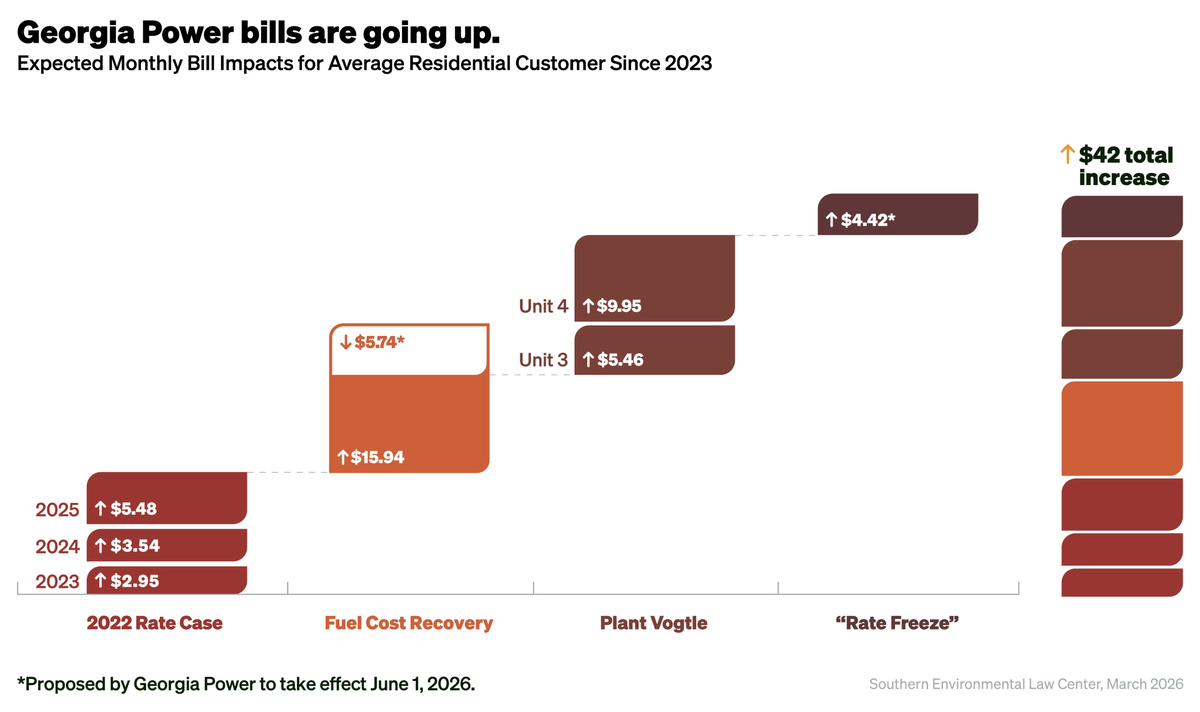
“Georgia Power’s trying to put a positive spin on this, that costs are going down, but that’s disingenuous because fuel costs are going up,” Levin said. “And there’s actually reason to believe that gas prices will continue going up. We have not yet priced in the impact of the war in Iran.”
Georgia Power relies heavily on gas — more than 51% — and projects that number to be 59% by 2035, according to Levin.
Fossil fuel insurance? PSC staff say no
Georgia Power proposes in this FCR to increase its hedging program, which means insurance. The company argues the best way to mitigate volatile natural gas prices for customers is through its hedging, an insurance program against extreme gas spikes.
“A robust hedging program serves as a critical tool to mitigate upward price volatility for customers,” Georgia Power vice president/comptroller Adam Houston and assistant comptroller Matthew Berrigan wrote in their April FCR-27 rebuttal testimony.
The current hedging amount is 40% of natural gas budgeted to be burned up to 36 months, and Georgia Power wants to increase it to 60% in 48 months. Like fuel costs, the company passes 100% of its hedging costs to customers.
The Public Service Commission staff, an independent body that presents their own evidence to the commission, refuted this idea in their rebuttal to Georgia Power in April.
“The natural gas hedging program should be terminated,” Tom Newsome, PSC director of utility finance, said in the PSC staff testimony. “The hedging program is not necessary to provide stable fuel rates for customers and has significantly increased ratepayer fuel cost over its history.”
Hedging has only helped customers four out of 21 years and cost customers hundreds of millions of dollars, Newsome said in his testimony.
Southern Environmental Law Center lawyer Jennifer Whitfield told the Ledger-Enquirer the PSC can decide whether to approve the termination of the hedging program and whether that cost should be paid for in “this bucket” of fuel costs.
While the FCR happens every three years, if Georgia Power is in debt by more than $200 million, an emergency case is held between meetings to notify commissioners. This is called an Interim Fuel Rider (IFR).
Georgia Power proposes the emergency trigger threshold to increase to $300 million, arguing in their rebuttal testimony that $200 million was the number used as far back as 2012 and $300 million is “more appropriate given the relative size of the total fuel expense incurred by the Company.”
But PSC staff and intervenors such as Lin and Levin disagree with this suggestion.
“We think that’s a bad idea because the only way that the commission and the public know that Georgia Power has collected way too much or not enough money for fuel is when they submit a filing like (an IFR),” Levin said. “Increasing the limit would decrease transparency.”
Fuel cost sharing and bill transparency
Another proposal intervenors argue for is something known as “fuel cost sharing.”
Rather than having customers pay for 100% of fuel costs, Levin argues along with intervenors for Sierra Club and Southern Alliance for Clean Energy that Georgia Power should also be exposed to a percentage of costs if they are higher than expected.
The reverse would be true, she said. If fuel costs are lower than expected, Georgia Power would earn a percentage.
“This would incentivize Georgia Power to keep fuel costs lower, and nine states already have this fuel cost sharing in place,” Levin said.
But Georgia Power said they already have incentives to keep costs low. They called this “duplicative and unnecessary” in their testimony and noted only 10 states doing this is too few to measure success or consider as a popular methodology.
And, according to Georgia Power’s own records, Lin calculated approximately 27% of customer bills are paying for fuel costs.
Levin also said Wednesday PIRG supports utilizing renewables like wind and solar, which don’t have a fuel and would remove this cost.
PSC staff, Levin and Georgia Interfaith Power and Light executive director Codi Norred support a line item added within bills to show consumers how much they pay for fuel.
“Most customers don’t even see this volatility on their monthly bill, but they pay for every dollar of it,” Norred said in an email to the Ledger-Enquirer.
Norred hopes commissioners push for increased transparency during the May 4 and 5 hearings — and push back on Georgia Power’s dependence on fossil fuels.
“Georgia Power’s reliance on methane gas continues to put an unnecessary strain on Georgians’ health and livelihoods,” Norredsaid. “Because 100 percent of fuel costs are passed directly onto consumers, when methane gas prices spike due to overseas war or winter storms, those costs are felt directly by customers. As reflected in the company’s own testimony, from 2023-2025 the price of methane gas swung from as low as $1.23 to nearly $13 per unit, and during Winter Storm Fern this past January, it spiked above $30.”
Levin said Georgia Public Interest Research Group has created a petition online that will be sent to commissioners to ask for protection from “unfair fuel costs.” She also called for Georgians to attend the PSC hearings May 5 and 6. The hearings will also be livestreamed on the Georgia Public Service Commission YouTube channel.
The decision about the FCR-27 will be made May 28, and possible bill changes are proposed to go into effect June 1, 2026.
This story was originally published May 1, 2026 at 2:10 PM.