
He risked it all to fight for the rights of Columbus’ Black voters. Meet Primus King.
Primus King was in his prime when he made history by winning a crucial victory in the ongoing war for Black voting rights.
When he walked into the Muscogee County Courthouse in 1944 to try voting in the all-white Democratic Party Primary, he was midway between being born a Russell County sharecropper’s son in 1900 and dying a successful Columbus businessman and Baptist preacher in 1986.
His actual aim was not to vote, but to be denied that right on account of his race. And he was: A white police detective accosted him, called him the N-word, and asked what he thought he was doing.
“I’m going to vote, sir,” King said.
“Ain’t no n-----s voting here today,” the detective said, putting his hands on King.
Witnessing this confrontation, the supporters who had accompanied King, dropping him off and watching from across the street, jumped in their cars and fled.
King remained calm, deflecting the officer’s aggression by complimenting his clothing.
“A nice looking gray suit you got on,” he said, and the detective released him. “I’ll see you later, sir,” King told him, and walked three blocks to the office of attorney Oscar Smith Sr., hiring him to sue the Democratic Party.
King’s account of what happened that day was recorded in a 1979 interview, now preserved in the Columbus State University archives.
A court case & a 30 year old check
The Democrats in 1944 claimed theirs was a private party that only white people were allowed to join. Black residents could register to vote, but they couldn’t vote in the primary, and the primary decided Georgia’s elections, because only Democrats won office back then.
“The Democratic Party is the dominant and controlling political party in Georgia,” U.S. District Court Judge T. Hoyt Davis wrote in October 1945, ruling in King’s favor. “No other party has held a statewide primary during the past 40 years. Since 1900 Democratic nominees for United States senator, members of the House of Representatives, governor, and other statehouse officers, nominated at primaries, have been elected in the ensuing general election.”
In the case titled King v. Chapman, Davis ruled the all-white primary violated King’s rights under the 14th, 15th and 17th amendments to the Constitution. The U.S. Circuit Court of Appeals in New Orleans upheld Davis’ decision in March 1946, and the U.S. Supreme Court refused to hear the party’s appeal.
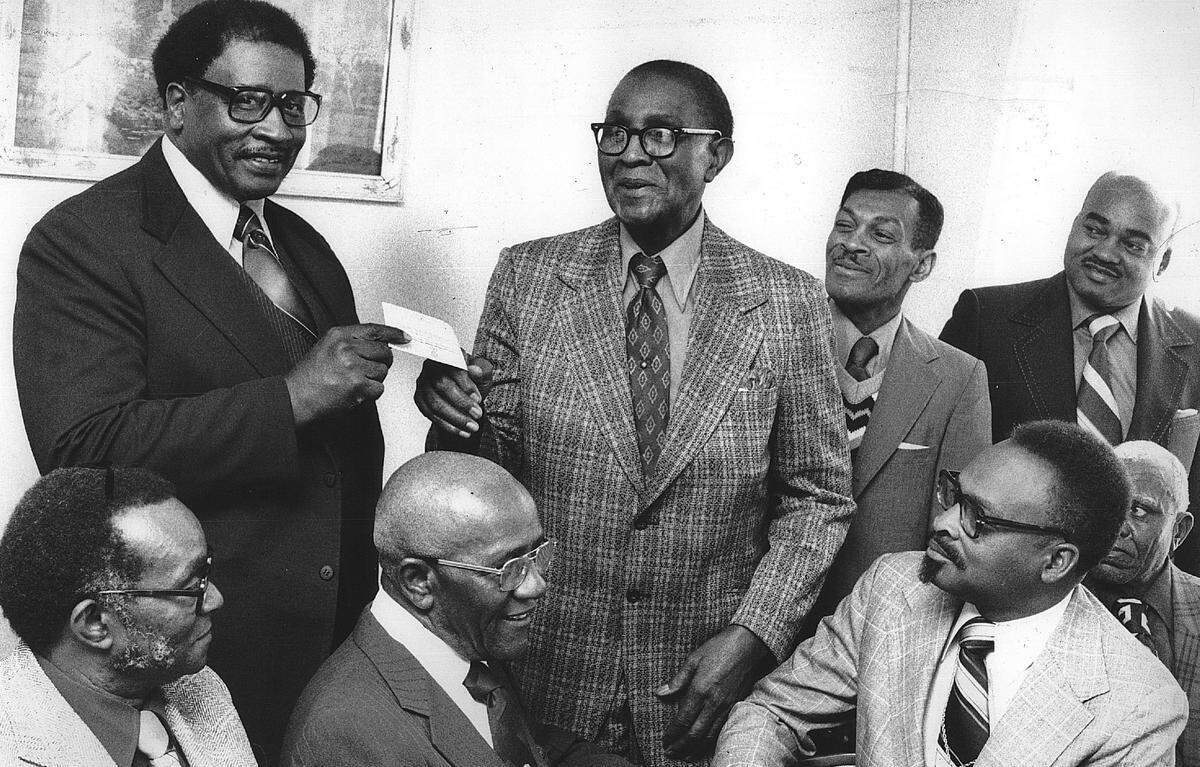
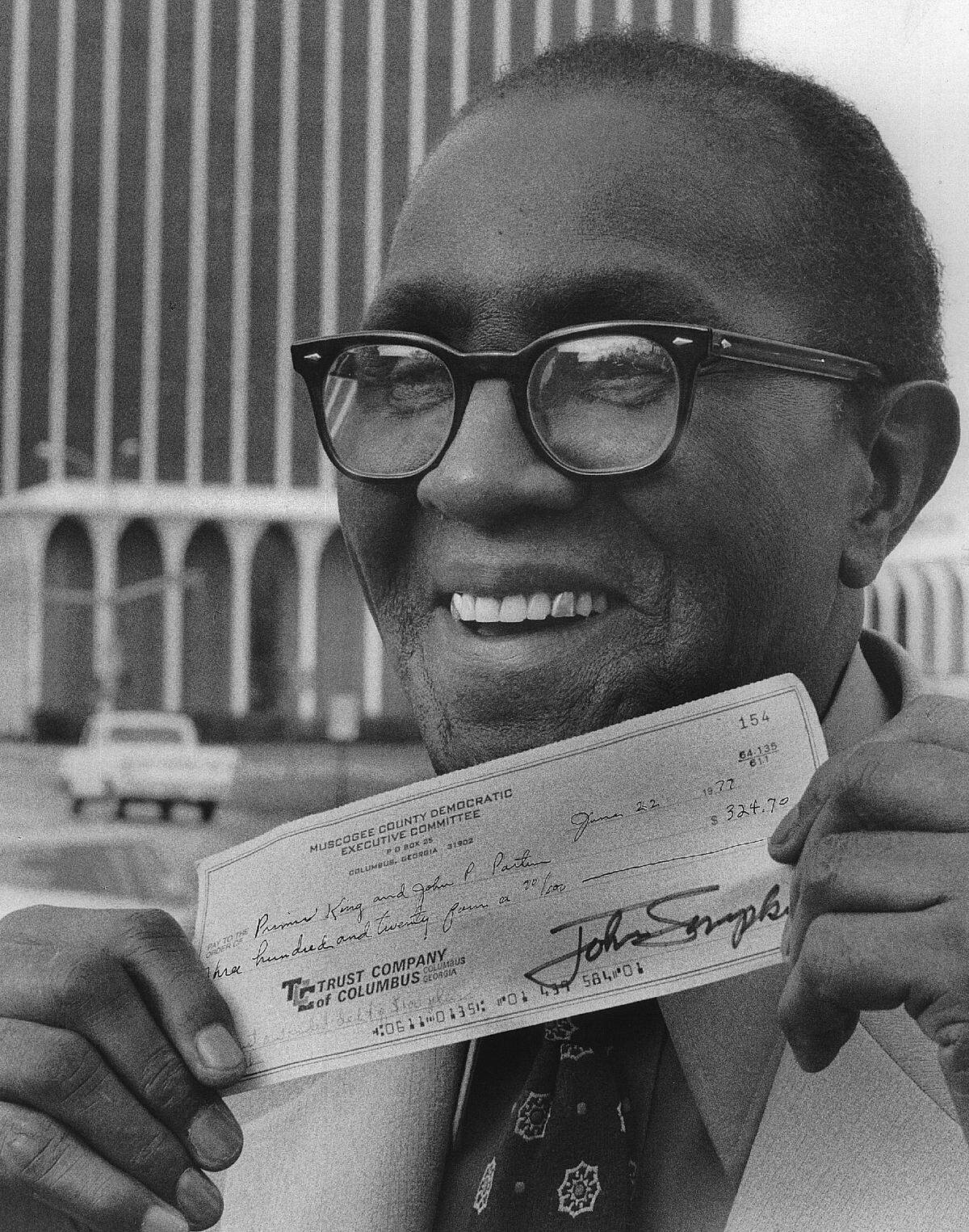
King had sued for $5,000 in damages. Davis awarded him $100, with interest. By the time King finally got a check, in 1977, it totaled $324.70. He’s often pictured holding it in archived Ledger-Enquirer photos.
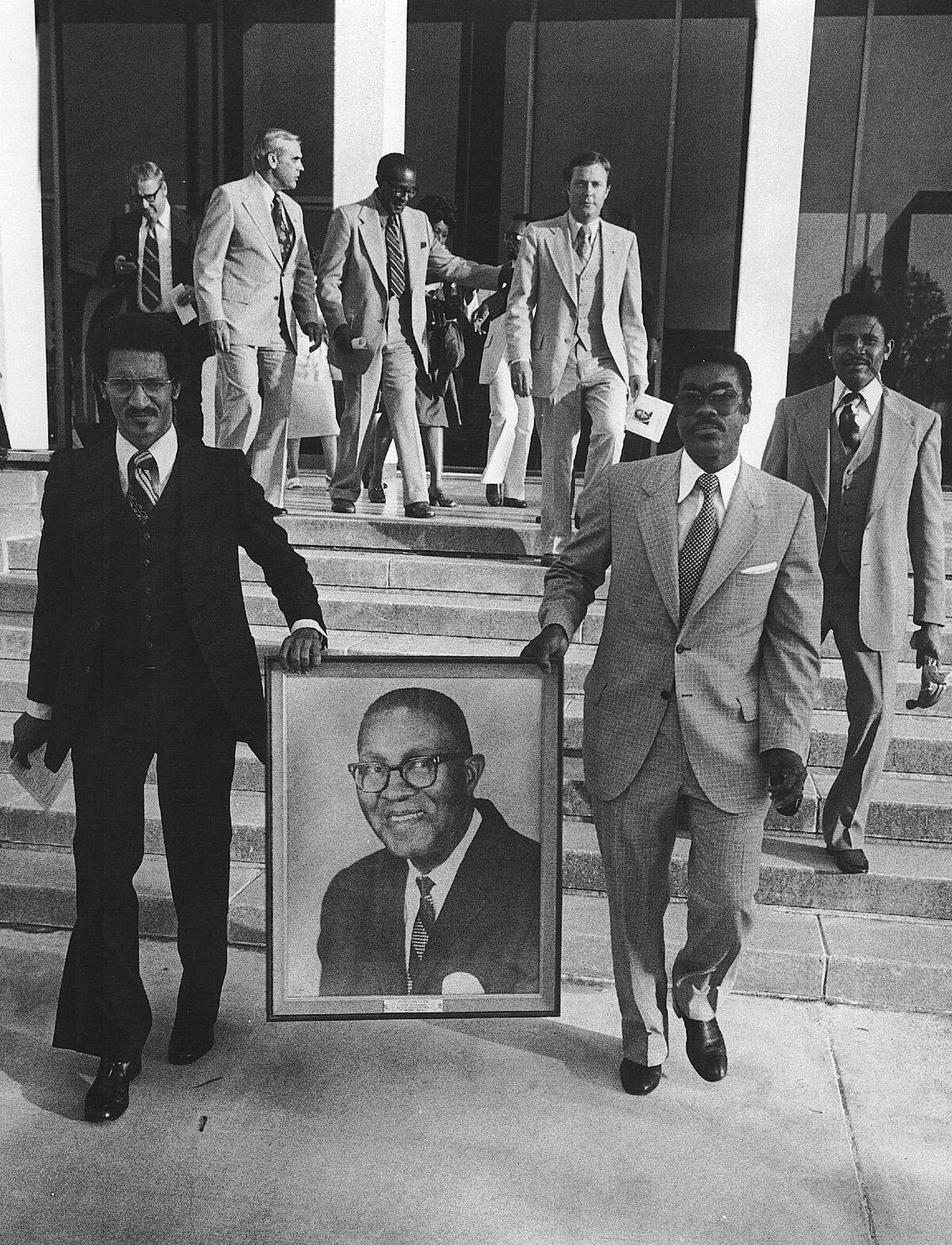
After he finally got paid, King was honored with a portrait mounted in the office of elections and registration, then located in the Columbus Government Center.
‘Very bold step’
John Allen, today a semi-retired Superior Court judge, was at the time an attorney and chairman of the civil rights group the Rainbow-PUSH Coalition. He and the Rev. William Howell, also with Rainbow-PUSH, carried the portrait as they led a procession into the building, with King and his wife Genie right behind them.
Allen had grown up in the same neighborhood where King had a barbershop, a business he bought for $8 after a white employer cursed King for allowing a Black woman selling vegetables door to door to speak to his wife. King quit working as the man’s chauffeur because of that.
He moved to Columbus in 1911, later working for white families as a cook, butler or driver. He endured the casual racism that was common at the time, but his 1979 oral history interview indicates he did not forget indignities.
“I’m a man that loved my people, Black folks, and couldn’t say that about them white people,” he said, later recalling how he was ejected from a café and told to get his food from a side window.
King was a dignified man, Judge Allen remembered, but he was not a quiet one: “He was always lecturing,” Allen told the Ledger-Enquirer. “He just seemed to be loquacious.”
When he spoke, people listened: “He had an air of authority about him,” Allen said.
He got death threats for filing his lawsuit, but he didn’t scare.
“It was a very bold step to step out and challenge the white primary,” Allen said.
Voting rights today
The struggle to secure minority voting rights is not over: The Georgia General Assembly today is considering legislation to restrict absentee by mail voting, after its widespread use in the November elections.
Allen noted such restrictions may be couched as reforms targeting voting fraud, a “ruse” to disguise attempts to suppress the Black vote.
“It points out the importance of the vote,” he said. “It’s still a key issue…. It’s an ongoing battle, it’s a long battle, a long war, with a lot of battles along the spectrum of that war.”
Editor’s note: A previous version of this story incorrectly named Primus King’s attorney in his 1944 lawsuit that ended Georgia’s whites-only Democratic Primary. The attorney’s name was Oscar Smith Sr.
This story was originally published February 1, 2021 at 6:00 AM.