
Confederate group sues Columbus mayor, councilors over removal of flags at Linwood Cemetery
The Sons of Confederate Veterans have followed through on their threat to sue Columbus over the city’s removing rebel flags and poles from historic Linwood Cemetery.
The group filed suit Wednesday in Muscogee Superior Court, and attorneys representing the city had the case transferred Thursday to federal court, because it involves allegations that city leaders violated the organization’s civil rights as guaranteed by the U.S. Constitution.
The conflict became heated this past October, when the SCV defied city policy by flying the Confederacy’s red, star-crossed battle flag at the 1828 cemetery, despite being warned that if it did that, city crews would remove two flag poles that Columbus Council by resolution allowed the group to install in 1994.
The SCV countered that if the city removed the flags and poles, the organization would sue under what some call the “monuments act,” a state law protecting war monuments such as those memorializing the Confederacy.
The SCV’s lawsuit cites a section of the statute that says no “person, firm, corporation, or other entity acting without authority” may “mutilate, deface, defile, or abuse contemptuously any publicly owned monument, plaque, marker, or memorial which is dedicated to, honors, or recounts the military service of any past or present military personnel of this state, the United States of America or the several states thereof, or the Confederate States of America or the several states thereof.”
The suit first claims Columbus city leaders violated that law by removing the flags and poles, and should be ordered to pay the SCV triple the costs of replacing the equipment, plus punitive damages, attorneys’ fees and court costs. The city also should be ordered to permit the SCV to fly Confederate flags at Linwood “in perpetuity,” the suit says.
It next alleges the city violated the SCV’s free speech rights under the First and 14th Amendments through “unconstitutional viewpoint- and/or content-based discrimination” while acting “under color of state law.”
Its third claim is breach of contract, alleging the resolution allowing the flags, which council passed by a 6-to-4 vote on March 28, 1994, constituted an “ongoing contractual relationship” between the city and the SCV, the terms of which the city violated.
It says city leaders “have acted in bad faith” and have been “stubbornly litigious,” causing the SCV “unnecessary trouble and expense,” and should have to pay a monetary judgment as punishment.
The parties
The lawsuit filed by attorney T. Kyle King of the Jonesboro firm Hodges, McEachern & King names as defendants the city, Mayor Skip Henderson, Deputy City Manager Pam Hodge, and the eight councilors who voted Oct. 22 to rescind the 1994 flag resolution: Gary Allen, Jerry “Pops” Barnes, Charmaine Crabb, Glenn Davis, Walker Garrett, Bruce Huff and Judy Thomas.
Councilors Evelyn Turner Pugh and Mimi Woodson weren’t present at the meeting.
The plaintiff is the local Sons of Confederate Veterans General Henry L. Benning Camp No. 517, which the suit describes as “people who honor the memories and legacies of their forefathers who fought for freedom during the War Between the States.”
Benning, for whom Fort Benning is named, is buried at Linwood, as are about 500 other Confederate soldiers. Some of those graves are concentrated in two plots where the SCV installed 35-foot flag poles.
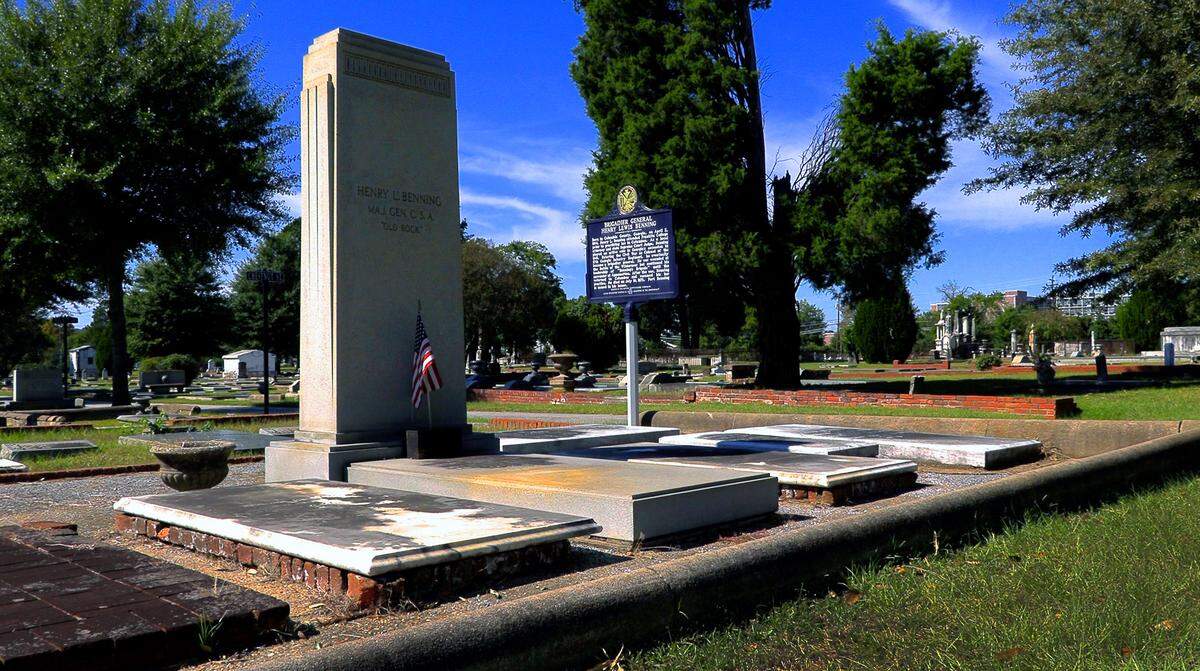
“From each pole a 6-by-10 battle Confederate battle flag will be flown 24 hours a day, seven days a week, with other flags of the Confederacy possibly being flown on Confederate holidays,” read a letter accompanying the 1994 council resolution.
That changed in 2017, when tensions over displaying the battle flag rose after a violent “Unite the Right” demonstration in Charlottesville, Va.
After that August event, someone removed the Confederate flags at Linwood. City officials said they did not order the flags’ removal, and no one with the city could have lowered the banners because each metal pole had an internal halyard secured by a lock to which only the SCV had keys.
Then-Mayor Teresa Tomlinson said she later issued a policy prohibiting the battle flag’s display on any city property.
She allowed the SCV to fly only two flags at Linwood: the current Georgia flag that’s patterned after the Confederacy’s first national flag, commonly called the “Stars and Bars,” and an early Georgia flag bearing the state coat of arms on a blue field.
The coat of arms, an arch over three pillars entwined with the motto “Truth, Justice, Moderation,” is in gold in the blue corner of the current state flag.

Pledging to resume flying the battle flag, SCV representatives met Sept 19 with Mayor Henderson, who told them the city would allow the two flags Tomlinson permitted plus the Confederacy’s first national flag, but it would rescind the 1994 resolution and remove the poles if the group flew the battle flag.
The SCV sent the city an Oct. 11 letter vowing it would fly the battle flag at Linwood the weekend of Oct. 18, and it did. Council then unanimously rescinded the resolution at its next meeting and had crews pull the poles up and haul them to storage.
“The current Columbus Council deems the flying of the Confederate battle flag offensive to a large segment of our community, and as a result it will no longer be flown in Linwood,” Henderson said at the council meeting.
One point of particular contention is whether the poles were on city property or privately owned cemetery plots. The SCV argues the plots were private; the city says the poles were on its property.
“Columbus has the right to control that property,” said Jim Clark of the Columbus firm Page, Scrantom, Sprouse, Tucker & Ford. He is among the attorneys defending the city.
“We think the case is completely without merit,” Clark said Friday.
Referring to the Columbus Consolidated Government as CCG, he added: “CCG is totally within its rights to do what it did, and we’ll be defending it vigorously.”
The city is arguing the flags were privately owned displays, not public monuments belonging to the government, so the state monuments act does not apply. As evidence, the city cites the 1994 agreement, which specified the SCV would provide, install and maintain the poles and flags and bear all the expenses.
Clark said the city has 60 days to respond to the lawsuit.
King, the SCV’s attorney, could not be reached by phone Friday afternoon.