Columbus students try to help NASA by building and launching their own satellite
A group of Muscogee County School District students is trying to help NASA improve its space missions and in return, these teens gain valuable knowledge and experience, often resulting in college scholarships and high-tech careers.
Last fall, Columbus High School physics and computer science teacher Luther Richardson and eight students in the Columbus Space Program (seven from CHS and one from Northside) partnered with Opelika High School to apply for a $5,000 grant from the U.S. Department of Education to help NASA figure out a better way to measure magnetic fields.
Their project is among the five out of 95 applicants awarded the grant, Richardson told the Ledger-Enquirer.
Columbus senior Tilahta Agbere, 17, said he was “absolutely blown away” when they won.
NASA measures magnetic fields in space to help detect solar storms, Richardson said.
“When a flare or other massive release of particles occurs, it can take days to reach the Earth or Mars,” he said. “The particles are preceded by a disruption in the magnetic field, which takes 8 1/3 minutes to reach Earth and about 12½ minutes to reach Mars. So this could give astronauts an early warning system with time to take shelter.”
The NASA Mars Global Surveyor, launched in 1996, used a magnetometer to map the magnetic field of the planet’s crust, which could help determine where to find fossilized microbial life, Richardson said.
The preparation
This project called for the students to build their magnetometer is a nontraditional way. The instrument usually is made out of Permalloy, composed of about 80% nickel and 20% iron. But that material is hard to find, so the Columbus team used metallic glass, which is cheaper.
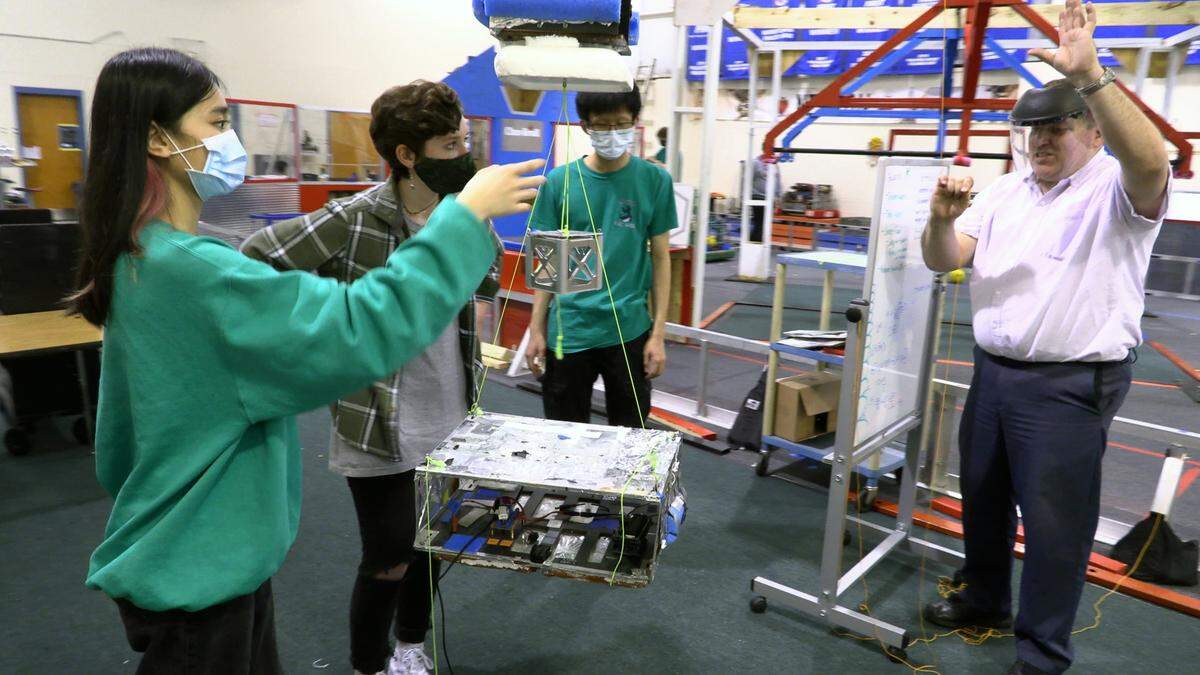
Before they get the thrill of the launches and landings, these teens must slog through hours of making the project’s custom parts and testing them at the school district’s Butler STEAM Center, where the former Muscogee Elementary School has activities for science, technology, engineering, arts and math.
“They’re making something that works and works the same way every time,” Richardson said. “It’s tedious, monotonous.”
But it’s a pleasure for students who enjoy hands-on learning such as Tilahta, who plans to major in aerospace engineering at Georgia Tech.
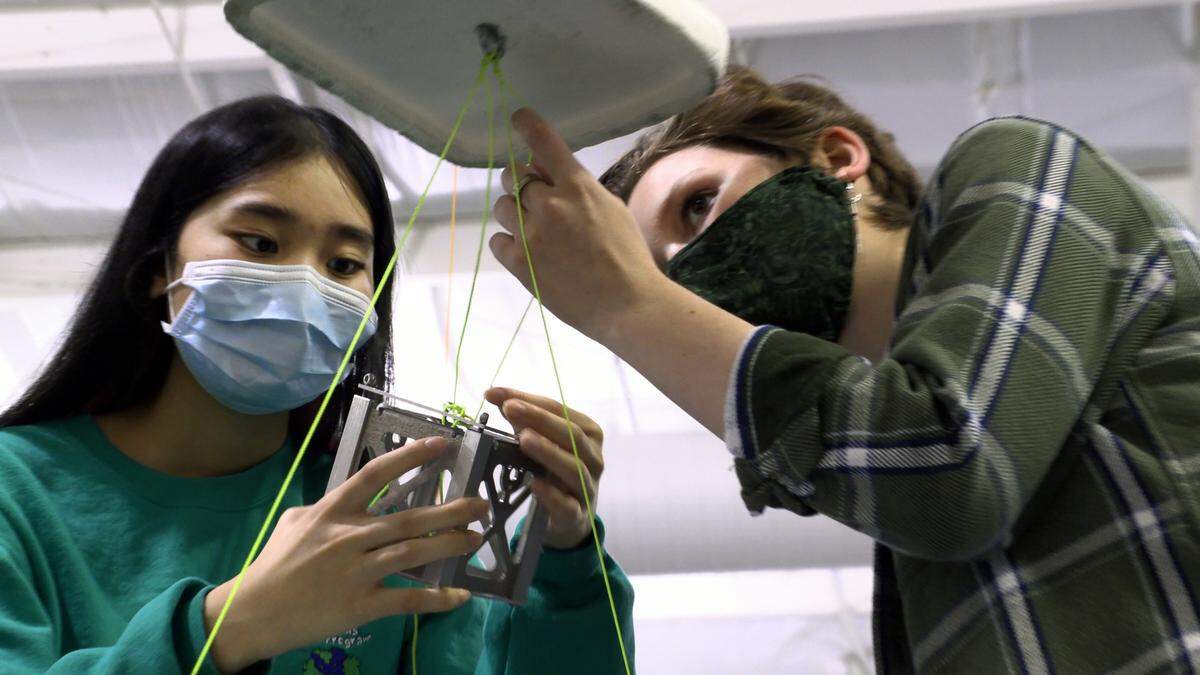
“Being able to follow it through to the very end and being able to see all that work actually go into practice with actually usable data to perfect the next version is crazy,” he said. “It’s absolutely ridiculous and amazing.”
Amazing is a word Tilahta used to describe Richardson as well.
Tilahta especially appreciates Richardson trusting the students to do most of the work themselves and encouraging them to push their knowledge beyond their comfort zones so they aren’t ashamed when their projects fall short of their goals.
To increase their chances of a safe landing, every day a week before they launch, they ran software that will predict where the balloon would land based on the weather.
“We’re pretty good,” Richardson said. “We can make something land within a 2- or 3-mile circle.”
The launch
In April, at a church parking lot in Little Texas, Alabama, the team launched a high-altitude balloon containing their experiment in a standard CubeSat, a 10-centimeter (3.9 inches) cube satellite made out of aluminum and weighing 2 pounds.
The balloon, made out of latex and powered by hydrogen, expands to more than 40 feet wide and about 50 feet tall at altitude. It was supposed to reach 110,000 feet before it burst 90 minutes after launch, but that happened at 97,700 feet (18.5 miles).
Outer space, the edge of the Earth’s atmosphere, has been considered beginning at 328,084 feet (62 miles), although a study three years ago lowered that estimate by 12 miles.
The twisting of the burst balloon was so extreme amid winds over 100 mph, Richardson said, the CubeSat fell out of the box, which contains the payload, despite being connected by four strings.
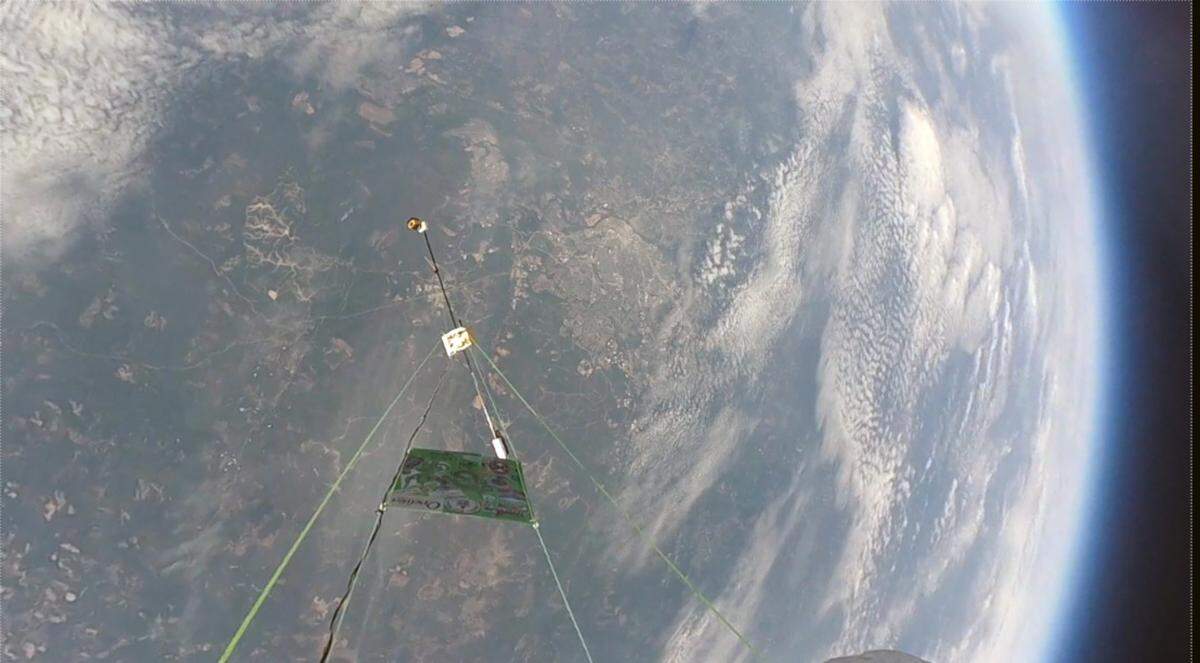
The 10-pound box, descending 20 mph with a parachute, landed on tree-farming land near Ideal, Georgia, about 100 miles away and 2 hours after the launch. The CubeSat, descending 33 mph without a parachute, landed on state-controlled hunting land west of Buena Vista, about 70 miles away from the launch.
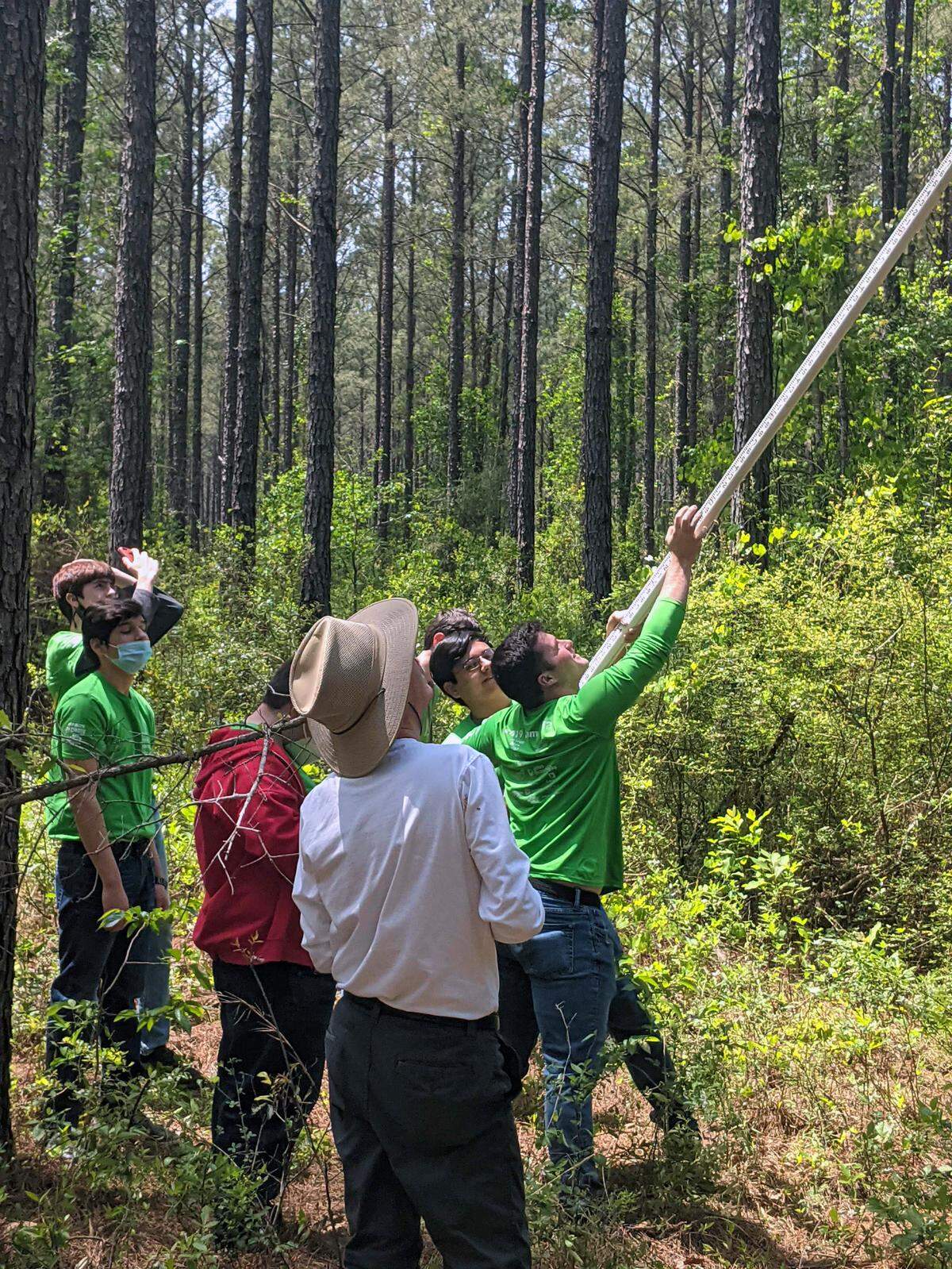
They retrieved the box but not the CubeSat — yet.
“We have high-resolution drone footage of the area and are still watching each video, hoping to see it,” Richardson said. “If not, it may be during fall hunting season that we may get a call.”
Fortunately, they designed the mission to collect the data three ways — 20 times per second — and two of those ways were retrieved.
“They’ll basically be able to tell a story with the numbers,” Richardson said.
The reaction
After the mission, Columbus senior Michelle Pham, 17, said, “I was absolutely ecstatic. … Knowing that the launch was successful was amazing.”
The data they did recover showed that they indeed measured the magnitude and strength of a magnetic field.
Despite the disappointment of their satellite separating from the balloon, Tilahta said, “I still think it was an amazing experience.”
The project could help the Columbus Space Program be accepted into the CubeSat Launch Initiative. In the initiative’s 11-year history NASA has selected 192 CubeSat projects, and 104 of them have advanced to be flown on a NASA mission, according to the space news company SpaceRef.
Richardson said this project achieved 70% of its goals, carrying the most complicated payload out of the 20-year-old program’s 32 missions called DREAMS (Doing Research at Extreme Altitudes by Motivated Students).
The magnetometer they made wasn’t ready by the launch, so they had to use a commercial unit instead. They plan to launch a follow-up mission in the fall. That will include a payload designed to capture microorganisms from the stratosphere to help NASA understand how microscopic life uses the stratosphere, Richardson said.
The impact
Richardson attended high school in Fort Rucker, Alabama, during the 1980s. He never imagined high school students could do such advanced science at this age. So he’s living vicariously through them.
“The mentors who come here, it’s the same thing,” he said. “These are the things we wish we could have done.”
In the program’s 20-year history, more than two dozen members have been accepted into Georgia Tech and 19 into the Massachusetts Institute of Technology, Richardson said. Program members also have landed jobs or internships at Apple, Google, NASA, Oneda, Pratt & Whitney and SpaceX, he said.
“The gamut is wide,” he said. “… The problem-solving they do here is what companies are dying for to get from employees.”
Michelle, who plans to major in electrical engineering at the University of Georgia, is thankful this program has expanded her horizon.
“This is something that even advanced college students aren’t doing,” she said. “It’s like one of the best opportunities ever presented to me.”
Michelle also learned how to better communicate with teammates as they worked on the project more than 10 hours per week from the fall and into the spring.
“We had to ask a lot of questions, and so that made me have to reach out to people, even though I didn’t want to,” she said. “It kind of scares me.”
Tilahta praised his teammates.
“They’re absolutely fabulous,” he said. “I’ve never had the experience working with such talented and intelligent individuals in my entire life.”
LEARN MORE
The Columbus Space Program is open to all Muscogee County high school students. To join, or for more information, visit the website ColumbusSpaceProgram.weebly.com.
This story was originally published May 26, 2021 at 6:00 AM.