Columbus State University president Chris Markwood retiring after seven years in charge
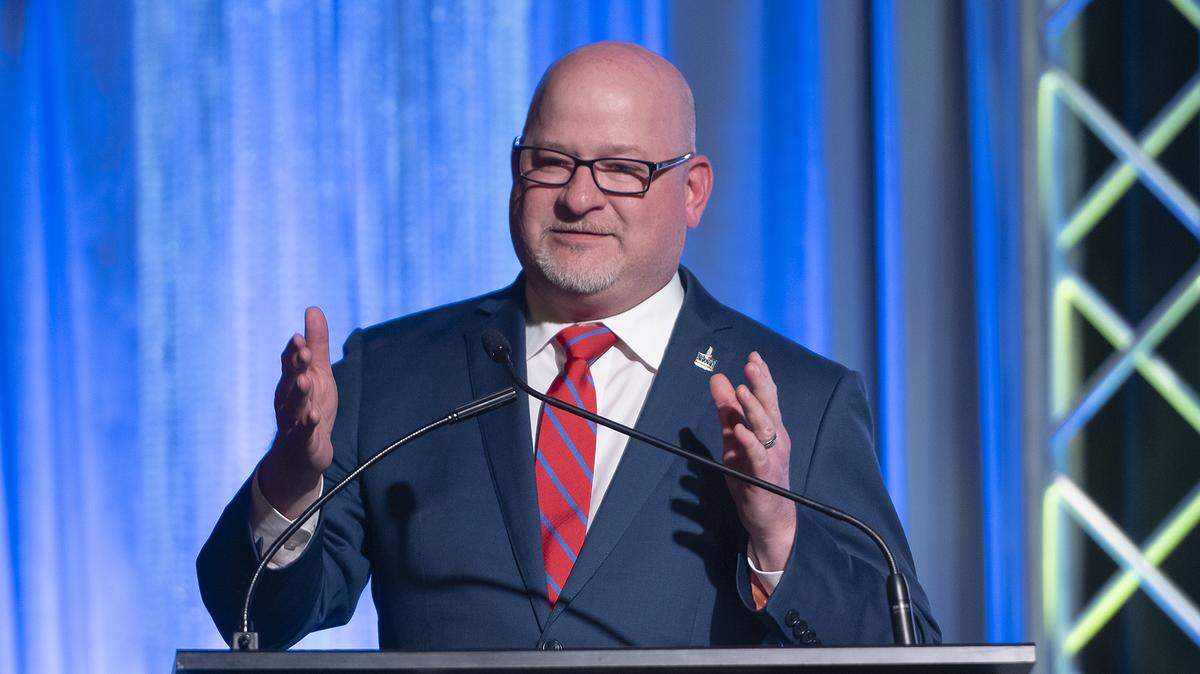
Columbus State University president Chris Markwood is retiring.
CSU announced the news Thursday. His final day as president will be June 30. John Fuchko III, the University System of Georgia’s vice chancellor for organizational effectiveness, will serve as interim president of Columbus State until a new president is hired.
“President Markwood has made a point throughout his career to focus on students and make sure they had the support they needed on campus and in the classroom to succeed,” USG acting chancellor Teresa MacCartney said in the news release. “We appreciate his service to USG and wish him and his family well.”
The USG Board of Regents approved the hiring of Markwood in April 2015. He started leading CSU that June, replacing the retired Tim Mescon to become the fifth president in the institution’s history, now 64 years.
Markwood, 56, previously was provost and vice president for academic affairs at Texas A&M University-Corpus Christi since 2011. He was at the University of Wisconsin-Superior for five years, serving as interim chancellor and vice president for academic affairs and dean of faculties. He also has served and taught at the University of Central Oklahoma and Lamar University in Texas. He has a doctorate in political science from the University of Missouri-Columbia.
In a letter emailed to the Columbus State community, Markwood explained his decision to retire “has come with a great deal of conversations with my family, guidance from close friends and mentors, and personal prayer.
“I could not have asked for a better place than Columbus State University and a better opportunity than serving as its fifth president for the past seven years. While I am grateful for every place and situation my 30-plus-year career has found me, I consider my time at Columbus State truly a privilege.”
After his retirement announcement, Markwood talked with the Ledger-Enquirer about his time at CSU. The following transcript is edited for brevity and clarity:
Why are you retiring now?
“Well, it’s time. Been here seven years. Out of 30 years so far in higher ed, about a quarter of my time has been here. … We’ve been doing a little bit of reflection on what we have accomplished since the campaign that was started before I got here (launched in 2012 and ended in 2019 after raising $120 million). We put together quite a list of sort of transformational accomplishments that have taken place, even in the midst of the pandemic, which was hard on everyone and tiring for so many people and deadly for even some in the CSU family. But that was an exercise to really set us up for what’s next, and that process really got me thinking: Am I up for what’s next? Or am I up for something different?
“We began talking about it as a family, and my wife’s business, Leader N U, really took off during the pandemic. She (Bridget Markwood) has figured out how to really educate, infuse and empower people with power skills, otherwise known as soft skills or special skills, through online formats. … The opportunity to work with her, (in the) higher ed division of that particular effort, was exciting. … I have an early retirement option out of another system where I have worked, and it just kind of all fell together.”
Anything else you plan to do in retirement?
“Not immediately, except for a break.”
Do you and your family plan to remain in Columbus?
“We have no immediate plans to leave.”
What have your years at CSU meant to you?
“This has been a really special relationship, I think. Columbus State and Columbus are extremely unique in this particular partnership that they have. It’s really been transformational. And you don’t see that at other institutions and in other cities. So when I think of what we’ve accomplished or what this time means to me, I think several things come to mind:
“One, an even tighter alignment of academic programming to workforce needs in the community and the region. … I think a second answer to that question is the whole issue of servant leadership. This city really takes that to heart, and so does Columbus State University, and I’ve enjoyed being a champion for servant leadership and for investing in people. We provide leadership training now for everyone on campus if they want it — and sometimes if they don’t. (Laughs.) We approach our budget reductions with people in mind, not looking to get rid of people. We’ve actually had to eliminate over 100 positions at CSU (out of nearly 1,000), and we did it without firing anybody. I’m proud of that.
“… Then I think a third is just the building a community on campus, bridging gaps between faculty and staff, encouraging faculty and staff to embrace students. I think those three things really are what I’ll take with me.
“I will say this, though: We’ve got four months left, and we’re not done. … One of the things we’ve got to get ready for is the next campaign. We’ve got to get ready for the next strategic plan. We’ve got some task forces out that are delivering their reports, not the least of which is an innovation task force. What did we learn during the pandemic, and how can we apply it in the future? And I’m looking forward to graduation. We’ll have five ceremonies, probably close to 1,000 students. It will be an exciting celebration of why we are here.”
You mentioned that, while you mulled retirement, you asked yourself, “Am I up for what’s next?” So what is next for the next CSU president?
“Putting together the next five- or 10-year strategic plan and implementing that, putting together the next campaign and implementing that. One of the things I think a leader should do is not develop a plan and hand that off to somebody else. If you’re going to develop a strategic plan, you need to own it and commit to finishing it.”
So was this decision to retire yours alone? Did anyone locally or on the state level have something to do with it?
“It was my wife’s and my decision to retire, probably egged on by a pamphlet from that other retirement system saying, ‘Have you checked your benefits lately?’”
What do you regret most about your tenure here?
“You always wish you could have engaged more. You could have done more. You could have given more. I think that’s normal, and I think that’s healthy. I’m going to leave very happy with the accomplishments that the people here at CSU and the people in this community have done together, and I look forward to seeing what happens next. … This city is committed to this institution in ways that so many cities are not. I just came from the (CSU) Foundation board meeting this morning, and to have that group of people give their time, talent and treasure for CSU, to hear them just want to be involved in what we’re doing and not just hear financial reports and investment reports of the endowment, that’s special.”
What are you most proud of about your tenure here?
“I think it’s going to have to be the way this campus and the community have embraced partnering with each other. And it’s not something new that I brought to the table. That’s how this campus started. But I think we were able to propel that to its next step. Examples include completing the campaign, include film, cyber, robotics, first in the state education contract guarantee. Those are micro accomplishments. But the macro accomplishment behind all that is the partnering in how we get things done. And that’s unique.”
What advice would you give to the next president of CSU?
“Take the time to listen and to understand how special and unique this place is compared to other institutions and to embrace that uniqueness.”
What else should the L-E’s readers know about this news?
“I still remember on my first day (as CSU president), I got to have lunch with (the late W.C. Bradley Company chairman and CEO) Bill Turner. … I asked him the question, ‘Mr. Turner, you’ve known all the presidents here at CSU. What advice would you give me?’ And he looked at me and said, ‘You need to dream big. … So dream big, make your case, and this community will line up behind you.’ And you know what? That has been my experience. Who would have thought that CSU would have had a robotics engineering program? Who would have thought we’d be making a play to become the third film hub in the state of Georgia? Who would have thought we could have such a strong relationship (with the Muscogee County School District) that guarantees employment for our teacher certification students? All of those are dreams, but they came true because we dreamt big, made the case, and the community lined up.”
This story was originally published February 24, 2022 at 11:31 AM.