Columbus mom who sued school district now praises it for helping autistic son graduate
When he graduates Friday with the Jordan Vocational High School Class of 2022 in the Columbus Civic Center, the ceremony not only will celebrate George Jenkins’ perseverance over his prognosis. It also will symbolize the transformation of education for students with autism spectrum disorder in the Muscogee County School District.
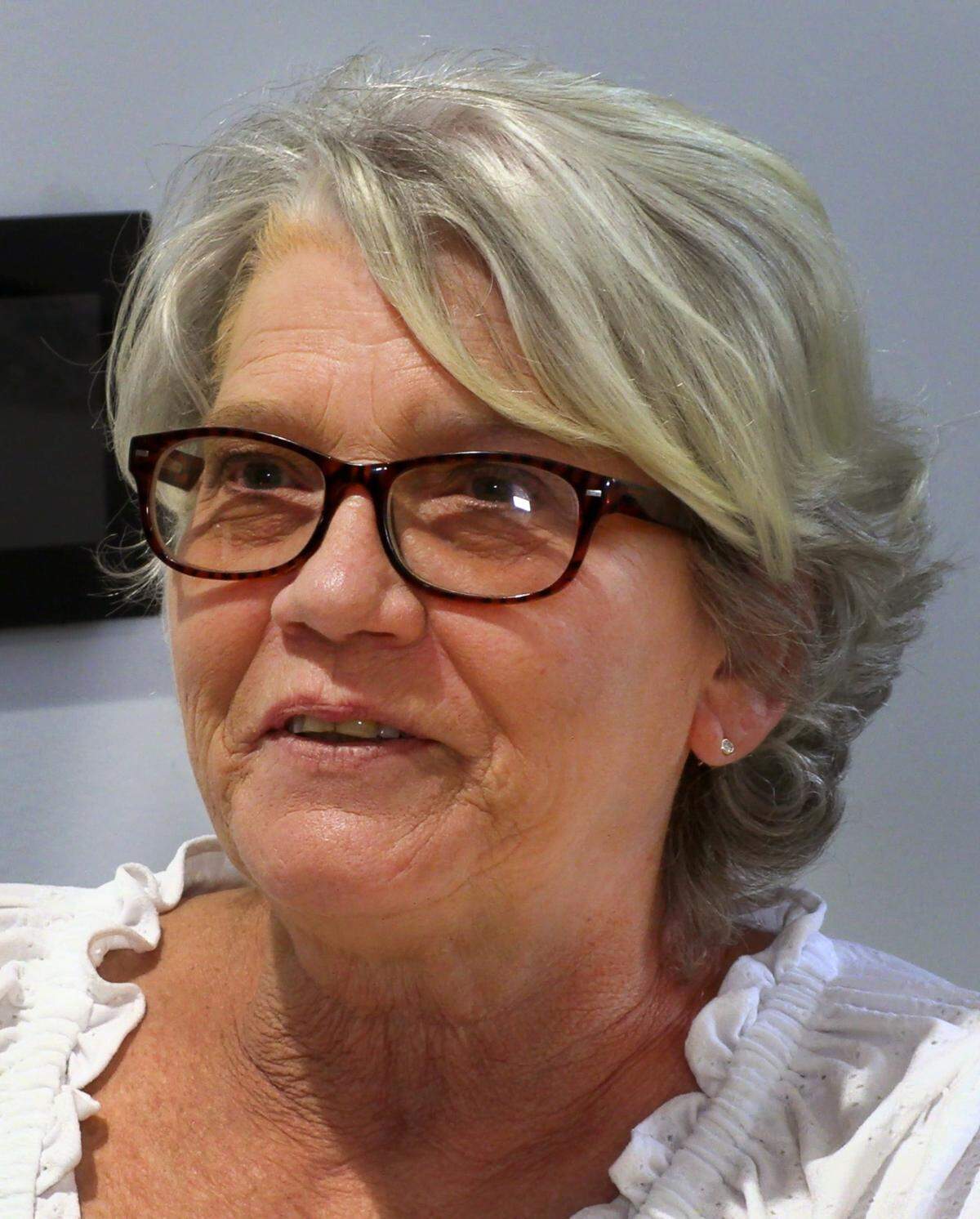
Lisa Jenkins, the mother who found George strapped to a chair at school 15 years ago and sued MCSD to improve the instruction and environment, now praises district officials for making the changes she sought for George and other students with autism.
“I’m extremely proud of my son, this team, the school district,” Jenkins told the Ledger-Enquirer.
Grim prognosis
Jenkins described George’s journey in MCSD as “hell and heaven.”
George, 20, was 18 months old when he was diagnosed with autism in 2004 at the Emory Autism Center in Atlanta after his parents asked a neurologist about his habit of repeatedly banging his head and biting himself.
Jenkins heard a doctor say George probably wouldn’t be able to live in their home by the time he was 10 if they didn’t get him proper treatment.
“Every minute counted,” she said, “and I couldn’t let up.”
George started prekindergarten the next year at Johnson Elementary School. The Jenkins family went to the Marcus Autism Center in Atlanta for training, and Marcus experts came to Johnson to train staff how to properly teach George. A manual was written for reference.
“They did an exceptional job,” Jenkins said.
But when George was assigned to Hannan Magnet Academy for kindergarten, the manual didn’t accompany him, and the staff wasn’t trained to properly teach him.
“It all just kind of fell apart,” Jenkins said. “… The teachers didn’t have the tools that they did at Johnson, which is unfair to the teachers and unfair to George because he couldn’t express himself and they didn’t know what he needed.”
Without the ability to speak or write, George’s head banging and biting increased.
“That was his frustration,” Jenkins said.
And it was her fear. Jenkins was “terrified every day” George went to school, thinking the teachers and facility weren’t equipped to handle his disability. MCSD teachers and administrators were scared of Jenkins, she said, because she would visit unannounced to see how George was being treated.
“I was direct,” she said. “… No filter. I call it like I see it. But I do it respectfully.”
Now, she said, MCSD officials “know I’m not here to destroy; I’m here to build.”
Thanks to Columbus voters renewing the 1% Education Special Purpose Local Option Sales Tax in 2015, MCSD received money to build classroom wings for students with autism at four schools.
Now, when Jenkins takes George to the school bus, the driver and monitor are trained to handle his disability. When he arrives at school, the staff and facility are equipped to educate him in the way he needs.
“I don’t have a problem leaving him here,” Jenkins said. “If I have any concerns, all I do is pick up the phone, and I can talk to the staff here or the principal. I don’t have to go to the leadership on Macon Road.”
And now, Jenkins said, “George is amazing. He has speech. … His IQ has gone up 20 points. It’s still below 70, but he can do the calculator, he can write, he can read some. He can advocate for himself. … He has compassion for other children and other people.”

From litigation to cooperation
The litigation lasted five years as it wound through three courts. Jenkins said she tried to work out the problem with MCSD but officials were more interested in protecting the district.
“We just couldn’t get George all he needed,” she said, “and MCSD was fighting us all the way.”
The school district got help from the Marcus Autism Center, but Jenkins insisted MCSD needed separate classrooms for students with autism.
Jenkins dropped the lawsuit in 2013 after meeting with MCSD’s new superintendent at the time, David Lewis, and sensing she could trust his commitment to improve the situation. The Lewis administration has a “totally opposite” mindset, Jenkins said, and cooperates with her and other parents of special education students.
Lewis explained why improving the education of these students was among his priorities.
“The bottom line is, our mission statement speaks to the whole fact that we are here to educate all students to their potential,” he told the L-E. “Even before our mission statement was developed, that’s something I was committed to. … We were learning more about autism at the time, and it just felt like it was the right, moral and ethical thing to do.”
Here’s how the district did it:
MCSD’s investment
Since 2010, MCSD has spent $3,685,195 to improve services for students with autism in the following ways, according to information provided by interim communications director Kimberly Wright:
- Renovated classroom wings at Jordan Vocational High School, Double Churches Middle School, Hannan Magnet Academy and Johnson Elementary School, funded by the ESPLOST.
- Funded a position at each site for a board certified behavior analyst to conduct assessments, programming, intervention support and staff training in applied behavior analysis.
- Expanded the number of classes for students with autism from two to 23.
- Trained and aligned support staff so an occupational therapist, physical therapist, speech-language pathologist and psychologist serve students at each site.
The 23 classes average seven students per classroom, each staffed by a teacher and two paraprofessionals, Jocelyn Powers-Corcoran, the manager and lead BCBA for the school district’s autism program, told the Ledger-Enquirer.

Jenkins couldn’t file a class-action lawsuit, she said, because the Individualized Education Program is different for each child with autism. But the result of the lawsuit was for every child, she said.
“It wasn’t just about him getting the services,” she said. “It was about the whole district getting the services.”
Add it all up, and MCSD serves more students with autism in more classrooms dedicated to their needs than any other school district in the state, Wright said.
Jenkins estimates more than 400 students have been served in the improved MCSD autism program during the past 10 years.
“That’s huge,” she said. “… We’ve come a long way.”
“Needed something different”
MCSD had been teaching students with various intellectual and behavioral disabilities, including those with autism spectrum disorder, in the same classrooms. About 15 years ago, Powers-Corcoran started working at Hannan in one of two special education classrooms limited to seven or eight students with autism, taught by a teacher and two paraprofessionals.
“We were moving toward knowing these groups of kids needed something different than what was currently being provided,” she said. “… The district was realizing that some of those placements weren’t necessarily meeting their needs as singular programs.”
Similar classes were added at Rigdon Road Elementary and Double Churches Middle School. This was the beginning of MCSD’s Autism Supports Program and collaboration with Marcus Autism Center School Consultation Program.
Although autism is an eligibility area that qualifies a student for special education in Georgia, special education teachers aren’t required to be certified specifically to teach students with autism. So MCSD officials wanted to do more than just change the environment for students with autism; they wanted teachers to receive training specific to best practices for educating students with autism, Powers-Corcoran said.
MCSD is the largest customer of the Marcus Autism Center’s School Consultation Program for applied behavioral analysis, Powers-Corcoran said. That developed MCSD’s capacity to conduct their own training of teachers and paraprofessionals educating students with autism.
“We’ve had a huge success with that,” she said. “… The dedication that this entire team has is as strong as it is because we’ve seen how far they’ve come: From not such great days on all sides, from families’ emotions and feelings being involved, to seeing kids make gains and the successes that they’ve gained.”
Before MCSD provided such training, the Jenkins family privately contracted with a BCBA to assess George’s educational services at school.
“When you have the state saying this is best practice and saying this is what they need, and you have parents saying this is what they need, and the school district gets on board, you form a partnership,” Powers-Corcoran said.
Seeing the improved autism services in the district, Powers-Corcoran lauded Jenkins for her advocacy.
“She has done an amazing job,” she said. “It’s not always easy. It’s not always popular. Parents are their child’s first advocate, even when that’s uncomfortable. … Lisa and I were able to leave that uncomfortable piece, the legal piece of it, outside of the classroom. … She’s still the biggest advocate out there, not just for George but anybody.”
Parent involvement
Autism is a lifelong disability, Powers-Corcoran said, but it doesn’t define those who are on the disorder’s spectrum if the services are aligned with their needs. She has seen George’s development “come amazingly far,” she said. “… He is miles above what many of us thought we were ever going to see.”
Parent involvement also is key, she said.
“Staying at the table, coming to the table, listening to parents that have already been there, joining those support groups, making sure that you educate yourself,” she said. “… The driving force of all this was somebody telling Lisa applied behavior analysis is what’s needed. Push for it, and she did. And that hasn’t changed. It is best practice and research.”
The key to effectively advocating for your child, Jenkins said, is communication — with grit and grace.
“Even if you don’t agree with everything going on, I still maintained the respect and dignity for my son to stay at the table,” Jenkins said. “… Let the legal process work out, but you maintain your composure and your focus, which is your child’s education.”
Through her training and experience, Jenkins learned George needs all his teachers and caregivers to guide him the same way.
“From the time he wakes up until the time he goes to bed, everybody is on the same behavioral program: school, Easter Seals and home,” she said. “Everybody uses the same words, the same treatment. Everything is consistent. … It’s a skill I had to be taught, and it’s a skill the teachers had to be taught.”
Learning in the Jordan autism wing
George is one of 25 students with autism ages 14-22 who attend school in the specialized wing at Jordan.
The students have their own schedules, based on their IEP and their progress.
“This is differentiation at its finest,” Jordan principal Ryan Hutson told the L-E.
In his classroom, George is one of five students attending in person. Another student attends via remote learning. They are taught by one teacher and two paraprofessionals.
Each student in the room has a desk and a cubicle with a list of activities in a binder that tells them their assignments and when they are supposed to do them.
In his IEP, George’s teacher or paraprofessional records data about his behavior every 15 minutes. The interval used to be every 5 minutes, Jenkins said, because his behavior was “really bad.”
His first IEP at school set a standard for George to sit in a chair for only 3 seconds. Now, it’s up to 20 minutes.
A classroom for life skills is modeled after an apartment where students develop abilities to be more independent, such as how to use a microwave, make a bed and fold laundry, as well as learn job skills.
Also in this classroom wing, George receives language therapy to improve his speech and occupational therapy to strengthen his muscle tone. He used to receive physical therapy to help him walk up and down stairs.
Each classroom has an adjacent observation room where parents can see and hear their child being taught without the student aware of their presence.
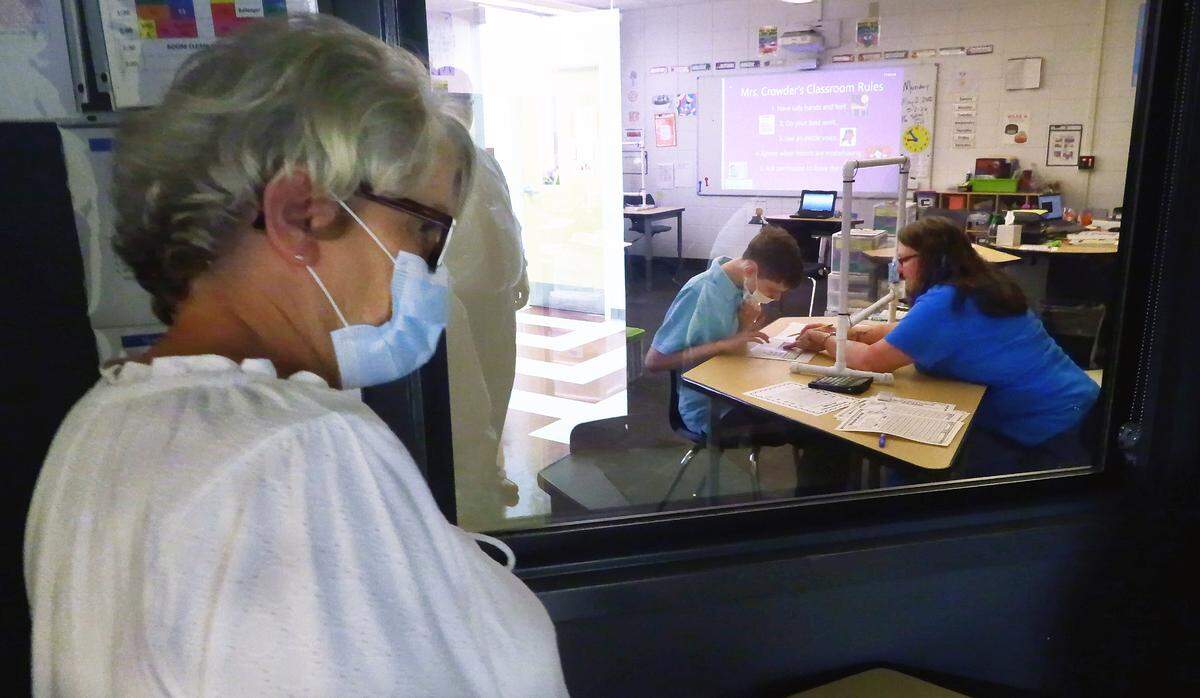
The only time George leaves the wing during school is to get lunch and attend art and gym classes with the general education students. A parapro accompanies him.
His reading and math skills are at kindergarten or first grade levels, but he can use a calculator and a computer. He is learning to write his name in cursive. His head-banging and biting have decreased to “very little,” Jenkins said, “as he has learned self-deescalating practices.”
And he paints. At last month’s MCSD board meeting, George presented one of his pieces to Lewis as a token of the Jenkins family’s gratitude.
Jenkins said she believes MCSD is the only school district in the state with this model to educate students with autism.
“I got a call this weekend from somebody in Florida wanting to know how we did this,” she said.
Jenkins told the caller it will take buy-in from the school board, district administration, teachers and community.
Looking forward to graduation
Powers-Corcoran plans to bring tissues to George’s graduation ceremony. She will escort him on the stage as his former teacher along with his current teacher, Christina Crowder.
Thinking ahead to that moment, Powers-Corcoran thanked Jenkins for her perseverance.
“I’m proud of Lisa for staying in it,” she said. “I’m proud of her for bringing in all the wraparound services and community services that she’s brought in and brought to the table.”
Although he is graduating, federal law allows students with disabilities to receive free public education until age 22. George will continue attending the Jordan autism wing for two more years, Jenkins said. His diploma from this modified curriculum qualifies him to attend college, but Jenkins said she hasn’t thought that far ahead.
The plan for his summer break, Jenkins said, is for George to volunteer as a greeter at a Chick-fil-A restaurant and play cards with residents at a nursing home.
“Continuing to learn social skills will enable him to be able to adapt to other situations life gives us,” Jenkins said. “. . . I’m hoping to get an artist interested in working with him.”
Her next mission, Jenkins said, is to help build a gated independent living community with and without supports for people on the autism spectrum disorder.
“I’m turning all my prayers over to God, and He’s laying the plan out now in front of me,” she said, “and it too will come to fruition.”
Noting how the treatment George receives from MCSD helped him progress beyond his original prognosis, Jenkins said, “He may have autism, but autism does not have him.”
A prime example: George attended the Jordan prom with Abby Tillery of Columbus High School as his date. Abby’s mother is MCSD board District 2 representative Nickie Tillery. Among the photos and videos Jenkins posted about the occasion on her Facebook page, she wrote, “George I am so proud of you! You have done an amazing job working to get the skills to live life to the fullest! You have succeeded. Soar with God on your next journey of life.”

After expressing gratitude for the teachers and administrators who helped her son reach this milestone, Jenkins mentioned one other person.
“I want to thank George for being who George is,” she said. “He did it. All they did was give him the tools.”