
Fort Benning has 100-year history with pandemics. Here’s how it’s battling COVID-19.
Fort Benning was in its infancy in 1918, established that October as the 1918 flu sickened an estimated 20 to 40% of the U.S. military during World War I.
The Army has not faced any comparable epidemic since.
This year, as Benning turns 102 years old, the post that supplies 35% of the U.S. Army’s fresh troops is battling a new pandemic that again threatens recruits kept in close quarters during basic training.
Were a contagion today to ravage the Army like the one in 1918, it could cripple military readiness. But now is not then, and that has not happened.
Visiting the post Wednesday, Secretary of the Army Ryan McCarthy said the military has weighed today’s COVID-19 virus against the 1918 flu.
“We’ve tried to look at several comparisons: The sheer scale of the pandemic in 1918, there were 150 million people that were affected by that, so from volume it was dramatically higher,” he said. “They went through two full years with that pandemic. So there are a lot of things to be learned, but it is not an apples-to-apples comparison.”
Health care and medical research have advanced, he noted, but so has globalization, with air travel able to spread disease around the world in days.
McCarthy said the Army now has 191,000 people deployed overseas and about 50,000 National Guard, reserves and active duty soldiers working here at home, to build hospitals and supply other needs.
The Army’s infection rate overall remains low, despite the number of people associated with the service, he said.
“If you look at the overall performance of the U.S. Army … active, guard, reserve, civilians, contractors, dependents, it’s a population of millions of people, and the cumulative infected rate of people is slightly over 2,700 worldwide.”
The number of people testing positive for the virus, in association with Fort Benning, no longer is reported locally to the public. The post’s public affairs office stopped giving notice of new cases when the Pentagon ended the practice March 30. Fort Benning had reported seven cases at the time.
Inspection
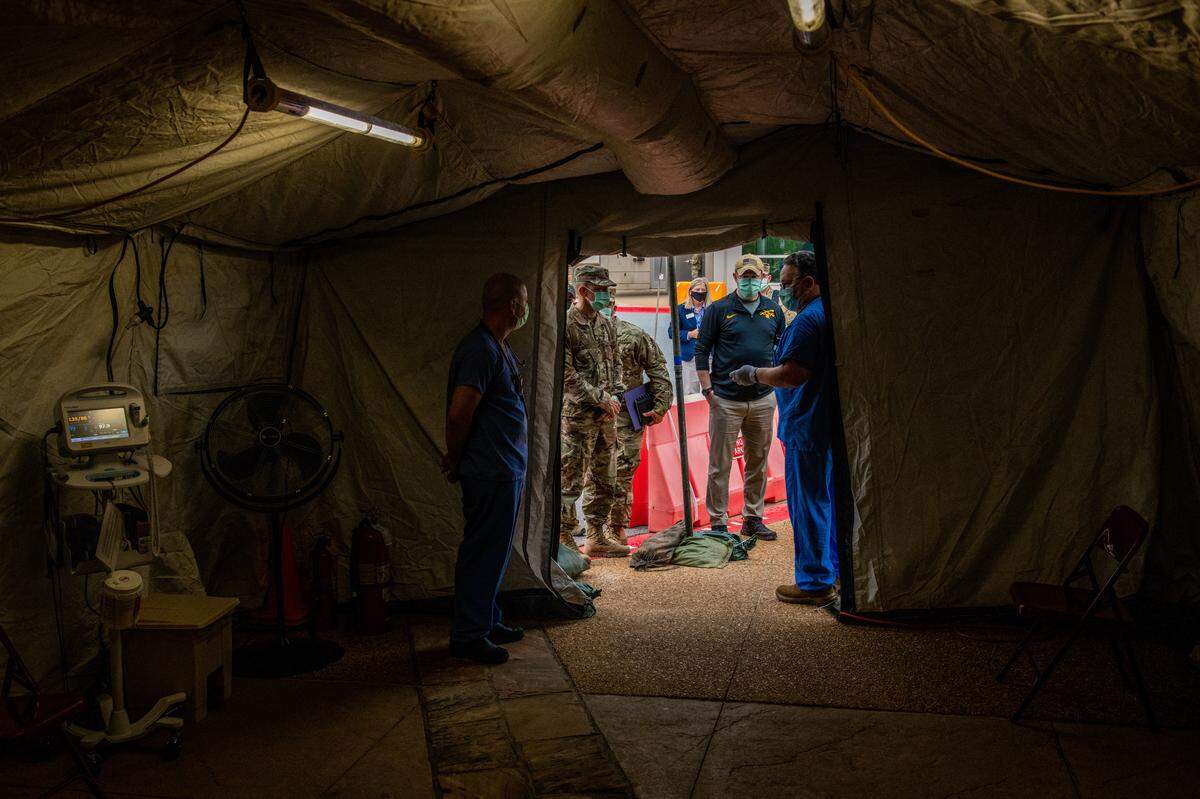
McCarthy was accompanied on his tour by Sgt. Maj. of the Army Michael Grinston and U.S. Senators David Perdue and Kelly Loeffler, who face opposition this election year. Their praise for what they saw was effusive.
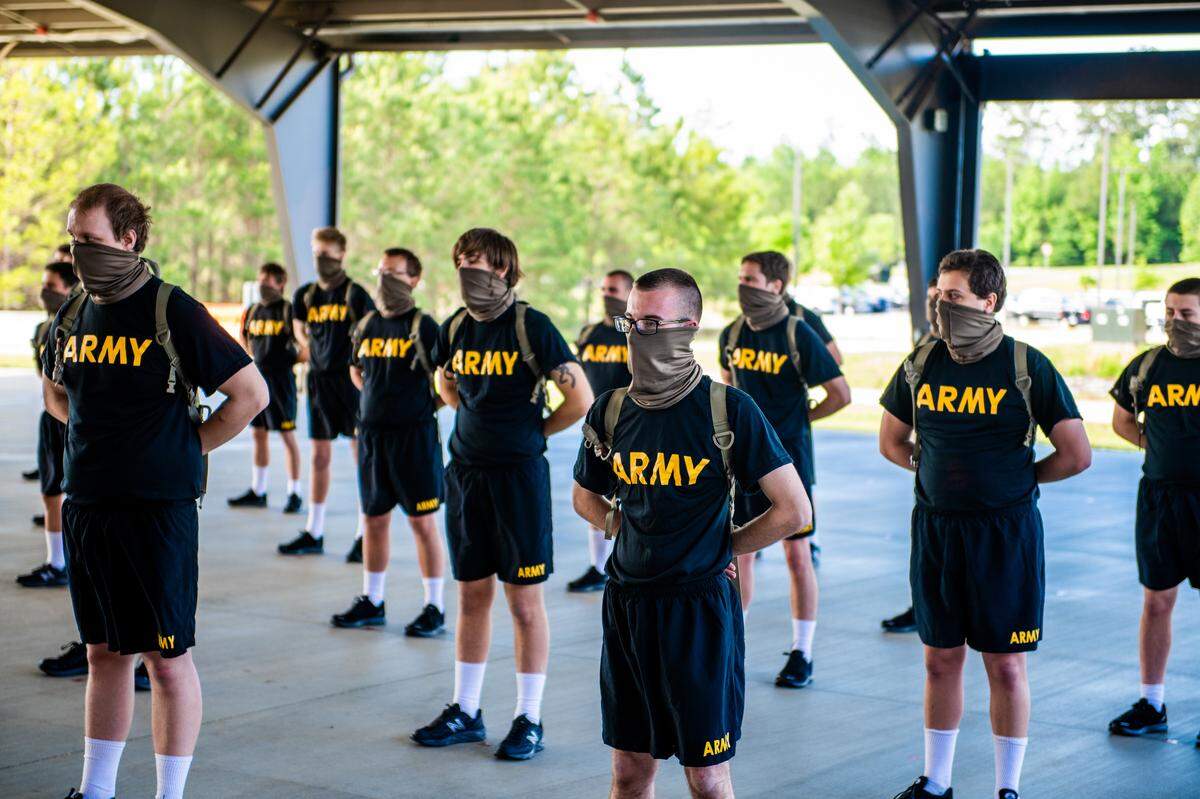
“I actually said this earlier: This is probably one of the safest places on the planet for COVID,” said Grinston, noting precautions such as mandatory cleaning and social distancing have become part of the regular discipline. “We’re rule followers…. We’ve got a whole bunch of people who can help you stand six feet apart.”
Perdue said Benning has carried on with little disruption. “What we saw here was their operational mission didn’t change,” he said.
The post established protocols of regular temperature screenings and testing for those with symptoms, with early use of face masks, some made by Army spouses.
Referring to personal protective gear, Perdue said, “They could not operate today though without PPE and testing capability, and that’s one of the things we’re lacking in the civilian world.”
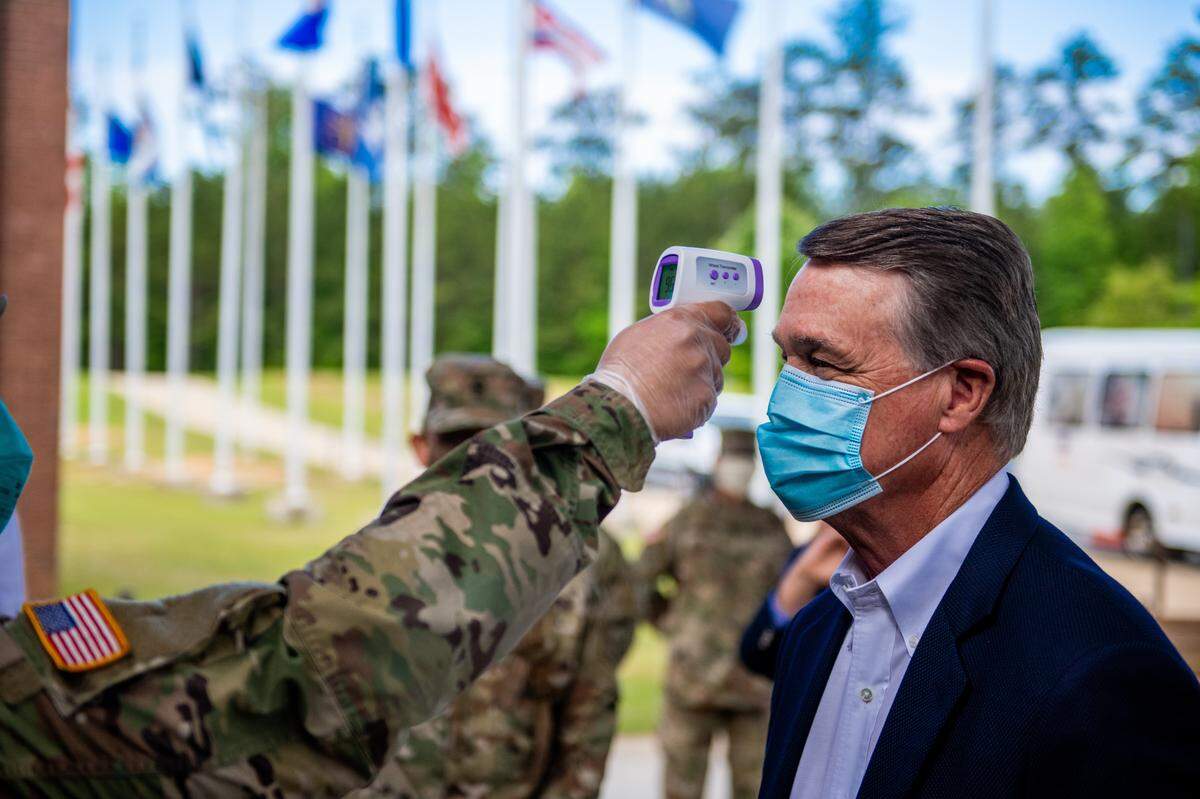
Said Loeffler, “We were able to see a couple of basic training classes, as well as a live-fire drill where social distancing and masks were in place. I really commend the work they’ve done at keeping everyone safe while protecting our country.”
Benning commander Maj. Gen. Gary Brito issued orders March 25 to restrict all but necessary travel off post, to maintain social distancing, to prohibit large gatherings and parties, and to require anyone with symptoms to be quarantined.
With those measures in place, Benning continued training, even when the Army suspended accepting new recruits April 6-20.
Among Benning’s adjustments were:
- Keeping recruits segregated from others for two weeks and shifting social-distanced classroom instruction to that early phase of training, before they are detailed to unit assignments.
- Maintaining that “bubble” of protection around the recruits until all are cleared to join units and complete the final weeks of basic training, before moving on to more specialized instruction such as Ranger training or Airborne school.
Impact
A century after the 1918 pandemic killed about 50 million people worldwide and 675,000 in the United States, Fort Benning is not the primitive Army camp first hammered together on the site of a former estate south of Columbus.
But Columbus today is experiencing some of the same effects as in 1918, when schools, parks and restaurants closed. Residents kept to their homes, frightened by what few understood at the time.
Just as Columbus has grown, so has Benning.
This fiscal year, the post expects to train more than 58,000 soldiers.
The expected output includes:
- 24,753 in basic training.
- 4,031 in Ranger School.
- 14,436 in Airborne school.
- 8,280 in officer or noncommissioned officer courses.
- 6,559 in Infantry or Armor functional courses such as sniper, mortar, or Bradley Fighting Vehicle instruction.
The post also has about 10,000 civilian workers and around 33,000 military dependents, with an economic impact estimated at $4.75 billion.
But this year it won’t be drawing the visitors it usually does: All those spring Army graduations that drew soldiers’ families to town were canceled, because of the epidemic, as were annual contests such as the Best Ranger Competition.
The other side
On Wednesday, McCarthy talked about reaching “the other side” of the COVID-19 epidemic, as the economy comes back to life and researchers develop a vaccine.
“Now we’ve got to find a vaccine to get to the other side of this,” he said, adding Army researchers at the Fort Detrick medical lab in Frederick, Maryland, are working on that.
“If there are 26 candidates worldwide, there are six that are really in the hunt,” he said. “There are about two or three that have entered clinical trials. The U.S. Army’s version we believe will hit clinical trials no later than the fall.... Now the clinical trials, that’s in humans. We’re testing in primates today.”
The Army will join with private laboratories in developing a vaccine, should they come up with a stronger contender, he added: “So if they have a horse that’s running faster, we’ll double-down on that one. We’ll help them within our lab architecture, and get it done faster.”
Two scientists on the Army’s medical research command staff were instrumental in developing vaccines for Ebola and Zika, he said: “They are working on the president’s task force, and we know that they’re going to crack the code and get us to the other side of this.”
Staff writer Nick Wooten contributed to this report.
This story was originally published April 30, 2020 at 2:09 PM.