
Columbus officials warned trailer park owner of code violations before demolition, records show
A Tampa, Florida, bankruptcy court judge has rejected a $50 million lawsuit in which an out-of-town property owner argued the Columbus city government illegally demolished mobile homes on his property.
Known as Fort Benning Estates, the 527 Farr Road trailer park was condemned by the city as a public hazard in December 2018. City contractors demolished the homes last October.
Florida resident Caleb Walsh owns the property under the name Columbus Partners Community Trust. He claimed the city without notice demolished both the Farr Road property and another he owns at Old Cusseta Road, despite their being protected by his Chapter 11 bankruptcy filed in July 2019.
Walsh filed a motion for damages against the city in November, seeking $50 million to “restore affordable housing to Columbus.” He said the city destroyed a total of 250 units.
Chief Judge Caryl Delano denied the motion at a December 16 hearing in Tampa.
In an email to the Ledger-Enquirer, Walsh said Columbus’ attorneys “gave a false report in court” and his lawyer will be responding.
“I will wait to comment further but I will go all the way to the Supreme Court to support the people of affordable housing and stop former mayor Teresa Tomlinson and current mayor Skip Henderson from a property taking scheme,” Walsh wrote.
Jim Clark of the Columbus firm Page, Scranton, Sprouse, Tucker & Ford is among the attorneys representing the city. He called Walsh’s claims “completely without merit.”
“Any further litigation filed by Mr. Walsh and/or his companies against my client CCG (Columbus Consolidated Government) will be vigorously defended and we will ultimately prevail and seek all available remedies against for frivolous litigation,” Clark said.
Code violations
City records show Walsh was warned multiple times of code violations at both properties.
Inspectors visiting Fort Benning Estates In November 2018 found the site lacking hot water, sewage disposal and trash pickup, and declared the property and its trailers unfit for human occupancy.
Walsh was given 10 days to resolve those issues, and the city condemned the mobile homes after no apparent efforts were made. Residents were ordered to vacate the site no later than January 3, 2019.
Walsh took the city to state court, blaming the Columbus Water Works for the sanitary issues, according to WLTZ. He said that his water bills “skyrocketed” because of high water pressure, and that the city was responsible for fixing the issues. Walsh lost that case.
In an April 1, 2019, letter from City Building Inspections and Code Enforcement Director John Hudgison, Walsh was notified of city code violations such as overgrown grass, solid waste accumulation and hazardous waste management issues at the site.
Records show the letter was delivered and signed for April 5 at Walsh’s company address.
Then in June, city code enforcement obtained a court-ordered abatement for Fort Benning Estates, authorizing the city to clear the nuisance before the mobile homes were demolished last year.
In a news release dated November 22, 2019, Walsh said no official condemnation proceedings for Fort Benning Estates were served to him.
Walsh’s Old Cusseta Road mobile home park was cited in March and June for code violations such as overgrown weeds and solid waste.
Receipts dated June 19, 2019, showed that someone at Cusseta Road Community Land Trust, another business Walsh owns, signed for a letter notifying Walsh of the violations.
The city got a court-ordered abatement in July, and the trailer park was the first land cleared in the city’s Cleaning Up Columbus campaign that started July 31.
Walsh filed for Chapter 11 bankruptcy July 25, 2019, blaming the “city’s wrongful actions in claiming the property was condemned and removing residents from their homes.” He claimed that put the properties under federal protection, a bankruptcy stay.
I-185 interchange
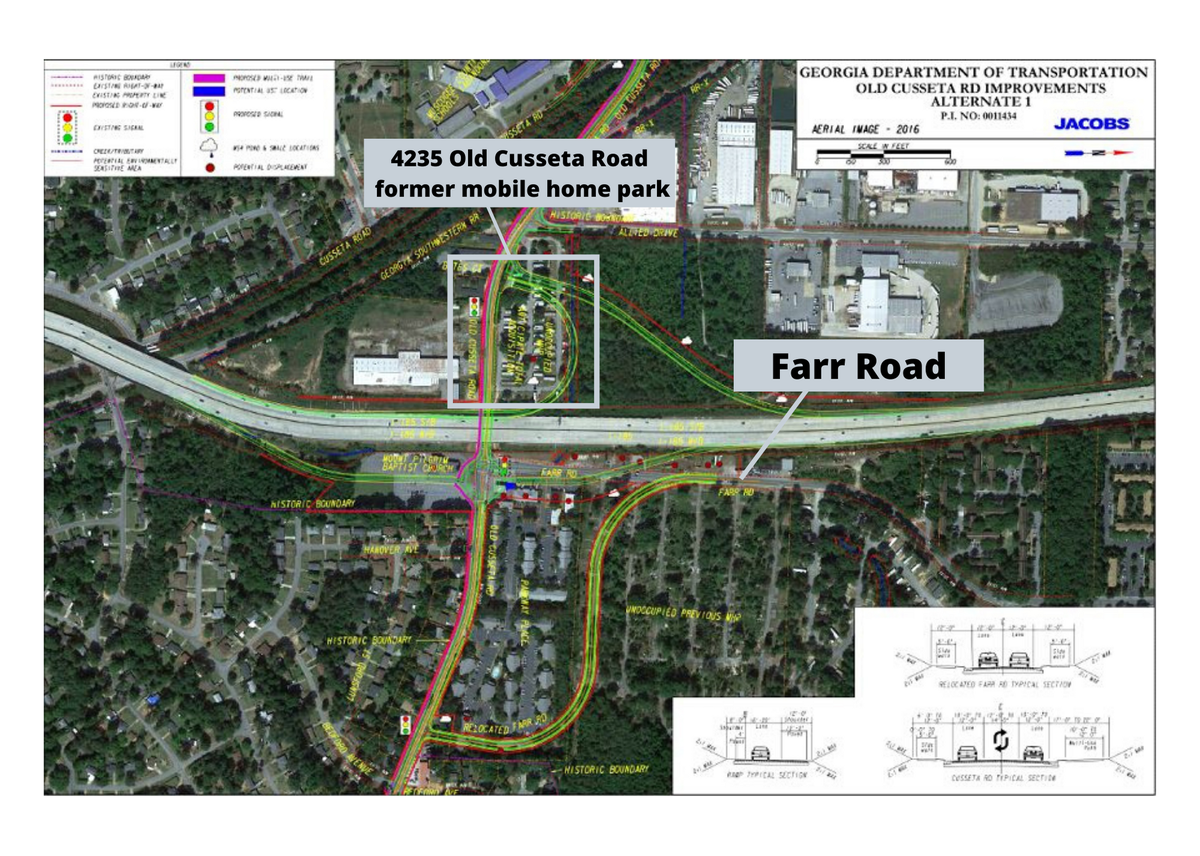
Walsh maintains the city demolished the mobile homes to make way for an interchange at I-185 and Old Cusseta Road.
“They defied (the federal protection) and preceded and demolished the properties and in my opinion it’s very obvious it’s just because there’s the very large off-ramp project that’s going to be happening there,” Walsh said in November.
An attorney for the city said the Fort Benning Estates abatement “was totally unrelated to any road projects.”
The interchange project will add on- and off-ramps from Old Cusseta Road to I-185’s northbound and southbound lanes, and relocate Farr Road.
City Planning Director Rick Jones said the city has identified areas the project will affect and places where right-of-way will need to be acquired, though it’s still early in the design phase.
A rendering of the interchange shows one ramp supplanting all of the former mobile home park on Old Cusseta Road. The former Fort Benning Estates property is located to the north of the project, and not pictured.
Both mobile home parks were targeted in the city’s $1 million campaign to erase blight. Mayor Henderson in April announced he would ask council to approve a $1 million budget to demolish burned out homes and trailer parks the city hadn’t the money to clear in the past.
Inspections and Code Enforcement Director Hudgison said his demolition budget typically runs around $56,000, with an average cost of $8,000 for each project.
Council voted in June to approve the demo budget as part of the city’s 2020 budget.
Though voters in 2012 approved a sales tax to fund improvements to the I-185 and Old Cusseta Road corridor, the Federal Highway Administration didn’t OK the concept until the “early part of 2019,” Jones said. With the first step finished, the project currently is in preliminary engineering, he said.
The estimated cost is upwards of $58 million, according to the River Valley Region project list.
The engineering could take another year and a half, followed by right-of-way acquisition, Jones said. Two years of construction would mean a completion date around 2025.
Henderson said Tuesday the city doesn’t feel like the demolitions were an “overreach” based on the authority the city has to ensure people are safe.
“When I put a million dollars (in the budget) for demolition across the city and targeting some of these really blighted areas, I had no reason to nor did I take a look at any kind of appropriation date for an interchange,” Henderson said. “This is strictly to try to improve the community.”
During a January 14 update to Columbus Council, Hudgison said the city has spent almost $850,000 of the $1 million.
Demolishing the mobile homes on Old Cusseta Road cost the city an estimated $188,500, and demolishing Fort Benning Estates cost an estimated $229,500, he said.
Under city protocol, the demolition costs are to be invoiced to Walsh, and if he does not pay, the city will place a lien on the properties. That means Walsh cannot sell them until he pays the demo cost and any accrued interest.
This story was originally published January 27, 2020 at 6:00 AM.