
Are Republicans targeting Sanford Bishop? How redistricting could impact Columbus, Macon
State lawmakers are in the midst of their once-in-a-decade task of redrawing Georgia’s state and congressional legislative districts.
While much attention will be given to changing boundaries in metro Atlanta, shifts in the Columbus and Macon areas could have long-term consequences.
The process that will determine the state’s boundaries for the next 10 years takes place against the backdrop of Georgia’s evolving political landscape and growing population.
Elections near the end of 2020 and the start of 2021 flipped both of the state’s U.S. Senate seats blue for the first time since 2003. A Democratic presidential candidate carried Georgia for the first time since 1992.
More than 10.7 million people call the state home, an increase of roughly 1 million in the last 10 years as Georgia grows more diverse and urban. The suburbs of Atlanta, Savannah and Augusta were the state’s fastest-growing regions while a swath of rural counties stretching from Columbus to Augusta lost residents.
The Republican-controlled General Assembly oversees the contentious process and will likely draw maps that strengthen their grip on the capitol. Maps proposed by Democrats or civil rights organizations are unlikely to pass.
State house and senate districts covering Macon and Columbus will be tweaked. But the biggest changes for residents in these areas will likely be the newly drawn 2nd Congressional District.
Republicans hope to make the district more competitive in hopes of eventually flipping the longtime blue seat.
Here’s what you need to know about statewide redistricting:
What will happen to the 2nd Congressional District?
Much of the attention around Congressional redistricting will focus on Republican efforts to regain the seat currently held by Democrat Lucy McBath in metro Atlanta, but changes to Rep. Sanford Bishop’s 2nd Congressional District will be important.
The current district includes most of Columbus and part of Macon, as well as the southwestern corner of the state, but it’s too small as currently drawn.
According to Census data, the district is home to 673,028 people, more than 92,000 short of what it needs. It is the most underpopulated Congressional district in the state.
The district will either have to stretch further to the north or east to boost its population numbers. The district is bordered by Alabama on the west and Florida to the south.
A newly drawn 2nd District could see all of Columbus or much of Warner Robins within its boundaries, according to several draft maps.
A proposed map from Lt. Gov. Geoff Duncan and state Senate Republicans would draw the rest of Columbus and the southern half of Harris County into the 2nd. Those areas lean Republican and are currently with the 3rd Congressional District represented by Republican Drew Ferguson. Some of northern Houston County near Warner Robins would also be included.
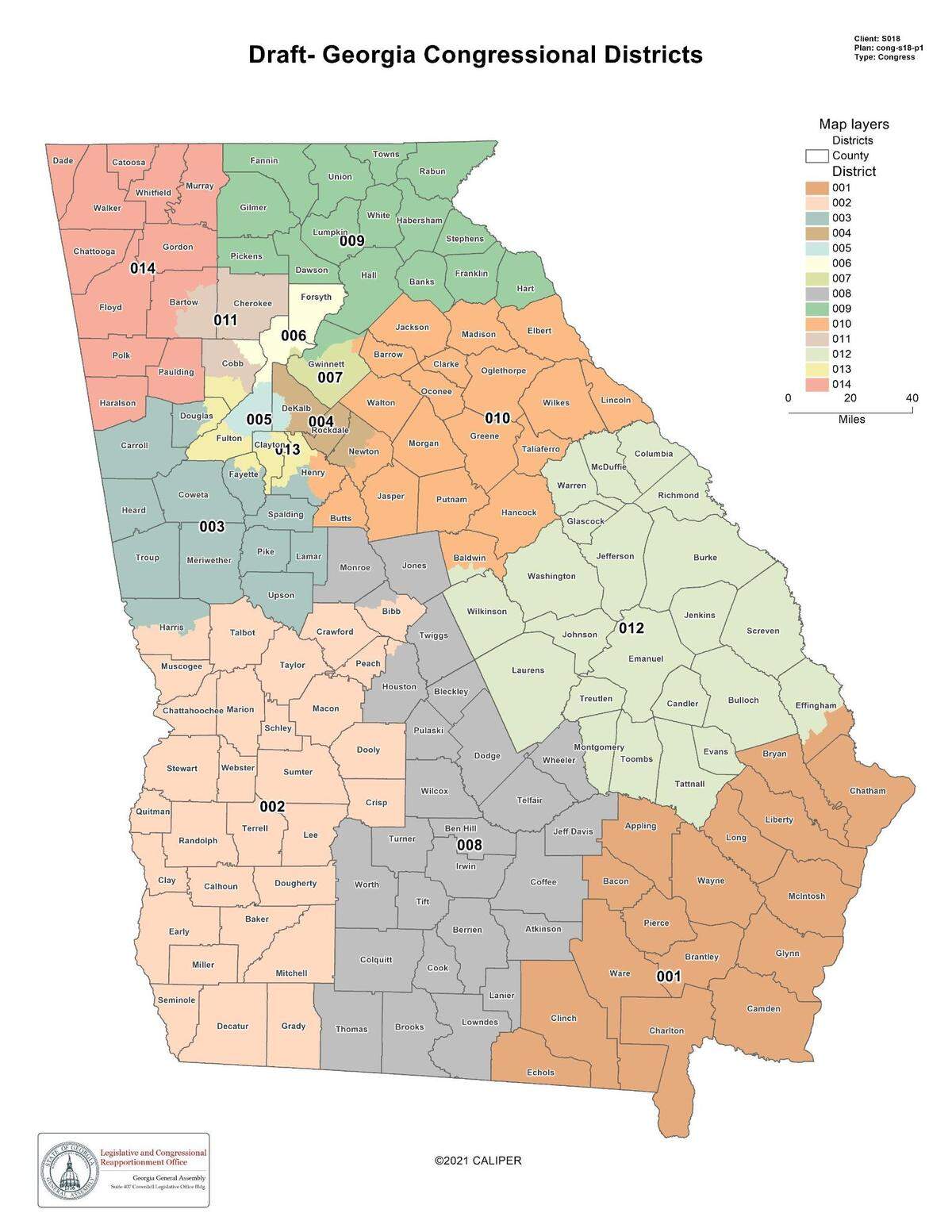
A map proposed by the Democratic Party of Georgia would leave Columbus split and bring in a portion of Warner Robins.
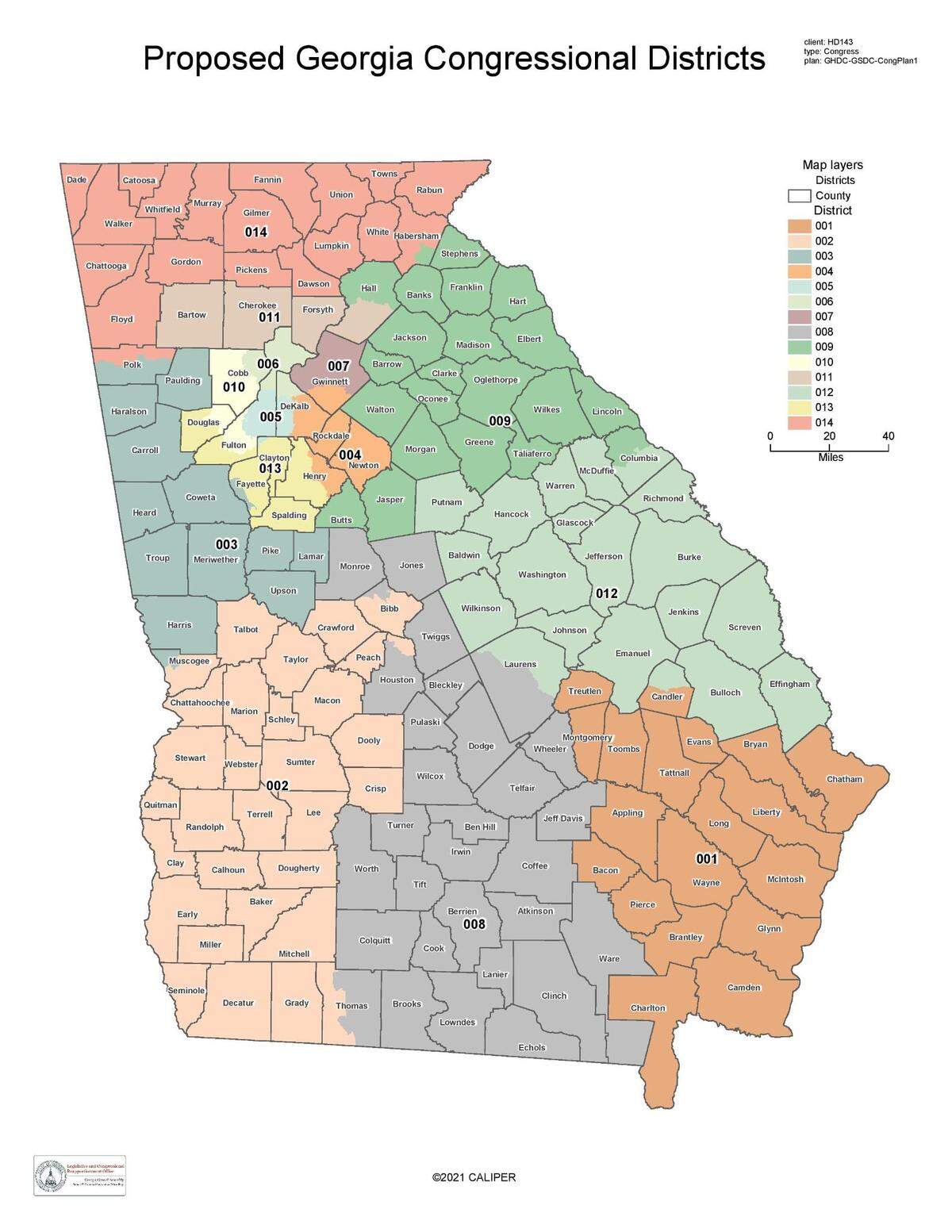
A third map published by a coalition of civil rights groups including the Georgia State Conference of the NAACP is similar to the Democrats’ proposal, bringing Warner Robins into the 2nd. The coalition’s map would also add Twiggs County.
The Democratic and coalition maps differ how much of Thomas and Grady counties end up in the 2nd. Both are southwestern Georgia counties along the Florida border.
Republicans hope they can gain ground and eventually flip the seat that has been reliably Democratic for decades to offset loses elsewhere, said Chris Grant, a political science professor at Mercer University.
“They are doing what they can to make (Bishop) more vulnerable,” he said. “He is going to retire eventually, and they may be opening the door for a Republican to replace Sanford eventually. ...Republicans are going to lose strongholds in the metro Atlanta area, and I’m not sure the districts they are creating right now will continue to perform very well in the long run.
“That may be the purpose of the map: to get Sanford to think about retiring,” Grant added.
The National Republican Congressional Committee is targeting Bishop and 69 other incumbent Democrats in hopes of flipping the U.S. House during the 2022 midterms. Bishop was added to the list after Republican Glenn Youngkin beat Democrat Terry McAuliffe in Virginia’s gubernatorial election.
Despite being in a potentially more conservative district after the maps are redrawn, Bishop would still perform well, Grant said.
“He is good at delivering on services for Georgia,” he said. “He’s good at working with Republicans on issues they need. He’s a good constituency service kind of guy.”
Brandon Phillips, chairman of the 2nd Congressional District’s Republican Party, pointed to several positive data points for the GOP in the district.
The 2nd was one of only two districts where Donald Trump’s vote share held steady or improved in 2020. Trump accounted for 43.4% of the district’s vote share in 2020, up slightly from the 43.3% in 2016. The other Georgia district where Trump saw improvements in 2020 was the reliably Democratic 5th Congressional District in Atlanta.
“The 2nd District, in particular, has more upside potential for the GOP than any other district and the trend from 2016 to 2020 shows that,” Phillips said. “The people here have long waited for a competitive district, and 2022 could be that year.”
Currently, eight Republicans and six Democrats represent the state in Congress. The newly proposed map from state Senate Republicans would draw nine Republican and five Democratic districts.
The Georgia House of Representatives
Columbus
Columbus’ state house districts will likely see some slight changes. The current districts are either a little larger or a little smaller than the ideal size except for Districts 135 and 137, according to U.S. Census data.
- District 133 needs to add 2,489 residents. The area includes a portion of LaGrange, much of Harris County and a sliver of north Columbus.
- District 134 is within 1% of the ideal population size. The area covers a portion of southern Harris County and stretches south into Columbus, reaching parts of the Lakebotton neighborhood.
- District 135 needs to add 6,728 residents. The area includes downtown and south Columbus. This district is represented by Calvin Smyre, the Dean of the Georgia House and longest-serving member of the Georgia legislature. He was tapped by President Joe Biden to serve as ambassador to the Dominican Republic. If Smyre is confirmed by the U.S. Senate, he’ll no longer serve as a state lawmaker.
- District 136 is within 1% of the ideal size. It stretches from parts of south Columbus to the county’s northern border.
- District 137 needs to add 4,214 residents. This area currently includes east Muscogee County, east Harris County, about half of Meriwether County and Talbot County.
Maps drafted by House Republicans and Georgia Democrats split Columbus within five state house districts. The divides are similar but not the same.
Under the Republican map, new vacant House seats would be created in Forsyth, Cobb, Fulton, Gwinnett and Rockdale counties. So, Columbus would be represented by the new 137, 138, 139, 140 and 141 Districts.
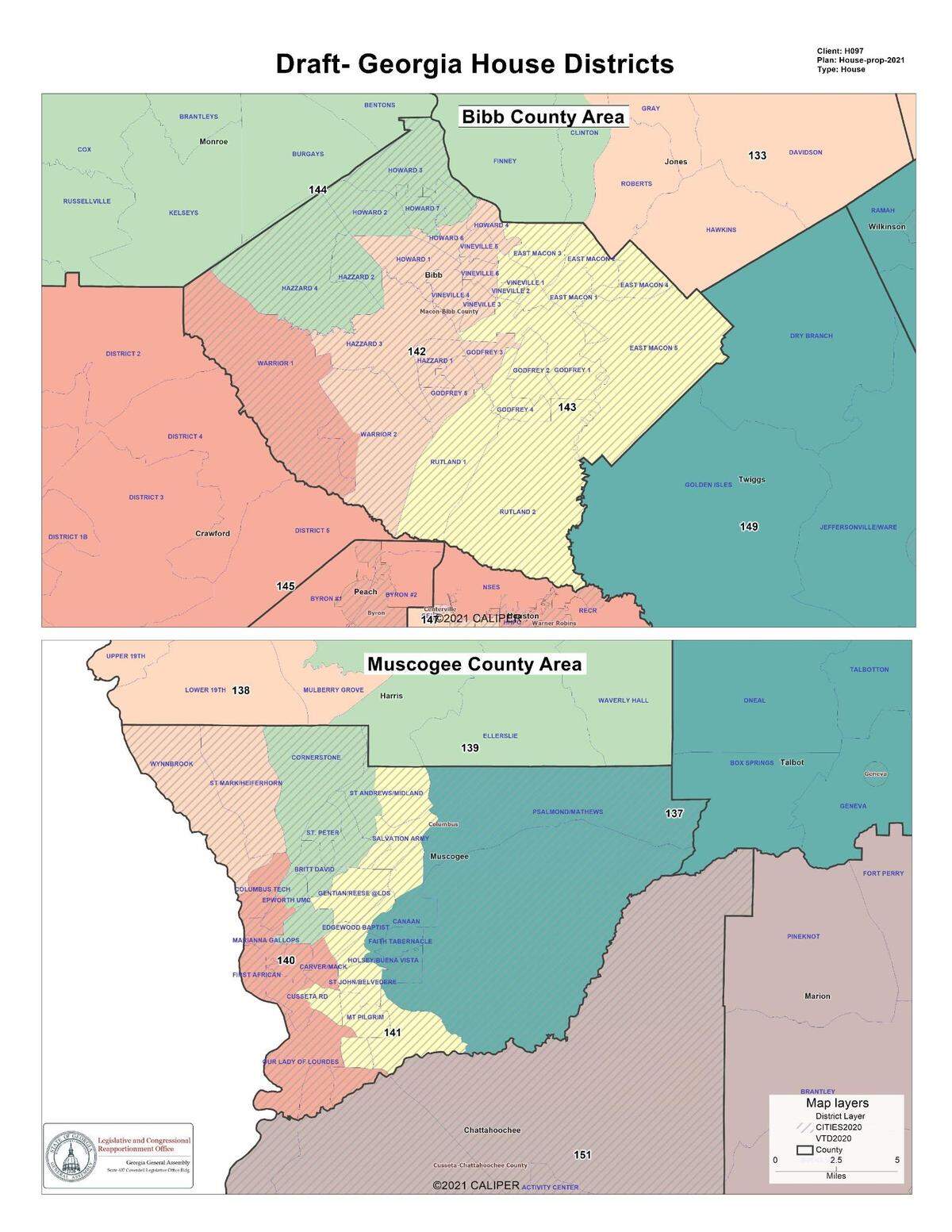
Columbus’ District 140, the old 135, would move further east. District 141, which mostly matches the current 136, would pick up areas around Columbus State University. District 137, which would stay the same number, would no longer include Harris County. It would lose a portion of Meriwether County but gain the southwest corner of Troup County. The proposed districts lean Democratic.
District 138, which matches up with the current District 133, would now cover 2/3 of Harris County and gain territory in Troup County. District 139, similar to the old 134, would give up part of its Muscogee County holdings, but take land in Harris County including Waverly Hall. The proposed districts lean Republican.
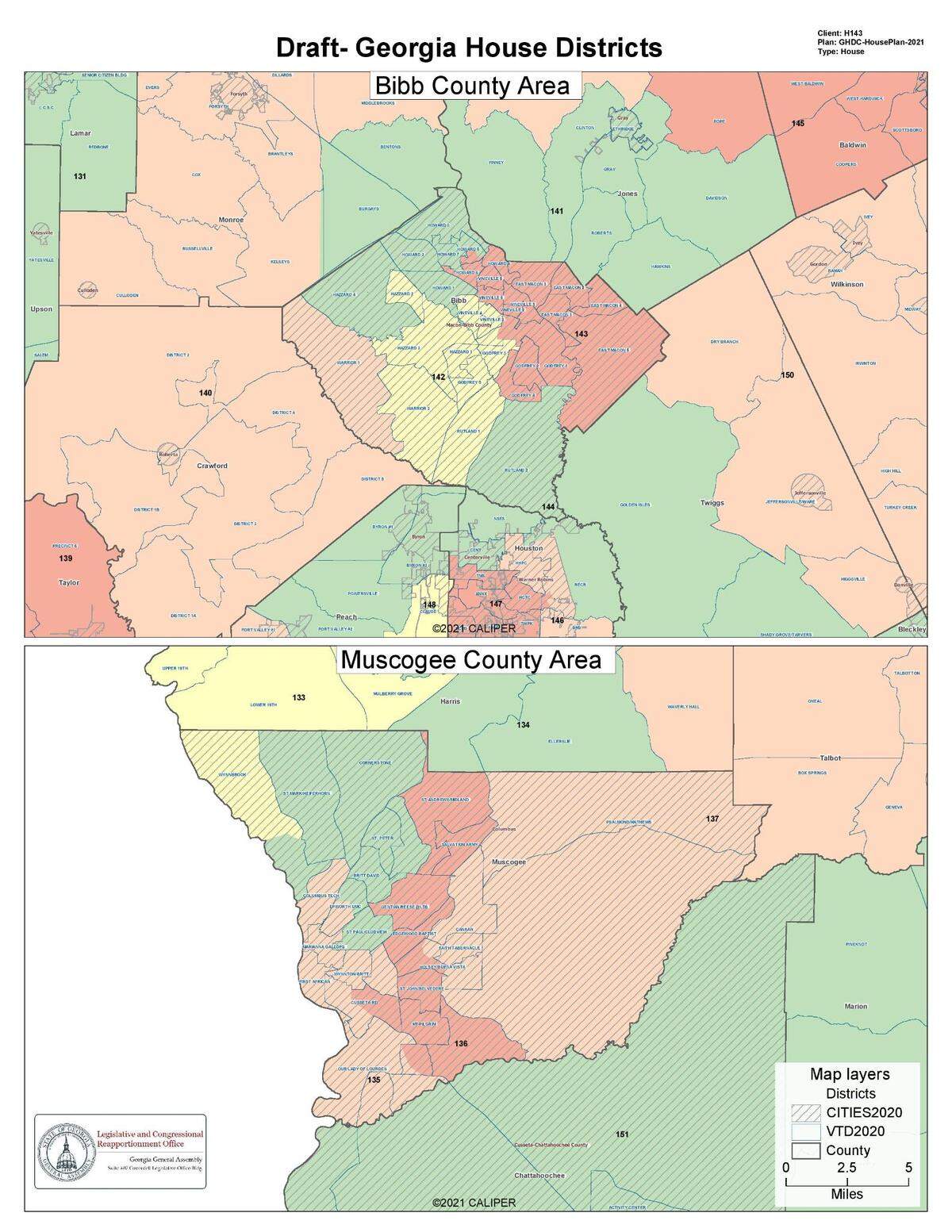
District numbers would not change under the Democrats’ proposed map.
District 133 would gain in Troup County and lose a little area Columbus. District 134 would gain area in northwest Columbus. Both would be Republican-leaning districts. District 135 would push a little further west in Columbus. District 136 would pick up area around Columbus State University and gain a small sliver along the county’s northern border. District 137 would change slightly. These would be Democratic-leaning districts.
The coalition map would create four Columbus districts. One would be a large Republican district that spans most of the northern portion of the county. The remaining three would be Democratic. Southeastern Columbus would be lumped into a massive district that includes Chattahoochee, Marion, Schley and Talbot counties.
Macon
Nearly all of the current house districts that cover Macon-Bibb County must grow, according to U.S. Census data.
- District 140 needs to add 4,249 residents. It currently covers southwest Bibb County, part of Monroe County and all of Crawford County.
- District 141 is within 1% of the ideal population size. It currently covers northwest Bibb County and parts of Monroe County.
- District 142 needs to add 7,816 residents. It currently covers south-central Macon.
- District 143 district needs to add 6,515 residents. It currently covers downtown Macon and eastern Bibb County.
- District 144 needs to add 6,191 residents. It currently covers southeast Bibb County, part of Jones County, Twiggs County, Wilkinson County, Bleckley County and part of Laurens County.
The House Republicans map splits Macon into four districts. New districts created elsewhere change some of Macon’s numbers. The Democratic-leaning District 142 and 143 would cover more than half of the county. A redrawn Republican-leaning District 144 would cover northwest Bibb County and parts of Monroe and Jones counties. A Republican-leaning District 145 would cover southwest Bibb County, Crawford County, as well as Byron and parts of Warner Robins.
The Georgia Democrats map more closely resembles the current map for Bibb County with a few tweaks. Most of the changes in Middle Georgia would occur just outside Macon.
The Georgia Senate
The Senate districts representing Columbus and Macon must grow during redistricting, according to U.S. Census data.
- Senate District 25, which includes a tiny piece of northern Bibb County, most of Jones County, a sliver of Walton County and Baldwin, Putnam, Jasper, Greene and Morgan counties, needs to add roughly 7,194 people.
- Senate District 26, which includes a little over half of Bibb County, Warner Robins, part of Jones County and all of Twiggs, Wilkinson, Washington and Hancock counties needs to add roughly 29,000 people to reach ideal size. It is one of the most underpopulated districts as currently drawn.
- Senate District 18, which includes west Bibb County, parts of Houston County, and Peach, Crawford , Upson and Monroe counties, needs to add about 9,967 people.
- Senate District 29, which includes north Columbus, all of Harris and Meriwether counties, and about half of Troup County, is within 1% of the ideal size.
- Senate District 15, which includes central and southern Columbus and all of Chattahoochee, Marion, Schley, Macon, Taylor and Talbot counties is nearly 24,000 people short.
Senate Republicans released an updated map proposal Thursday, but their plans for Macon and Columbus appear consistent across drafts.
The Republican-leaning 25th District would lose Greene and Morgan counties as well as its portion of Walton County in exchange for Butts County and southern Henry County. The Democratic-leaning 26th District would pick up Johnson County and more of Warner Robins. The Republican-leaning 18th District would see slight changes around the Bibb and Houston county borders, adding even more of northern Houston.
The Republican-leaning 29th District would lose a little of north Columbus, but add all of Troup County. The Democratic-leaning 15th District would move slightly north, taking up just a little more of Columbus.
The Democratic Party of Georgia proposal would see the 25th District move out of Macon. The Democratic-leaning 26th District would gain more of southern Bibb County and Warner Robins. The Republican-leaning 18th District would lose Upson County but gain Baldwin County and parts of Jones County.
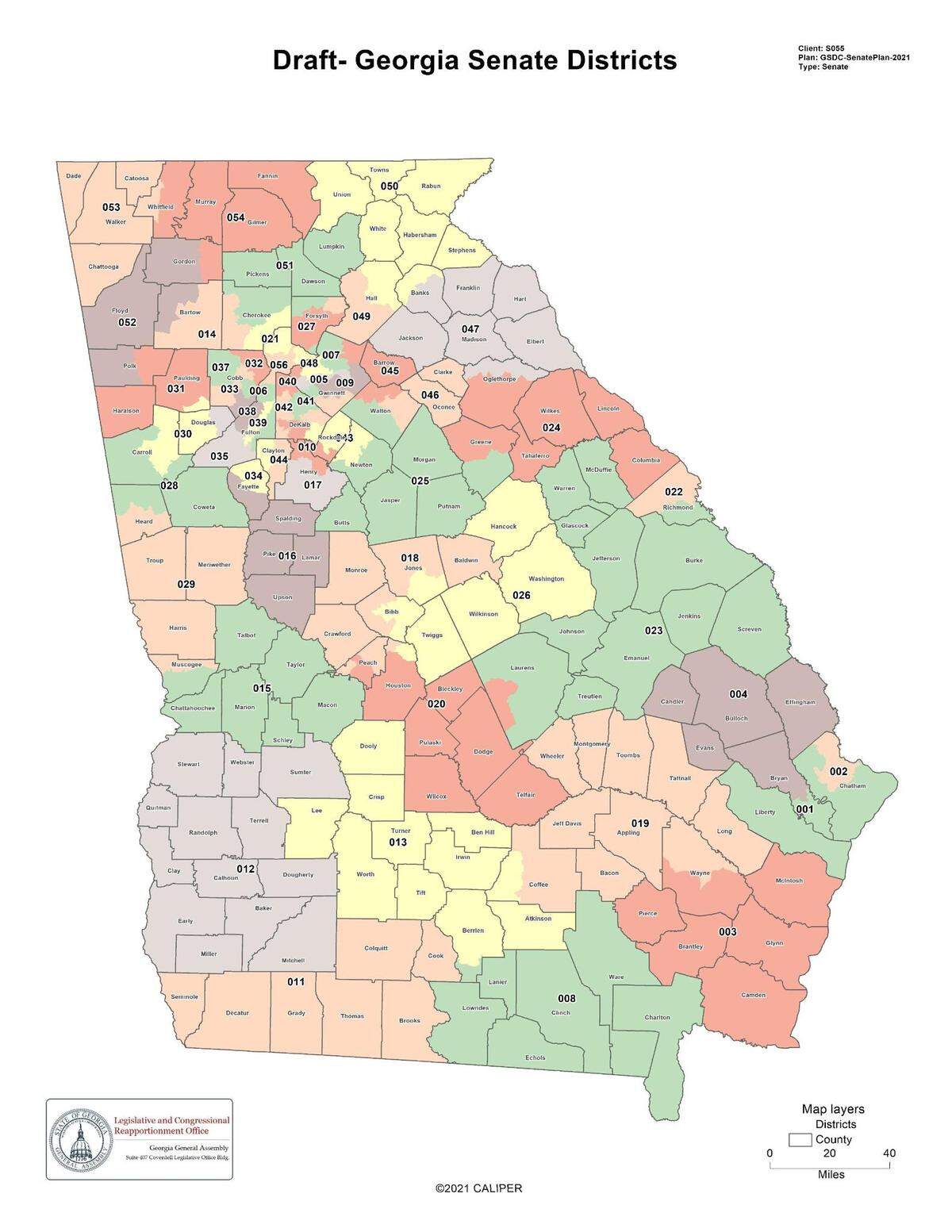
The Republican-leaning 29th District would lose some of north Columbus but gain the rest of Troup County and half of Heard County. The Democratic-leaning 15th District would move slightly north, taking up just a little more of Columbus.
This story was originally published November 7, 2021 at 7:00 AM.