
Columbus Council, school board maps are now redrawn. What happens next?
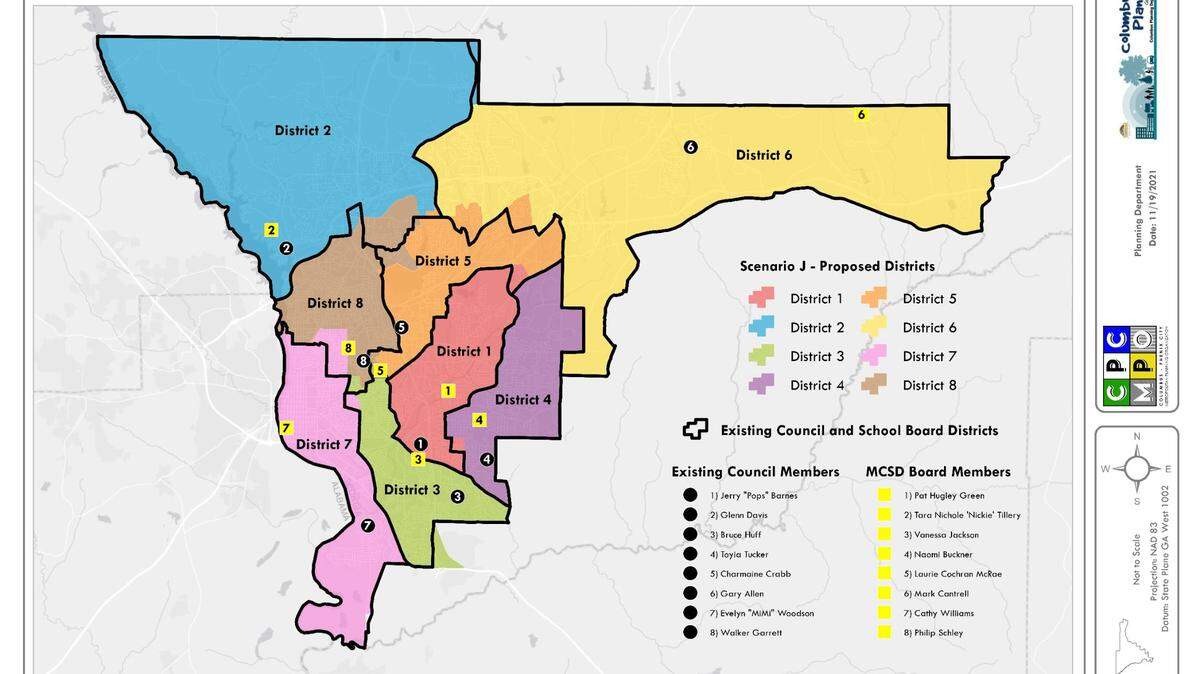
The commission tasked with redrawing Columbus’ council and school board boundaries crafted a new map, and the Columbus Council will vote on the newly proposed districts next week.
Under the new map, Districts 2, 4 and 6 will shrink because they had too many residents, and the remaining territories must expand and pick up more people.
The map received near-unanimous approval from the Districting Commission with one member voting against the map over concerns that a midtown district wasn’t being fairly drawn for Black voters.
The new map must now be approved by state officials, the Columbus Council and the Muscogee County School board before it takes effect.
The council and school board have indicated they want the same district maps, but the bodies could ultimately decide to draw their own borders.
What does the new map look like?
The maps are redrawn each decade following the release of U.S. Census data.
The Districting Commission voted Saturday to approve Scenario J. The boundaries for all districts change slightly. These are some of the most apparent changes from the current map:
District 3 gains a small square near 17th Street, Cherokee Avenue and Forest Avenue.
District 5 gains territory on the border of Flat Rock Park.
- District 7 gains land near Warm Springs Road and Lakebottom Park as well as a small section of Wynnton Road.
- District 8 gains territory around Britt David Park and Weems Road.
To see where your new district would be, type your address into the interactive map below. You can also see the other scenarios the Districting Commission considered for new maps. The map currently displaces Scenario J.
What did the commission, residents say about the proposed map?
Districting Commission chair and Muscogee County Probate Court Judge Marc D’Antonio told the Ledger-Enquirer the goal of the mapping process was to give residents ample notice and an opportunity to be heard.
“I think we accomplished that goal,” he said.
Before the commission’s weekend voted, members of the public offered comments on the map. Board chair of the Southern Anti-Racism Network and Columbus resident Theresa El-Amin was among those who spoke.
El-Amin criticized some commission members for comments in previous meetings about protecting incumbents by not drawing them out of their current districts.
“The driving force should be protecting Democratic engagement by all the citizens,” she said in a portion of her speech. “No one should run unopposed, and you protecting incumbency flies in the face of that principle.”
Many Columbus incumbents live on the edge of their districts. State guidelines seek to prevent incumbents from being drawn out of their districts, and in previous meetings, commission members including D’Antonio said they’d prefer to see voters make decisions about their representatives.
Drawing a representative out of their district could be seen as politically motivated, commission member Mary Sue Polleys said in a previous commission meeting.
The 16-member commission, chosen based on nomination by the grand jury and appointment of the mayor and council, spent nearly two months discussing new districts maps. Only one member, Katie Bishop, voted against Map J during Saturday’s meeting.
Bishop told the Ledger-Enquirer her primary reason for voting no was the racial makeup of the new District 8.
District 8 is currently represented by Walker Garrett, who wasn’t present at commission meetings attended by the Ledger-Enquirer. Currently, the district stretches from the Lakebottom Park area to Bradley Park Drive and Whittlesey Road. The district includes the Bibb City, North Highlands and Clubview Heights neighborhoods.
From 2010 to 2020, District 8 saw its Black population grow by 2,000 residents while it lost about 1,500 white residents. Black residents made up 33% of the district’s population in 2020, while white residents accounted for 52%.
Bishop said she had concerns with how District 8 was drawn in each map. Map J would see the district’s white population rise to about 56% while the Black population would fall to just over 28%.
“I was just uncomfortable not only ... ethically and morally but also from what I believe we were there to do — which is to make sure that (the way) we drew the lines were fair and equitable,” she said. “In order to do the right thing for the people, it may not be the best case for the incumbent. I felt like that’s kind of where we were with District 8.”
What happens next?
The Columbus Council introduced the proposed council districts during its Dec. 7 meeting. They will vote on the map during its Dec. 14 meeting.
Before the council votes on the new districts, the Georgia General Assembly’s Legislative and Congressional Reapportionment Office must approve the new map.
Under the terms of the city charter, the new map would be approved too late for the 2022 council elections unless the state moves the election date back. New boundaries don’t prevent an incumbent councilor or school board member from serving the remainder of their term.
The Columbus Council must enact a redistricting ordinance within six months of receiving the commission’s report. If it doesn’t, the commission’s map is final.
It’s unclear when the Muscogee County School Board could vote on the new boundaries, board attorney Greg Ellington told the Ledger-Enquirer. The next school board meeting is Dec. 13.
This story was originally published December 7, 2021 at 5:27 PM.