Over $600,000 in speeding fines at 2 Columbus school zones last year. Where did money go?
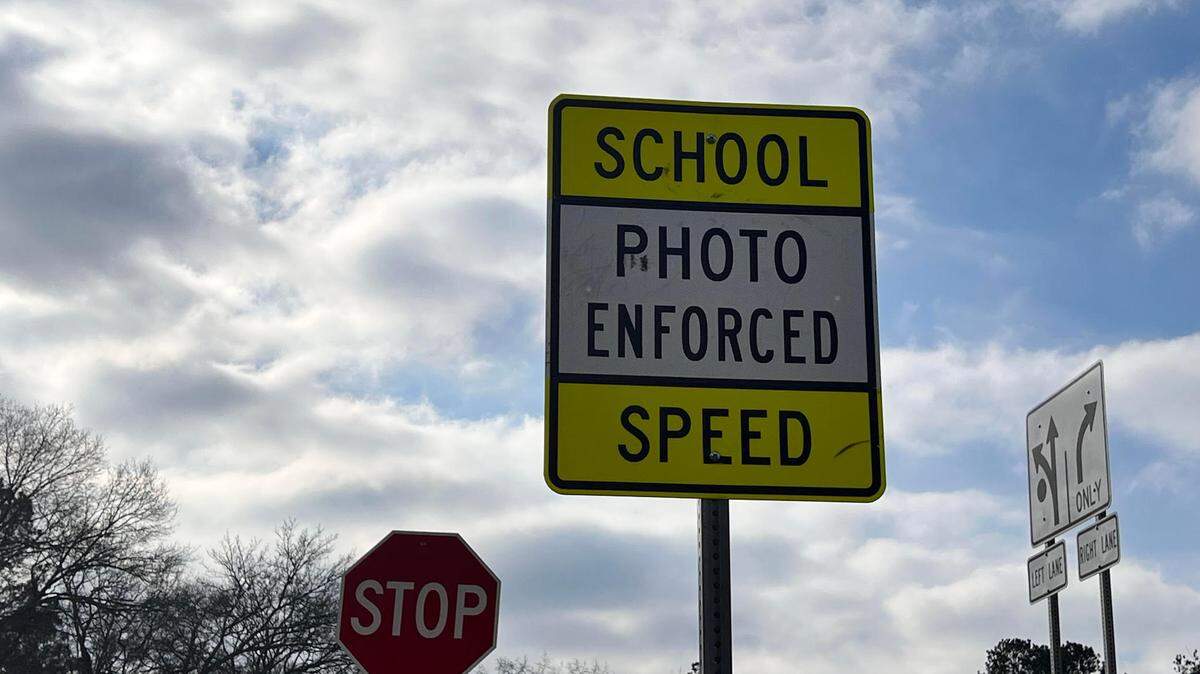
The warning period for two zones at public schools in the Columbus Police Department’s School Zone Safety Program is ending as the Muscogee County Sheriff’s Office reports cameras at two private schools resulted in fines totaling more than $600,000 last year.
However, as the program rolls out to more schools in the Muscogee County School District, the Georgia General Assembly is considering new legislation that would make it illegal.
If the violations aren’t paid, according to CPD’s website, drivers will be issued a second notice. A final notice will be sent if the violation still isn’t paid. After that, information on the vehicle will be sent to the Georgia Department of Revenue, and a hold will be placed on the registration and title.
Two years ago, two Rothschild Leadership Academy students were struck by a car in a fatal car accident on Steam Mill Road in Columbus. This incident motivated officials to do more to slow down traffic in school zones, CPD public information officer Brittany Santiago told the Ledger-Enquirer.
“We’d gotten a lot of complaints by then,” Santiago said. “But that really sparked a lot of (action).”
Citations began with private schools
The Muscogee sheriff’s office and CPD are working with an Illinois-based company, RedSpeed USA, to implement cameras in school zones. RedSpeed’s cameras have built-in Flock Safety technology, Muscogee County Sheriff Greg Countryman told the Ledger-Enquirer.
Flock Safety uses artificial intelligence to read license plates and identify vehicles, according to the company’s website. It is best known for locating stolen vehicles, the website says.
“This is a critical piece of technology for investigative purposes,” Countryman said.
Cameras in the Brookstone and St. Luke school zones went live last year and are the responsibility of the sheriff’s office.
The number of citations that were issued last year is not available, Countryman said, but he estimates that it’s in the thousands. Citations are issued when drivers go more than 10 mph over the speed limit, he said.
Between February 2024 and December 2024, fines from those two school zones totaled about $612,000, according to a report from the sheriff’s office. From that amount, about $411,000 went to Muscogee County after RedSpeed collected its payment.
This money will go toward funding the sheriff’s office, Countryman said.
“The monies can be used in addition to my fiscal year budget,” he said. “However, the monies cannot be used to supplant my budget.”
CPD’s School Safety Zone Program
CPD is responsible for cameras for public schools within the Muscogee County School District.
Although the department announced its school safety zone program last year, the implementation was delayed until this year.
Twenty MCSD schools will have cameras in Phase A of the program, Santiago said. By the end of implementing Phase C, all public schools with be part of the program. The first group of schools was chosen based on complaints, traffic studies and prioritizing younger students.
Residents can find a color-coded list of the zones online. Zones highlighted yellow are in a warning period, and zones highlighted red are live and issuing citations.
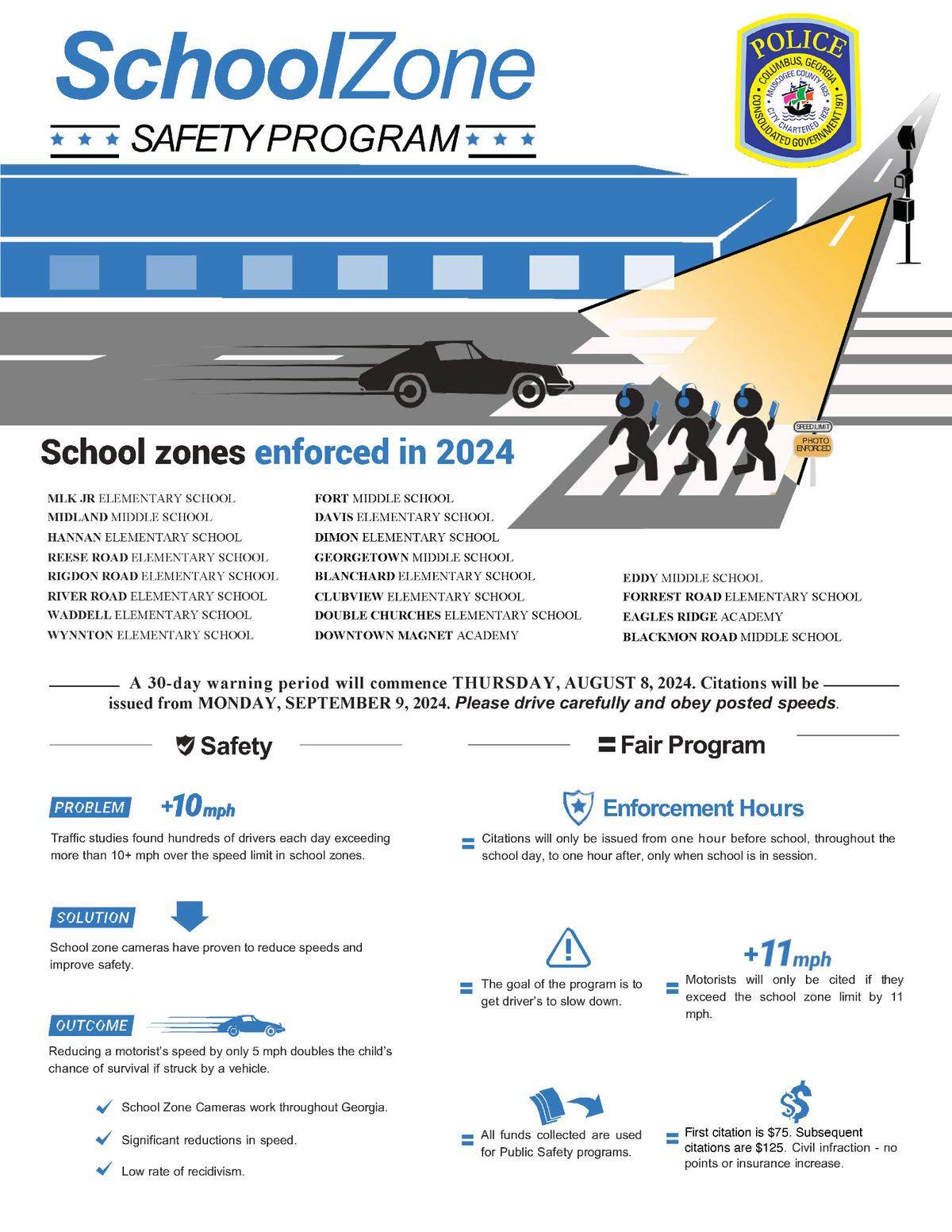
School zone speed cameras at Blanchard Elementary School and Midland Middle School became the first cameras operated by CPD to begin issuing citations Feb. 25.
Like the cameras at the private schools, vehicles must exceed speed limits by more than 10 mph before they will receive a citation.
All money collected from fines for speeding violations in zones at Columbus public schools will be used for CPD public safety programs. The first citation is $75, according to a 2024 CPD news release, and subsequent citations are $125.
The cameras are violator-funded, Santiago said. RedSpeed will cover all costs associated with installing and maintaining equipment, CPD previously told the Ledger-Enquirer.
“It costs no money to taxpayers,” she said. “It costs nothing for the city. It’s just a way to reduce speeding in school zones because we have been having a big issue with it.”
Georgia General Assembly considers repealing law
The Georgia General Assembly passed House Bill 978 in 2018, which allowed the use of automated speed-detection cameras in school zones.
However, state Rep. Dale Washburn (R-Macon) introduced HB 225 in February. This bill would repeal repeal all laws related to enforcing speeding violations in school zones through the use of automated traffic enforcement safety devices.
“I’m sure (HB 978) was well-intentioned at the time,” Washburn said while introducing HB 225 in a Feb. 18 Motor Vehicles Committee meeting. “But over the years since it was passed and implemented, it has not done what it was apparently designed to do.”
Instead, automated speed enforcement is generating millions of dollars in revenue for local governments and camera companies, he said.
Members of the General Assembly have received complaints from their constituents about the cameras, Washburn said, and over 100 legislators co-signed the bill. It is a bipartisan effort, he said, with about an equal number of Democrats and Republicans co-signing the bill.
Columbus resident David Young spoke against automated traffic cameras during a Nov. 12 Columbus Council meeting after several of his family members and friends received fines.
“It’s just a money generator,” Young told the Ledger-Enquirer. “They say it’s under the guise of safety for the kids. But if we have a problem with unsafe school zones, put an officer there.”
Young supports ensuring laws are enforced, he said, but he has a problem with using cameras to take photos of license plates to send citations.
The violations from the automated cameras are better for residents than receiving one from an officer, Countryman said. What people receive from the camera does not count against their insurance, he said.
“If we put a uniform officer out there to write these tickets, you pay a higher cost,” Countryman said.
Young also is concerned about the cameras wrongly citing drivers who were not speeding. Drivers may request a hearing within 30 days of receiving the violation, according to CPD’s website.
Anyone who may be concerned about receiving a violation from a camera operated by the Muscogee County Sheriff’s Office may call his office, Countryman said.
“We’re always willing to work with our general public,” he said.
As of November 2023, 24 states and Washington D.C. permitted speed safety cameras, according to a 2024 report by the Governors Highway Safety Association. Numerous studies have found that speeding is reduced when cameras are present, the GHSA report says.
This is not the first time Georgia lawmakers have attempted to repeal the use of automated cameras. HB 225 is a replica of a bill introduced by state Rep. Clay Pirkle (R-Ashburn) that died in the Rules Committee last year.
If residents are careful not to speed in school zones, then they should have no issue, Santiago said.
Countryman is watching what is happening in the General Assembly, he said, but he is confident that the program is working to slow down drivers.
“There is a total disregard for driving the speed limit in school zones,” Countryman said. “Our two reasons for having RedSpeed cameras are safety and compliance.”
This story was originally published February 26, 2025 at 9:14 AM with the headline "Over $600,000 in speeding fines at 2 Columbus school zones last year. Where did money go?."