
Columbus commission considers rules for proposed data center. Here’s their vote
The Columbus Planning Advisory Commission (PAC) met Wednesday to give their recommendation for the technology overlay district ordinance for Project Ruby, the $5.18 billion data center proposal.
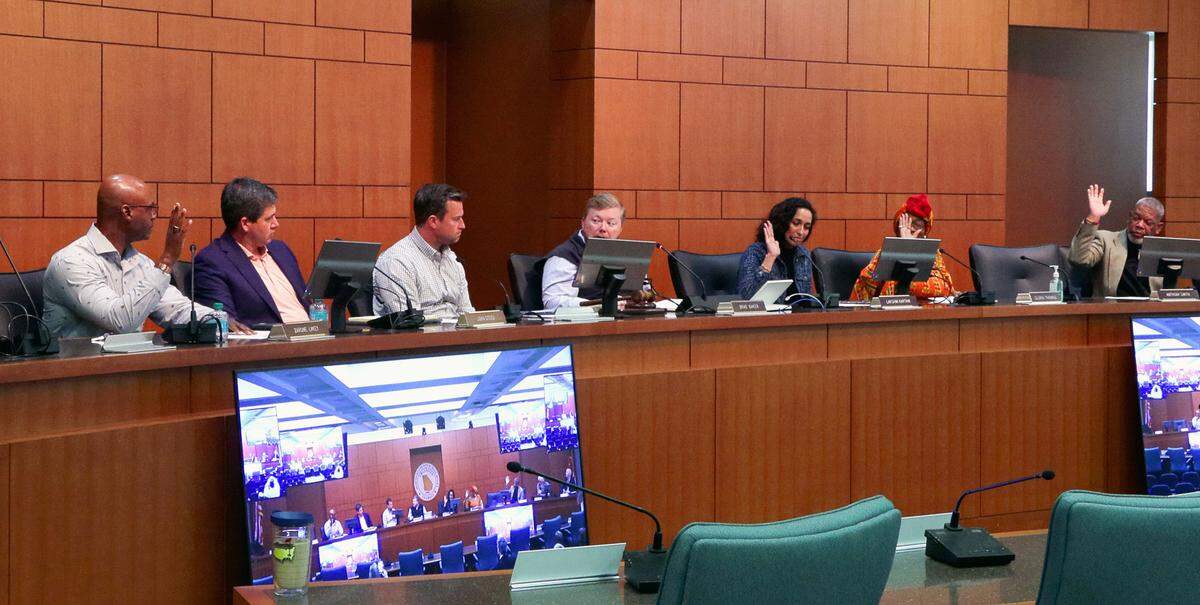
By a vote of 4-3, commissioners decided to table, or delay, a recommendation on the ordinance for PAC members to receive further information about the proposed project and its effects on the surrounding community. The reconsideration vote had not been scheduled as of publication.
Commission member Zarome Lakey made the motion, and members Lakshmi Karthik, Gloria Thomas and Anthony Smith voted in favor. PAC chairman Brad Baker and members John Steed and Michael Ernst abstained. Vice chairman Rick Stallings and commission member Haley Lyman were absent from the meeting.
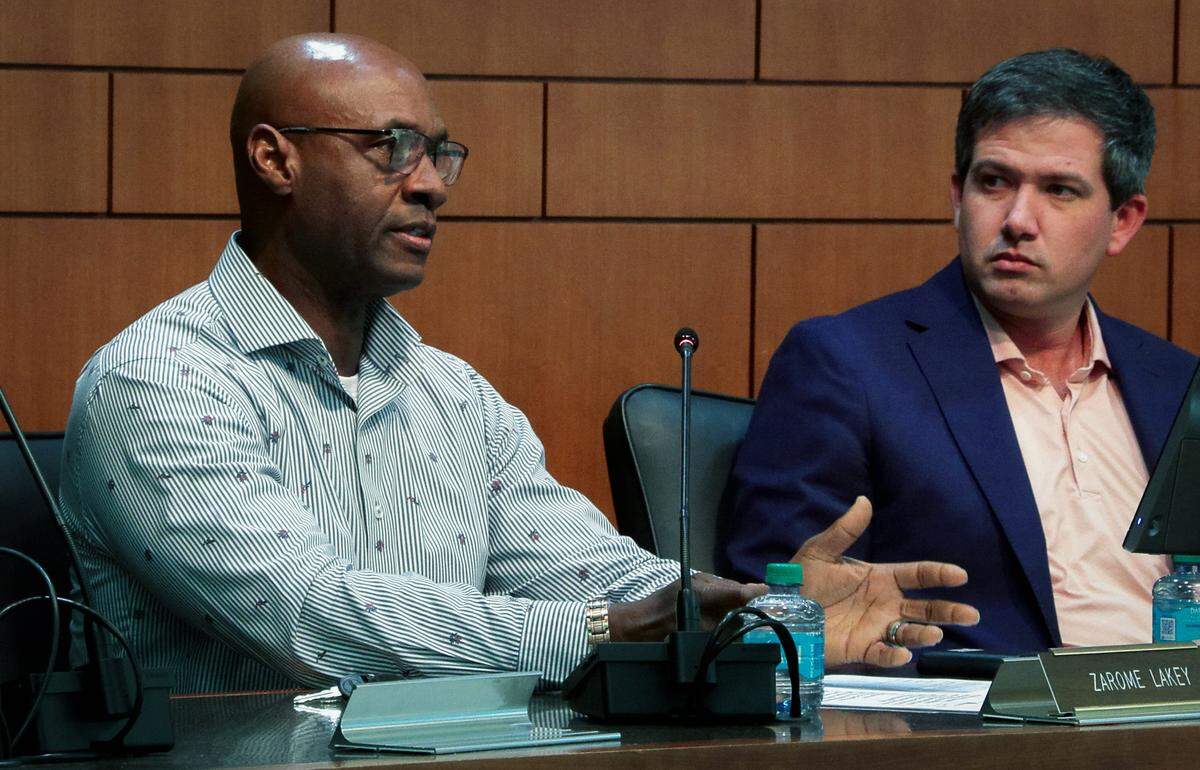
Thomas explained her reasoning for her decision in an interview with the Ledger-Enquirer.
“People are concerned for their families, concerned for their neighborhood, their wildlife, especially their children,” Thomas said. “They came together today to voice their choice and their opinion.”
Thomas said she is leaning toward voting against recommending the ordinance.
“I’m a no because I’m a mother, a grandmother and a homeowner. I’m concerned,” Thomas said. “I’m very concerned about what goes on in my neighborhood. I can feel what they’re feeling.”
The PAC recommends to the Columbus Council whether to approve or deny zoning and planning requests. The technology overlay ordinance will proceed to the council for a vote only after a recommendation from the PAC.
This ordinance is the first step in the approval process for the proposed data center. Project Ruby still must undergo a formal rezoning to become fully operational, according to planning director Will Johnson.
“People need to have the opportunity to voice their concern, whether it’s for or against. and everybody did a really good job of sharing what their concerns were,” Baker said in an interview with the Ledger-Enquirer. “Today’s meeting primarily was about the idea of this technology overlay district, not any specific property that will come down the road when and if a property applies for the actual rezoning for a specific property.”
What is in the Columbus technology overlay district ordinance?
The ordinance explains the minimum requirements for the zoning of Project Ruby and other related technology facilities, including design, construction and operation details for the proposed data center.
The facility cannot exceed 75 feet from its structure pad level and must use a minimum of 75 acres. The proposed site for Project Ruby is approximately 900 acres.
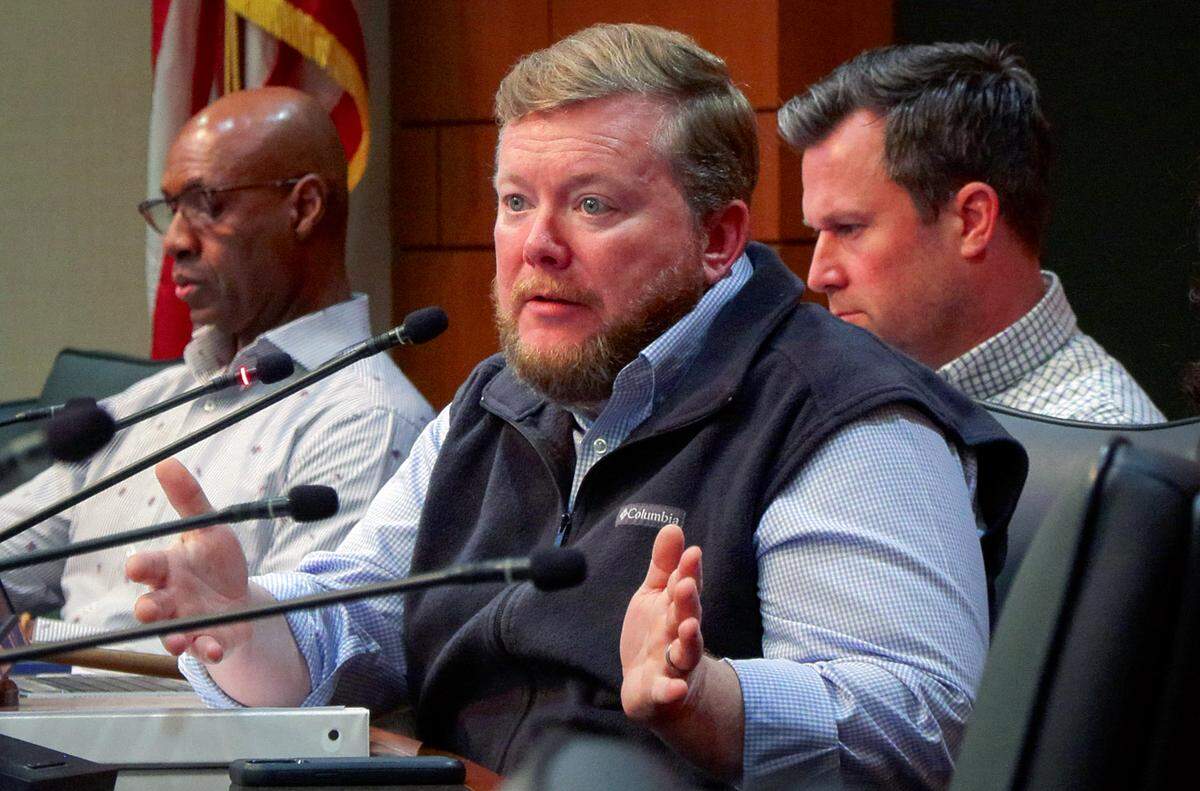
Baker referred to the ordinance as a “file folder.”
“The purpose of it is to have a file folder where if a property is applying to go into the file folder to be designed as a part of that technology overlay district, in this case, potentially a data center, they are the rules and regulations,” Baker said.
The ordinance also defines what data centers and other technology facilities can be used for. The requirements include computer systems and facilities design, data processing, information product research and development, internet website design and hosting, public utility facilities, software design and development, solar or renewable energy facilities, technology consulting and management, and telecommunications infrastructure. The ordinance prohibits these facilities from being used for any sort of cryptocurrency mining.
The proposed data center’s operations are also not allowed to exceed an average of 65 decibels, the volume of a normal conversation or a running dishwasher, over any-30 minute period from 8 a.m. to 6 p.m. It also bans the data center from producing an average of 55 decibels, the volume of light traffic or a humming refrigerator, over a 30-minute period from 6 p.m. to 8 a.m.
The ordinance also requires data center developers to use a closed-loop cooling system, which keeps recirculating the cooling fluid, water or refrigerant in a sealed loop without evaporating or consuming it. Closed-loop systems can reduce water usage by up to 70%, according to a study by the Environmental and Energy Study Institute.
The full draft of the technology overlay ordinance can be found on the PAC Trello Board.
“People have every right to have their voice heard,” Baker said.
What do residents think about Project Ruby and the PAC meeting?
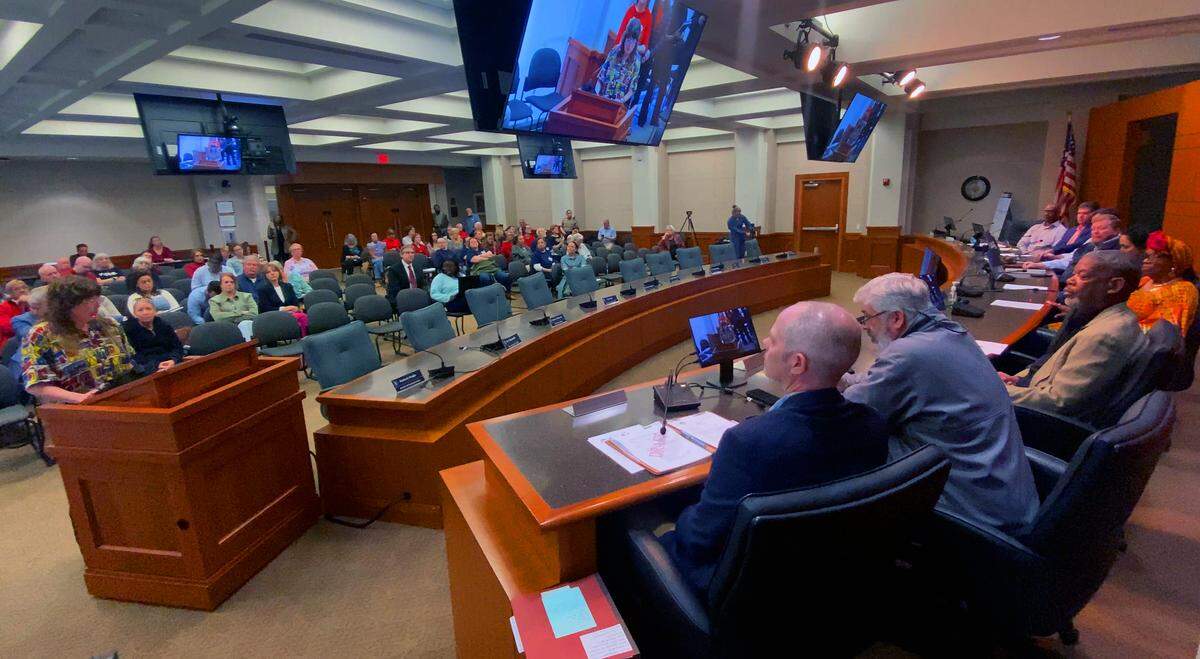
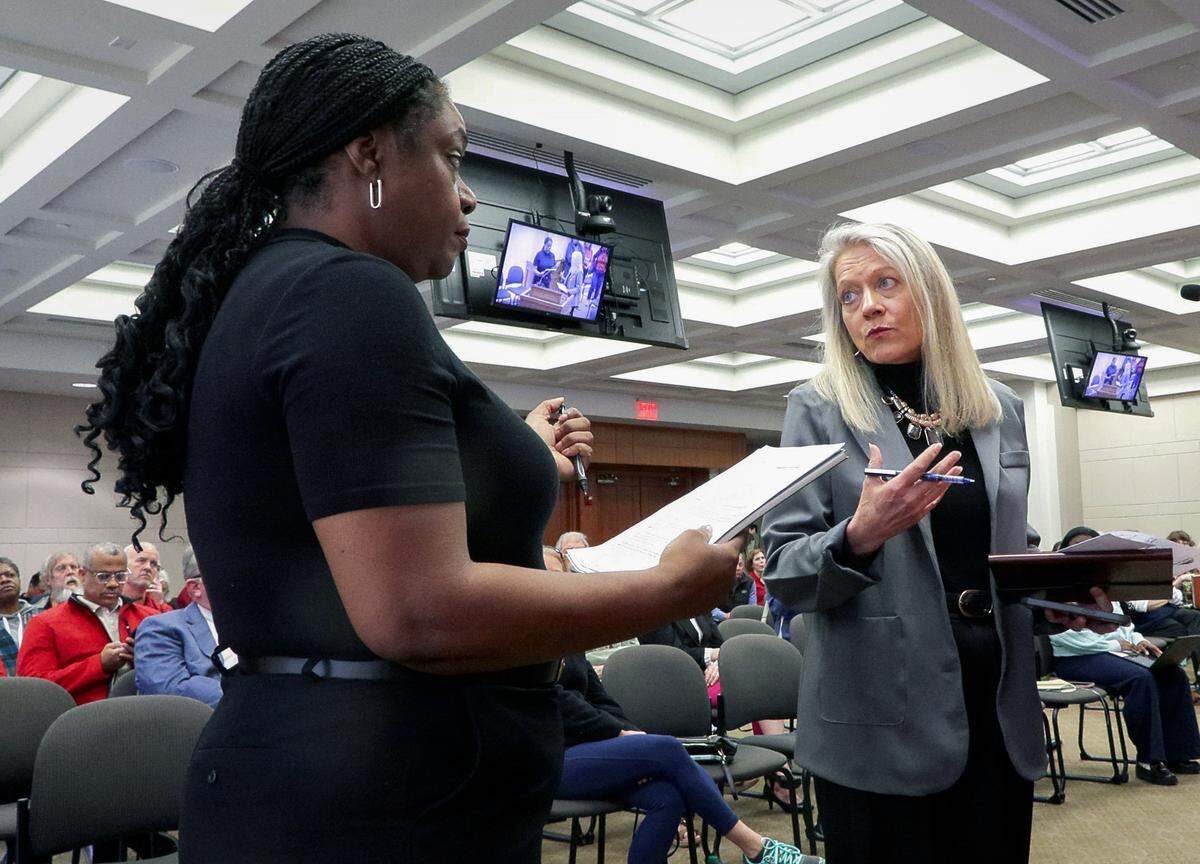
Over 70 residents from Muscogee, Harris, and Talbot counties came to the meeting in the boardroom at the Muscogee County Public Education Center. Residents spoke to the commission about their concerns with the data center, including noise pollution concerns and long-term effects on public health and the environment.
Residents’ opinions about Project Ruby and data centers are on a spectrum. Some residents are fully in favor of Project Ruby. Others are completely against it.
Joshua Ferguson, a technology consultant and Harris County native, told the Ledger-Enquirer that a data center could attract more businesses to the region.
“We’ve got to make [Columbus] a place where medium-sized businesses can locate here,” he said. “This is one of the things that I see all the time. People I work with, they need these things, period.”
Although he understands other residents’ concerns, Ferguson said, those concerns don’t outweigh the long-term benefits
“I get it. People want their home to be the way it is,” he said. “But, I honestly think it’s a generational thing too, to the point where, if all people do is look out and protect the value of their property, they are enriching the elderly in a way and taking away opportunities for the next generation.”
Lydia Ray, a computer science professor at Columbus State University, told the Ledger-Enquirer, “I know that, no matter how many rules they put in here, creating an AI data center will be damaging in many ways. I don’t have any questions. I have a conviction that we should not have an AI data center here.”
Ray spoke about her concerns with the long-term economic impact of increased AI technology.
“We need more education and more training, more understanding of AI,” she said. “A lot of old jobs are being taken away by AI. It’s happening. So, without preparing ordinary citizens for that disastrous economic consequence, they are trying to create more and more data centers. … I think that’s disastrous, and I don’t want that to happen to Columbus.”
Residents’ opinions about the PAC’s decision also exist on a spectrum.
Leslie Landi, a resident living near the proposed Project Ruby site, said she has mixed feelings about the delayed vote.
“This is a very emotional thing for our family, specifically, and several of the neighbors that are out there,” she said. “I don’t want to delay it if it’s going to go through. Let’s figure out what we have to fight if it’s going to.”
Landi plans to attend the city council meeting March 10 to propose a moratorium, or temporary pause, on Project Ruby development.
“Six months would be wonderful,” she said. “I don’t know if that’s reasonable to ask, but to me, that would be perfect. I would like to have more time to have public meetings with officials. We keep being told we’ve got all this misinformation, but we’re not being given any information other than what we can read on the internet, and most of it is negative. For us, that’s a huge concern.”
Jeremy Gibson, another resident living near the Project Ruby site, emphasized the importance of transparent communication.
“One of the things we’re saying from the constituents, if you will, of Layfield Road is that we’re not necessarily opposed to the data center wholeheartedly, but there have to be some considerations made,” he said. “There has to be some concessions. There needs to be open dialogue and transparency about what we are doing, how we are doing it and what the effects are.”
Gibson listed a few of his non-negotiables for ordinance amendments.
“I think that they’re a little too passive on the noise abatement. Those could be a little bit lower,” he said. “I think that the sewer and water, the privacy, the aesthetics, how it is that this thing comes to fruition, I think they’re a little lax. We’re missing some detail. There’s a little bit too much room to allow the developer to interpret some of this guidance and be a little more lackluster than what we would want as residents who are local to it.”
These residents say they plan to continue coming to public meetings about the project’s progression to ensure their voices are heard.
What’s next for proposed Columbus data center Project Ruby?
Missy Kendrick, president and CEO of Choose Columbus, will host a public meeting to discuss economic development projects. The meeting will be March 6, from 2-4 p.m., in the City Services Center, at 3111 Citizens Way.
This story was originally published March 4, 2026 at 1:22 PM.