
80,000 ballots. 40 workers. Inside first day of presidential vote recount in Columbus
Forty Columbus Republicans and Democrats assembled on short notice Friday morning to begin the “heavy lift” of hand-counting more than 80,000 ballots cast here in the Nov. 3 presidential election.
The risk-limiting audit of Georgia’s statewide vote tally is essentially, in this case, the same process as a recount by hand. It was requested by Georgia Secretary of State Brad Raffensperger due to the thin margin in the presidential race results.
In this audit, bipartisan teams sort through batches of printed ballots, examine each, divide them by candidate into separate stacks, and tabulate them.
The work is expected to go on for days, through the weekend, to be completed by the state’s deadline of midnight Wednesday, so Georgia can certify its statewide vote tallies next Friday, Nov. 20.
“It will be a heavy lift, but we will work with the counties to get this done by Friday,” Raffensperger said Wednesday at a capitol press conference.
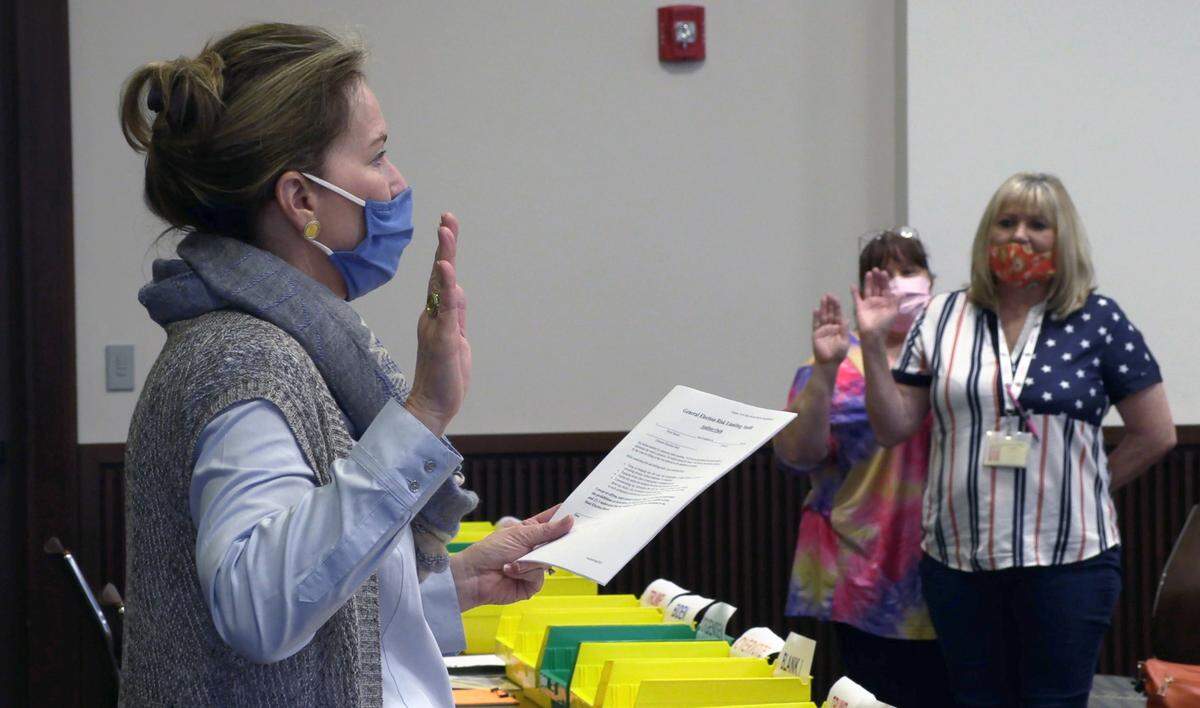
Nancy Boren, executive director of the Muscogee County Board of Elections and Registration, asked those chairing the two major local party organizations to gather at least 16 volunteers to be divided into eight teams, with a Democrat and Republican on each. Additional representatives were needed to serve other functions.
That’s how 40 people wound up waiting at 9 a.m. Friday outside the Columbus Council chamber at the City Services Center off Macon Road, where tables, trays, clipboards and folders were set out for the count at eight workstations.
Besides the two-person teams of “auditors” who would sift through the ballots, about a dozen party representatives were designated as “monitors,” who silently would observe the count to ensure its integrity.
How are ballots sorted?
Besides sorting the ballots into votes for incumbent Republican President Donald Trump, Democrat Joe Biden or Libertarian Jo Jorgensen, the auditors had to account for what are called “overvotes,” “undervotes,” and “undetermined.” Those ballots are set aside for review by a bipartisan audit committee that decides whether the voters’ intent can be determined.
An “overvote” means the voter marked more than one candidate’s name in the same race. An “undervote” means the voter marked no candidate’s name. “Undetermined” means the voter’s ballot is marked, but not clearly.
Boren told auditors overvotes happen only on hand-marked absentee by mail ballots, because Georgia’s new touchscreen, ballot-marking devices will not accept votes for more than one candidate in a race.
As an example, she cited voters’ marking a chosen candidate, but then marking the opponent’s name and scribbling “Anyone but him” beside it, leaving the audit committee to decide the voter’s intent.
As an example of “undetermined,” Boren said voters sometimes mark a presidential candidate, but then also check the ballot’s write-in section and add the vice-presidential candidate. It’s undetermined even if the correct running mate’s name is written in, and again the audit committee must decide the voter’s intent.
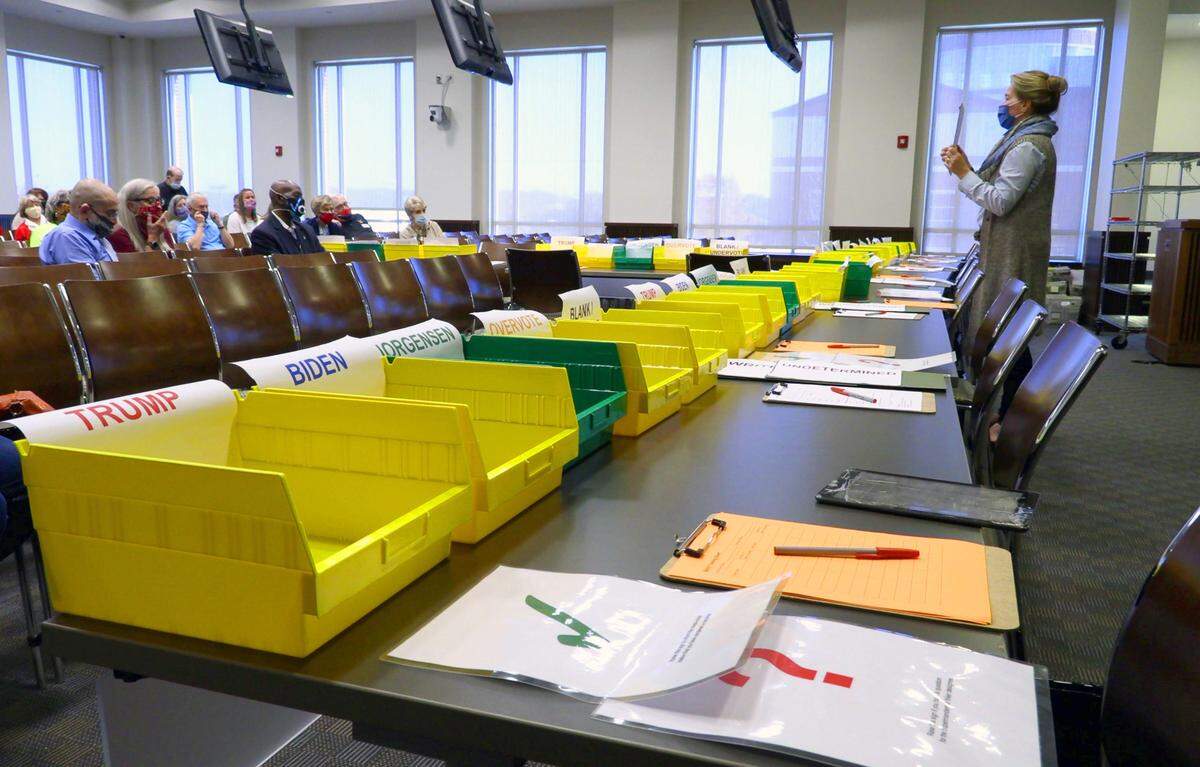
Getting started
After nearly two hours of training, with questions and answers, the auditors finally got to work about 11:15 a.m., digging “batches” of 24-26 ballots each out of black plastic bins, to review one batch at a time, with one partisan sorting the ballots before the second double-checked and verified the tally. A bin could contain more than 100 batches, Boren said.
They started with the absentee by mail ballots, which were expected to be the most time consuming. The county had 10 bins of those. After those were done, the ballots from residents voting early in person would follow, Boren said.
Among the unpaid volunteers doing the work was Ruth Carpenter, 71, a Democrat.
Was it what she had expected?
“Yes, but not so soon,” she said shortly after 2 p.m., when the auditors took a lunch break. She had expected the first day to be only training, with the counting to start later: “We were coming to training, and then we were right into it. It was all right.”
She and her Republican cohort had no trouble setting a pace, reviewing a batch of 25 ballots in about five minutes, she said.
“We got a system going, and we’re fine,” she said. “There are a few strange ballots, but we figured them out real quick, and then we went on with the normalcy.”
She planned to stick with the Republican who was working with her.
“I don’t think I’ll come every day, but the woman I’m working with, we’re going to try to stay together, because we’ve got a good system,” she said. “We’re both retired military, so we’ve got something in common.”
Both Laura Walker, the local Democratic Party chair, and Alton Russell, the Republican county chair, said they were satisfied with how the election went here, and with the audit process.
“I think Nancy and the staff and the board are doing the best they can with an unprecedented request, and that is to count 80-plus ballots by hand in the space of six days,” Walker said.
She noted Boren could have chosen elections staff or other volunteers to do the work, with party representatives only observing, but instead decided it would be more transparent and credible to have volunteers from each party participate directly.
That so many from each major party came out with only a few hours’ notice shows their commitment to ensuring Columbus has a fair and accurate count, Walker said: “It’s historic. It’s also something that people want to make sure is done correctly.”
Here’s a breakdown of Columbus’ presidential vote tabulation the five-member county elections board certified on Nov. 7:
Donald Trump
- Total: 30,018
- Election Day: 6,527
- Early in-person: 17,106
- Absentee by mail: 6,368
- Provisional: 17
Joe Biden
- Total: 49,425
- Election Day: 6,579
- Early in-person: 25,227
- Absentee by mail: 17,586
- Provisional: 33
Jo Jorgensen
- Total: 961
- Election Day: 305
- Early in-person: 397
- Absentee by mail: 257
- Provisional: 2
When the audit is done and the statewide vote is certified, the losing campaign may request a recount, or the Secretary of State may order one. It would not be a hand count, but would require feeding the marked ballots back through the optical scanners that were used in tabulating the initial vote, officials said.
This story was originally published November 13, 2020 at 2:17 PM.