
Auburn University isn’t too ‘woke’ to partner with the federal government, memo shows
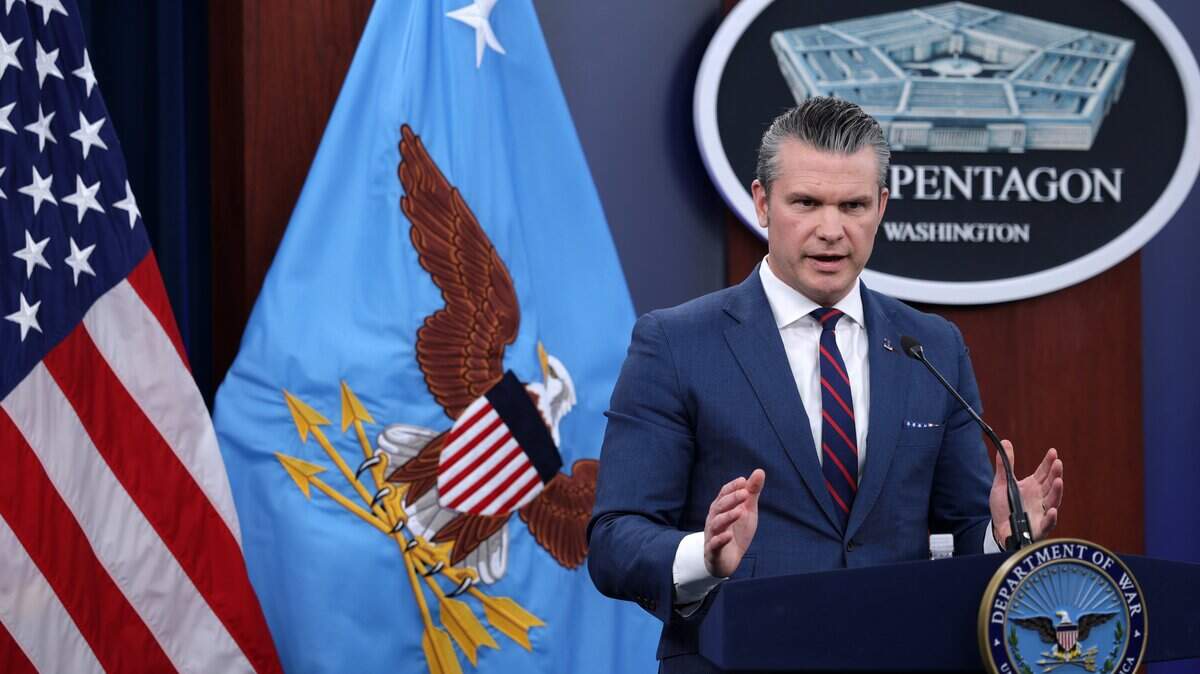
The U.S. Department of Defense is cutting ties with more than a dozen universities and pulling funding for military education while eyeing potential “value-aligned” replacements.
Auburn University is among 21 institutions identified as possible replacements in a memo titled “Aligning Senior Service College Opportunities with American Values.”
Attempts to reach Auburn for comment were unsuccessful on Tuesday.
Why Auburn?
Auburn has been identified as a potential partner, but no formal agreement has been announced. However, the university’s next-generation defense technology could seem highly attractive to Secretary of Defense Pete Hegseth.
What makes it a good fit:
- Secured an $11.4 million contract with the Missile Defense Agency in 2025 to build a radiation-hardening test facility at Redstone Arsenal
- Auburn’s Applied Research Institute works directly with Army commands out of Huntsville’s Cummings Research Park
- Intentionally connects campus research with battlefield needs
- Re‑designated a National Center of Academic Excellence in Cyber Research by the National Security Agency
- Operates as a land, sea and space‑grant institution
- Auburn’s mission dovetails with the Defense Department’s Laboratory‑University Collaboration Initiative goal of engaging leading university scientists and students in long‑term basic research for defense
- Its mission further intentionally connects campus research with battlefield needs
What is the Pentagon cutting?
In a social media post and a memo he signed later that day, Hegseth announced the cancellation of troops’ attendance at graduate programs at several top universities. He called them “woke breeding grounds of toxic indoctrination.”
Schools cut include Harvard, Princeton, Columbia, MIT, Brown and Yale, effective the 2026–2027 academic year, including Senior Service College fellowships at 13 universities.
About 93 military students are enrolled across affected institutions; enrollees can finish their programs, but no new fellows will be placed.
Why are these universities being cut?
The internal memo describes the new preferred partners as having “minimal public expressions in opposition of the Department” and “minimal relationships with adversaries,” signaling an explicit ideological and geopolitical litmus test for where troops can study.
Hegseth’s stated reasons:
- He has labeled Ivy League and similar schools as “anti‑American.”
- Elite universities have become “factories of anti‑American resentment.”
- The institutions “replaced the study of victory and pragmatic realism with the promotion of wokeness and weakness.”
- Programs “no longer meet the Department’s standards for rigor, realism, and mission relevance.”
- Too many officers return from these programs “looking too much like Harvard,” with “globalist and radical ideologies” and not enough “warrior ethos.”
What is replacing the other institutions?
The U.S. State Department has separately suspended dozens of universities from its Diplomacy Lab program over DEI policies. This action is part of a broader pattern of using federal funding to reshape higher education along ideological lines.
Under consideration:
- Auburn University
- Clemson University
- The Citadel
- Hillsdale College
- Liberty University
- Regent University
- University of Michigan
- University of North Carolina (Chapel Hill)
- Virginia Tech (Virginia Polytechnic Institute and State University)
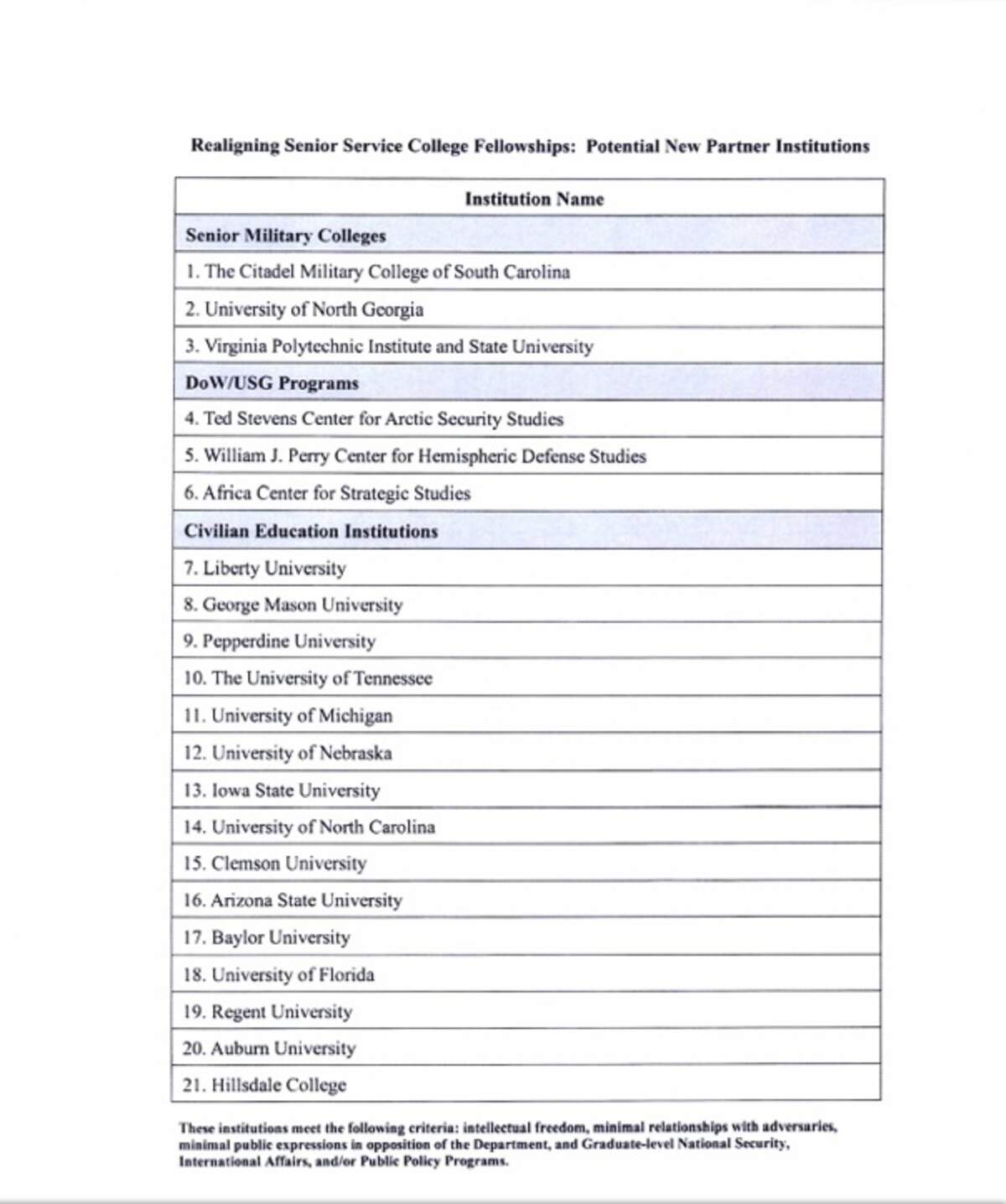
Fifteen more schools made the 24-institution list without being named publicly; all are evaluated on criteria like “intellectual freedom” and “minimal relationships with adversaries.”
This recent directive from Hegseth has drawn criticism from higher ed outlets as well as Democratic lawmakers, and legal action is pending from some of the purged universities.
No metrics or criteria about what constitutes a “value-aligned” partner have been given, and Auburn has not been tapped officially by the administration.
This story was originally published March 11, 2026 at 6:00 AM.