
9/11 created a strong bond in US. Does that spirit continue these many years later?
“Do you know where the director of Student Engagement is?” the man dressed as a hospital worker asked me on our campus. “We’d like to do a blood drive later this month.”
As I walked him over to the office, I remarked, “We must be your smallest blood drive of the Southeast.” He shook his head. “Actually, LaGrange College is one of our best places to have blood drives. You have three times as many blood donors as bigger universities.”
“Per capita?” I inquired. He replied, “No, that’s in overall numbers.”
After 9/11, our nation’s blood banks were overwhelmed by blood donors, each hoping to help our nation recover in some small way. Donations poured in. But was that a different time? Do we still see ourselves as linked by a common fate?
Matt Baretto, Lorrie Frasure-Yokely, Edward Vargas and Janelle Wong wondered the same thing. Right after the 2016 election, they surveyed what percentage of Americans see themselves as having a “linked fate” that “affects us all.” Whatever post-9/11 spirit we had then may not be as strong as it once was.
It was reassuring to see that a little more than 60 percent agreed that we do have a common fate, with African-Americans most likely to agree with the statement, followed by whites, Asian-Americans and Hispanics. Among those who agree with the statement “a lot,” again African-Americans led, followed by Hispanics, whites and Asian-Americans. Only about 30 percent of Americans see such unity as a big priority. But that’s still almost 40 percent who disagree, who see it as everyone for himself or herself.
At our church, our pastor and youth ministers organized a “Blessings in a Bookbag” where our church kids would pack meals for needy students to have a meal or two over the weekend. Turnout wasn’t too bad on a late Sunday afternoon, where kids gave up watching the NFL or playing videogames to help students they’ll probably never meet. Do the kids “get it” in a way some adults might have forgotten?
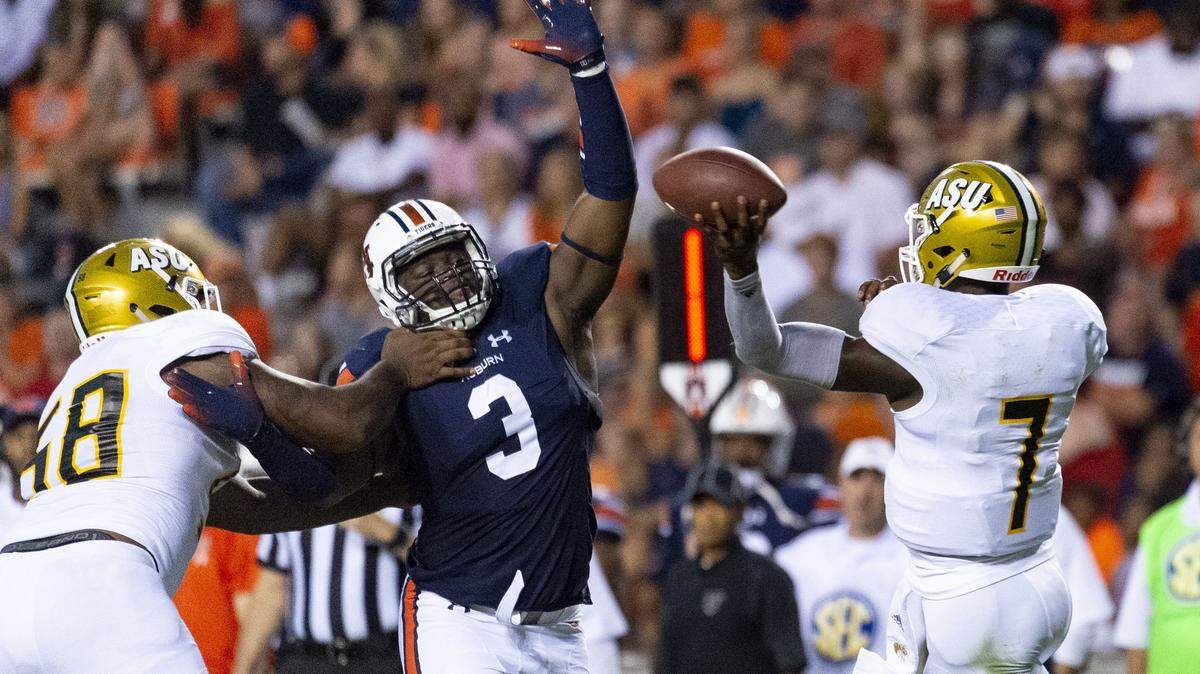
It was encouraging to attend the Auburn University football game a couple of weekends ago. The students and fans generally treated the visiting Alabama State University fans pretty well, even cheering the ASU band with the same intensity as a “War Eagle” battle cry after each Auburn Tiger touchdown. (That band was really that good!) But students told me a fraternity mocked ASU’s graduation rate in a classless pregame display.
Moreover, as we debate the response to Hurricane Maria, I heard that at a different school, some kids were claiming we shouldn’t help Puerto Rico because “they aren’t really Americans.” Not only is the statement false, but shouldn’t we be our brother’s keeper even if they weren’t Americans?
Nearly 150 students packed into our presentation, discussion and prayers on 9/11 this year, in a room with seating for only 75. One student who spoke was moved to tears, saying how happy her dad in the armed forces would be if he could see the turnout, and hear the students speak. I pray we don’t need another 9/11 tragedy to regain that spirit of unity, and to understand that we share that common fate, no matter our race or ethnicity.
John A. Tures is a professor of political science at LaGrange College in LaGrange, Georgia. He can be reached at jtures@lagrange.edu. His Twitter account is JohnTures2.