Next step in I-185 interchange project gets green light. Here’s latest on timeline
Columbus Council has approved an application to rezone a vacant property for church use, further paving the way for the ongoing I-185 interchange project.
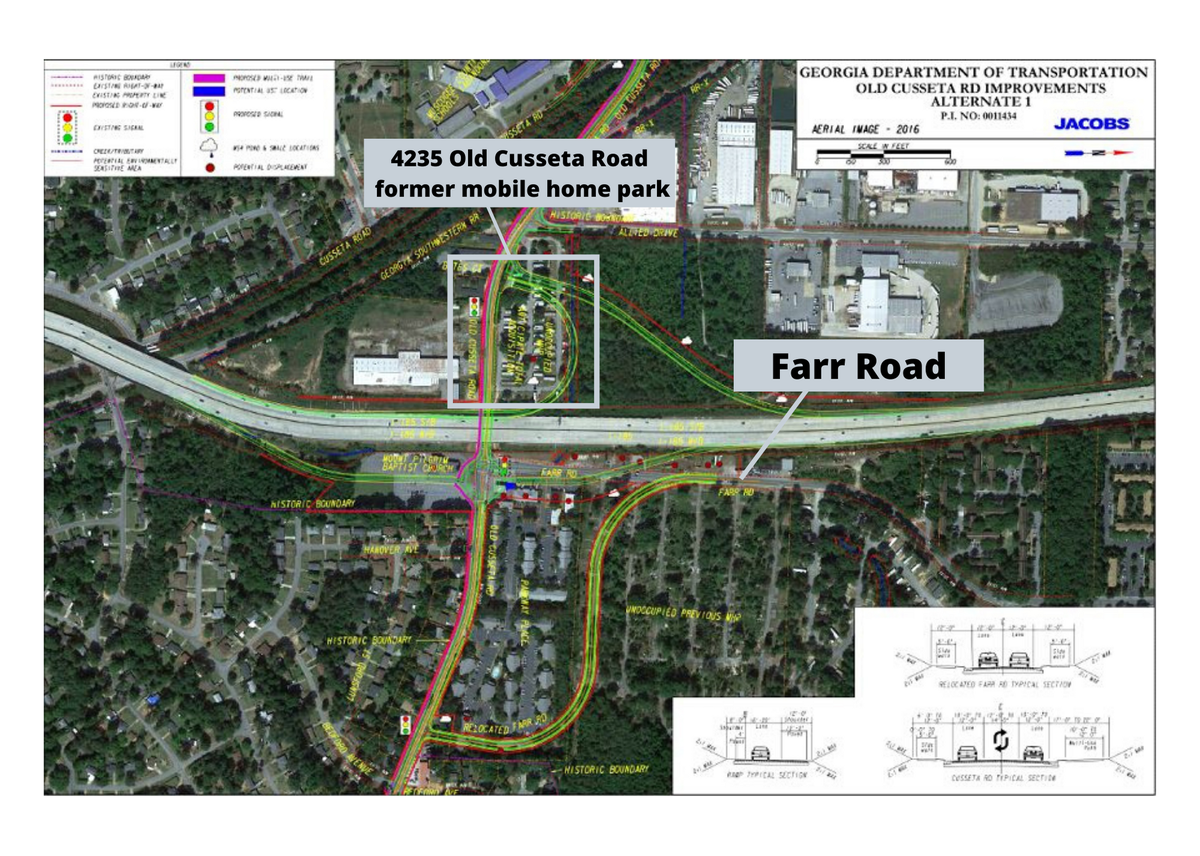
Council approved a resolution on May 25 authorizing a special exception to allow a church with more than 250 seats in a general commercial zoning district at 375 Farr Road. This will allow Mount Pilgrim Baptist Church to build its new location, which is part of the action necessary to clear the way for the I-185 interchange at Old Cusseta Road.
Columbus Consolidated Government Planning Director Rick Jones told the Ledger-Enquirer that the proposed off-ramp would “really go right through the middle of the church.”
“We were sensitive to their needs, and they understood our needs,” Jones said. “We envision really that the interchange will open up that entire area of the community for new development possibilities.”
The interchange project will add on- and off-ramps from Old Cusseta Road to I-185’s northbound and southbound lanes, and relocate Farr Road.
Next steps
Georgia Department of Transportation is acquiring additional right of ways (types of easements that allow someone to travel through another person’s land to get somewhere else) necessary for the project.
That probably will take another year to 18 months, Jones said. The city hopes that process wraps up by summer 2022.
Construction for the project is expected to start by Q1 of 2023, with completion around three years later in mid-2026, Jones said.
Controversial past
A Tampa, Florida, bankruptcy court judge rejected a $50 million lawsuit in January of last year, in which an out-of-town property owner argued the Columbus city government illegally demolished mobile homes on his property.
Fort Benning Estates, a trailer park at 527 Farr Road, was condemned by the city as a public hazard in December 2018. City contractors demolished the homes in October 2019.
Florida resident Caleb Walsh owns the property under the name Columbus Partners Community Trust, according to the Columbus Consolidated Government’s public access site. He claimed the city without notice demolished the Farr Road property and another he owns at Old Cusseta Road, despite being protected by his Chapter 11 bankruptcy filed in July 2019.
Demolishing the mobile homes on Old Cusseta Road cost the city an estimated $188,500, and demolishing Fort Benning Estates cost an estimated $229,500.
Walsh filed a motion for damages against the city in November, seeking $50 million to “restore affordable housing to Columbus.” He said the city destroyed a total of 250 units.
Chief Judge Caryl Delano denied the motion at a December 16, 2019 hearing in Tampa.
City records show Walsh was warned multiple times of code violations at both properties.
Inspectors visiting Fort Benning Estates In November 2018 found the site lacking hot water, sewage disposal and trash pickup, and declared the property and its trailers unfit for human occupancy.
Walsh was given 10 days to resolve those issues, and the city condemned the mobile homes after no apparent efforts were made. Residents were ordered to vacate the site no later than January 3, 2019.
In an April 1, 2019, letter from former City Building Inspections and Code Enforcement Director John Hudgison, Walsh was notified of city code violations such as overgrown grass, solid waste accumulation and hazardous waste management issues at the site. Records show the letter was delivered and signed for April 5 at Walsh’s company address.
Walsh’s Old Cusseta Road mobile home park was cited in March and June for code violations such as overgrown weeds and solid waste.
Walsh filed for Chapter 11 bankruptcy on July 25, 2019.