
As Georgia enters COVID-19 resurgence, Columbus rates stay low. There’s a likely reason why
Columbus’ mask mandate has likely been a significant factor in keeping local coronavirus case rates low as Georgia heads into a COVID-19 resurgence.
As of Nov. 26, the state’s case rate is 317 cases per 100,000 people over the past 14 days, according to data from the Georgia Department of Public Health. Georgia has been in the “red zone” for case rates since Nov. 8 when the state hit a rate of 112 cases per 100,000 people.
In Columbus, the current rate is 144 cases per 100,000 people. Though case rates are lower locally than in the rest of the state, they’re still high — anything above 101 cases per 100,000 people will put an area in the red zone. Columbus’ case rate has stayed above that threshold since Nov. 9.
The virus was surging in Columbus in the summer months and peaked at 706 cases per 100,000 people on July 13, according to raw case data analyzed by the Ledger-Enquirer. The mask mandate was issued on Aug. 21 and by Oct. 10 the case rate in Muscogee County had fallen to 97 cases per 100,000 people.
Large-scale public health data show that communities where mask mandates were implemented report fewer cases and lower levels of COVID-19 transmission compared to those that do not, said Dr. Harry J. Heiman, a clinical associate professor at Georgia State University.
The number of new cases in the weeks following a holiday can be a good indicator of the efficacy of mitigation efforts, says Pamela Kirkland, spokesperson for the state health department’s West Central Health District.
A week after the July 4th holiday weekend, the health department was already seeing spikes in newly reported cases. Following Labor Day weekend — when the mask mandate was in effect — the number of new cases remained relatively constant. Kirkland cites this as a good sign that mask-wearing, social distancing and other public health measures are working.
Once case rates decline below 100 cases per 100,000 people, local governments can’t enforce a mask mandate, per Georgia Governor Brian Kemp’s executive order. Cases in Columbus began to rise again almost as soon as the mask mandate was lifted in late October. Muscogee County’s 14-day case rate rose back up above 100 cases per 100,000 people on Nov. 9.
“You can almost see where we discontinued it because it immediately began a very, very slight increase,” said Columbus Mayor Skip Henderson.
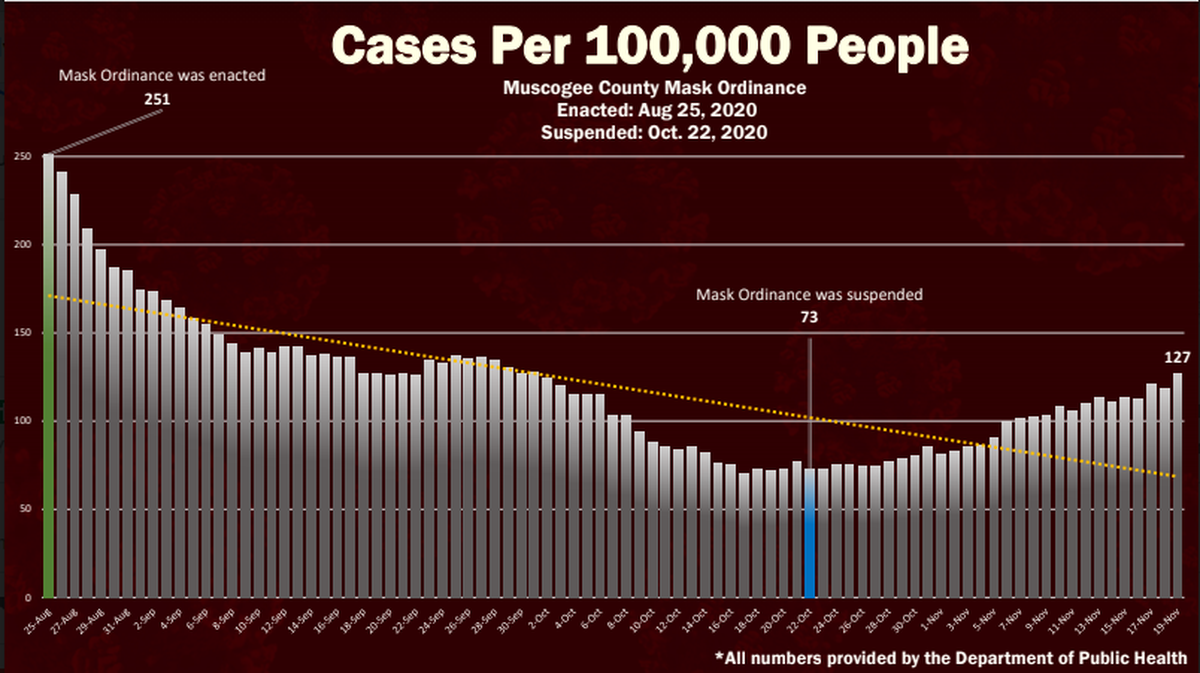
Henderson reinstated the mask mandate on Nov. 19, and hopes it will help offset post-holiday surges. Though case rates have continued to rise since then, it usually takes a few weeks to see the impact of mitigation efforts.
“We need to make sure we’re doing all we can to keep this from getting ratcheted up into a full-blown second surge,” he said.
This week’s coronavirus numbers near Columbus
In Muscogee County, 151 new cases of COVID-19 were reported from Nov. 20-26, according to data from the Georgia Department of Public Health. A total of 6,865 cases and 185 deaths have been reported in Muscogee since the start of the pandemic.
The test positivity rate in Muscogee County averages 4.7% over the past seven days.
In Chattahoochee County, 37 new cases were reported in the same time period. A total of 1,951 cases and one death have been reported in Chattahoochee County since the start of the pandemic.
The test positivity rate in Chattahoochee County averages 1.8% over the past seven days.
What’s in the White House report
The most recent report from the White House’s coronavirus task force shows that Georgia is in the early days of a full resurgence.
There’s been an increase in new cases across the state, accompanied by stability in test positivity. This means that an increase is due to an increased prevalence of the virus, rather than increased testing.
In Georgia, 16,924 new cases were reported from Nov. 16-22. That’s a 36% increase from the previous week. Test positivity was 8% from Nov. 16-22, a change of 0% from the previous week.
Georgia is in the red zone with 159 cases per 100,000 people and the 48th highest rate in the country. The report notes that 66% of all counties in Georgia have moderate or high levels of community transmission.
This is the moment to dramatically increase mitigation, the report says.
Georgia hospitals are reporting early signs of a reduced supply of protective equipment, such as gloves, gowns, and N95 masks.
Proactive, focused testing for the identification of presymptomatic and asymptomatic cases is recommended. Silent spread from presymptomatic and asymptomatic individuals continues to drive surges.
“This must be combined with significant behavior change of all Americans,” the report reads.
Recommended behavior change includes wearing masks at all times in public, increasing physical distancing by lowering the capacity of public and private indoor spaces, and ensuring “every American understands the clear risks of ANY family or friend interactions outside of their immediate household indoors without masks.”
Staff writer Nick Wooten contributed to this report.