Environmental groups want GA PSC to delay $15.6B Georgia Power decision. Here’s why
The Sierra Club and the Southern Alliance for Clean Energy, two environmental advocacy groups, formally asked the Georgia Public Service Commission Wednesday to hold off on a final decision in a major Georgia Power business request until newly-elected commissioners are in the room.
PSC staff and intervenors were set to take the podiums Dec. 10, 11 and 12, briefs were to be made Dec. 16 and a final decision was set to be made Dec. 19 about whether a 10 gigawatt, $15.66 billion dollar power request from Georgia Power would go forward.
Isabella Ariza, lawyer for the Sierra Club and SACE, filed a motion for a 30-day extension for hearings and decision, which would push the events to January. Two newly elected commissioners, Alicia Johnson and Peter Hubbard, will have started their time in office by then.
The motion says there was overwhelming support for the two newly-elected Democrats in the polls, showing a desire from Georgians to break from the current commission’s makeup. The motion also says the request from Georgia Power, which would have a timeline from 2027 to 2031 but would impact energy for the foreseeable future, is unprecedented in its size and scale. The motion also says that making a decision that significantly influences the next 45 years of power plans should not be decided by people leaving these roles.
“A decision in the All Source Certification dockets should not be finalized during a transition period when newly elected commissioners have yet to take office,” the motion reads.
The motion also says Hubbard and Johnson each won nearly 63% of the vote, and no candidate has received more than 60% since 1998.
“Georgia voters overwhelmingly rejected the current PSC’s approach to oversight of Georgia Power,” Adrien Webber, from the Sierra Club Georgia Chapter, said in a statement. “This proposal will have a generational impact on our state; The PSC should respect the will of the voters and allow Commissioners-Elect Johnson and Hubbard to consider the merits of this plan.”
This major request from Georgia Power is part of an all-source RFP and a supplemental plan. It would be the largest approved plan in “a single docket in the history,” the motion from the environmental groups says. The Sierra Club and SACE lawyer suggests this should not be rushed, and the final decision does not have to be Dec. 19, but could be as far out as March 10, 2026, per a 180-day procedure which began Sept. 11, 2025.
The entire portfolio today for Georgia Power is 16 GW. The power company wants to increase it to about 25 GW by 2031. Georgia Power wants to source the energy through a mix of battery storage and solar, as well as gas. The make-up of the proposed 10 GW is roughly 60% gas and 40% batteries.
Of the nearly 10 GW of requests, 3.7 GW would be supplied by Georgia Power-owned natural gas plants at plant Bowen, Wansley and McIntosh, which have a 45-year life span.
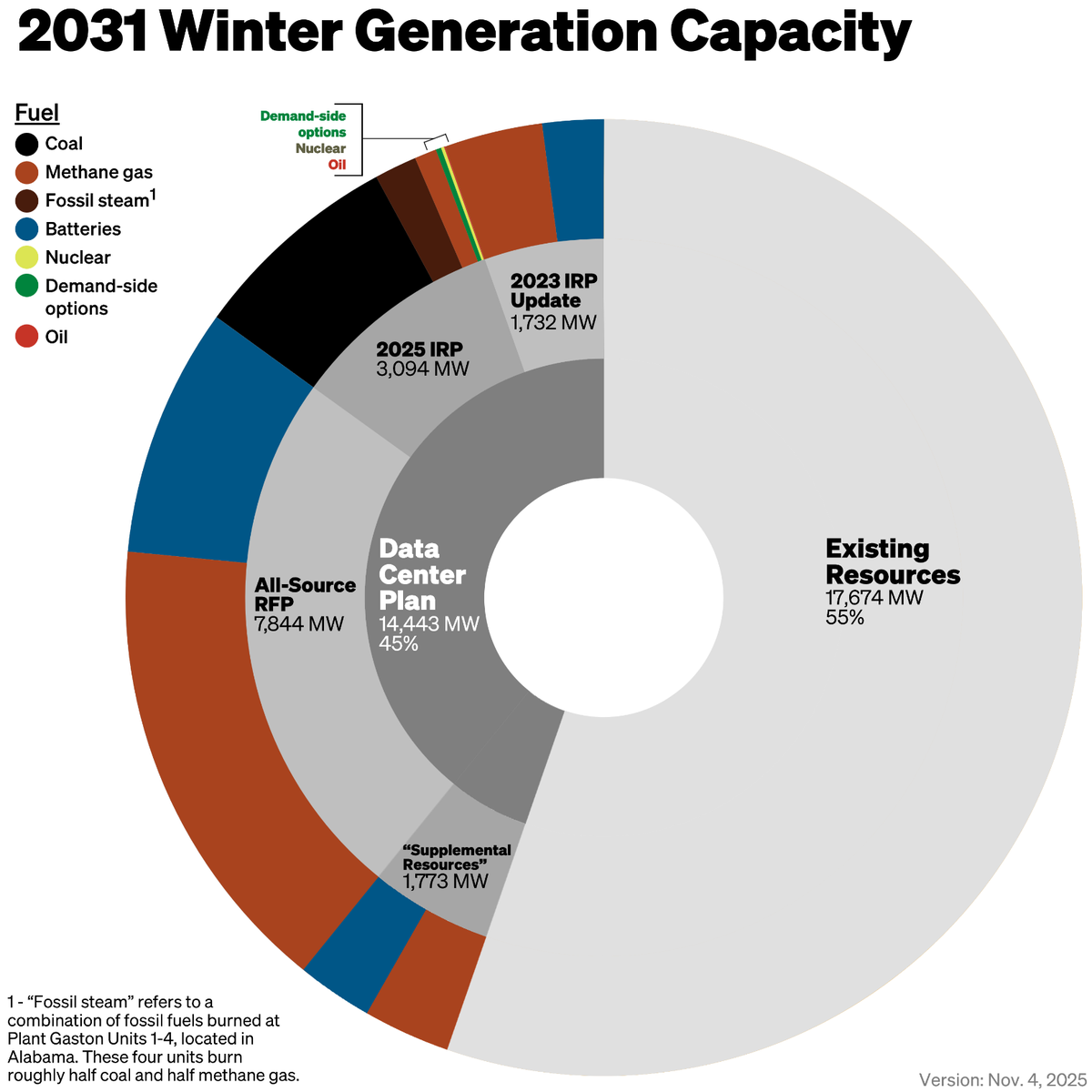
“The 3.7 GW alone is enough to power the entire metro Atlanta area’s residential load,” the motion states.
“Approving Georgia Power’s plans to run these extraordinarily expensive new fossil gas plants will lock electric customers into increased rates and volatile fuel costs for decades to come,” Stephen Smith, Executive Director of SACE said in a statement.
The request is so large because of data centers. Francisco Valle, Georgia Power forecasting director, testified in September with the commission, stating 90% of the growth is because of data centers.
What could the Georgia PSC do, and when?
The PSC’s public information officer, Tom Krause, said the PSC can make their decision about the motion at a committee meeting. The next committee meeting is Nov. 26. .
PSC Chairman Jason Shaw has “unilateral” power, according to Krause, and could approve or deny this request from the environmental groups. The commission also could discuss the motion and vote on it.
When asked if there is a comment from the PSC or when Shaw might make his decision, Krause said the commissioners “do not have any comment at this time” and “the Chairman has not made a decision” as to how the motion will be addressed.
“A 30-day extension is nothing compared to the scale of the decision being made, which will shape Georgia’s energy system, public health, and climate trajectory for the next generation,” Ariza told the Ledger-Enquirer.
This story was originally published November 13, 2025 at 2:19 PM.
CORRECTION: This story has been updated to clarify the next committee meeting for the PSC, and how the PSC could decide to address the motion.