This Georgia power provider is upping its green energy with 500-acre solar plant
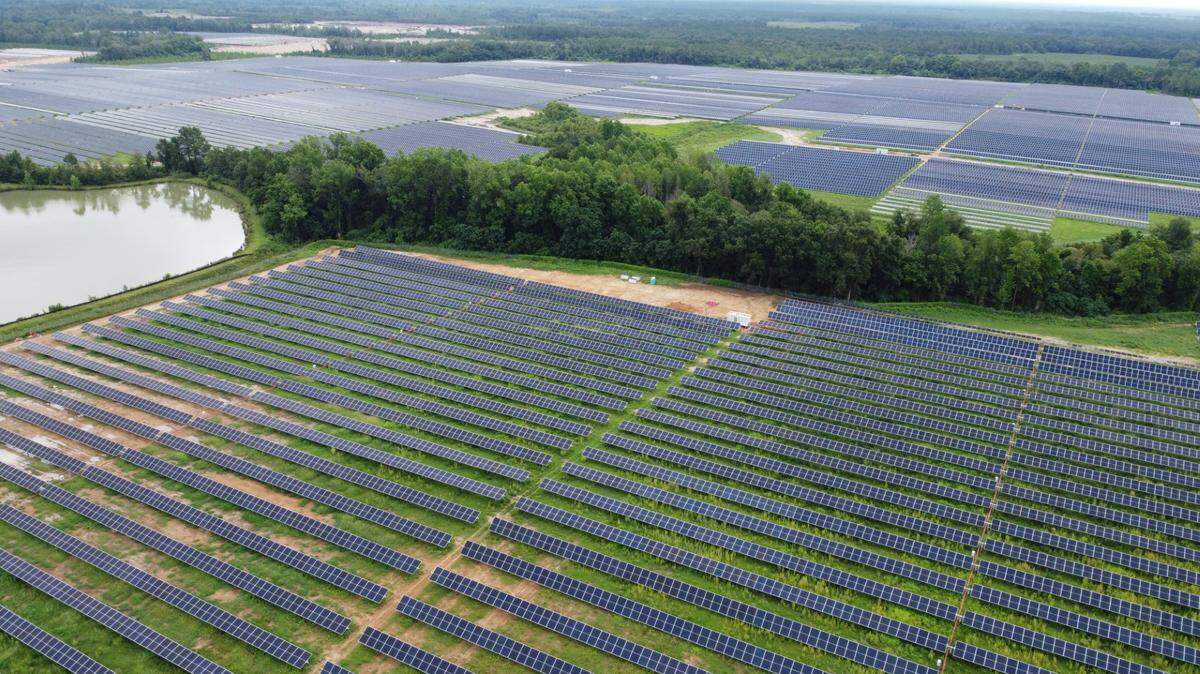
The Municipal Electric Authority of Georgia Power is moving into solar power plants, marking a major move for MEAG, which has operated since 1975 as a public power organization delivering electricity to cities and towns across Georgia by selling it wholesale directly to cities.
MEAG Power has partial ownership in power plants such as nuclear Plant Vogtle and Plant Hatch, as well as gas plants including Wansley and Scherer. Those partial ownerships have allowed MEAG Power to deliver energy to 49 cities and towns, about 635,000 customers, across Georgia.
Since 2016, an average of about 65% of the organization’s power has been emission-free, largely because of nuclear power, according to MEAG’s latest annual report. MEAG Power delivered 2,300 MW of energy in 2024, and 56% of it was nuclear.
The amount of emission-free power will rise thanks to the organization’s first-ever solar power plant, which is expected to deliver 80 megawatts of clean energy to 22 MEAG Power cities this spring.
A 500-acre development called Pineview Solar broke ground in Wilcox County just over a year ago. Between now and April 1, all 20 inverters are to be turned on, soaking up the sun’s energy and converting it to electrons powering 15,000 homes annually.
“Adding solar energy to our balanced resource mix is a significant step for MEAG Power and our participants,” said MEAG Power President & CEO Jim Fuller during the November groundbreaking. “Non-emitting solar generation from Pineview will add diversity to our generation portfolio, further enabling us to provide reliable, affordable, and clean energy to our Participants throughout the state.”
The municipal electric authority has a 15-year power purchase agreement with Linea Energy, a solar developer. MEAG Power said this power project will prevent the release of 1.5 million tons of carbon dioxide – a global warming pollutant – over the 15-year agreement.
Stephen Smith, the executive director of Southern Alliance for Clean Energy, supports this project because it makes sense financially and adds clean energy to Georgia’s grid.
“We are 100% supportive and very glad to see they are doing solar development,” Smith told the Ledger-Enquirer. “I applaud it and will continue to say this – solar is the least cost, least risk generation option available to anybody trying to generate electricity today.”
Felipe Rivera-Uribe, a senior development analyst on the Pineview Solar project team, said the project was able to utilize Inflation Reduction Act tax credits. A good chunk of the credits will expire soon from the budget reconciliation “Big Beautiful Bill Act” passed last year.
“The investment tax credit helped reduce the cost of electricity for rate payers,” he said. “We cannot disclose the exact cost of the project, but it is in line with industry standards.”
Smith speculated as to why Linea and MEAG Power didn’t utilize battery storage to couple the solar project because of solar’s “intermittent” deliverability, and said it has “maximum viability with battery.”
Rivera-Uribe said the original agreement didn’t include battery storage at the time, and the project team isn’t advancing it now, but it could be added at a future point.
MEAG Power’s website says the organization is projected to be “nearly 90% emissions-free by 2045.”
Discovery Industries managed construction on the facility, which employed up to 224 workers at its peak. Anywhere from two to 24 people will work at the facility while it’s operating, Rivera-Uribe said. The closest town, Pineview, has 469 residents.
Linea and MEAG Power selected this site because of its proximity to electrical infrastructure and load, and few environmental constraints (flat ground, few wetlands), according to Rivera-Uribe.
“The underlying land is currently owned by members of the Wilcox County community and is being leased to Linea for the purpose of the project,” he said.
Smith said MEAG Power investing in its own generation is smart, and he emphasized the low-risk of solar in the current energy economy in Georgia.
“They are being smart investing in their own generation and they are going with low cost low risk options,” Smith said. “It is consistent with a public power message in wanting to look out for customers and not just make profits for shareholders. I think that public power should be the tip of the spear in deploying clean, renewable energy that is low risk and low cost.”
“With the overbuilding by Georgia Power and speculative data centers you want technology like solar that is low cost and low risk,” he added.
The 22 MEAG Power communities who will receive the solar benefits are: Albany, Blakely, Buford, Cairo, Calhoun, Camilla, Cartersville, College Park, Covington, Crisp County, Douglas, East Point, Forsyth, Griffin, LaGrange, Marietta, Monroe, Moultrie, Newnan, Palmetto, Thomasville, and Oxford.
This story was originally published January 13, 2026 at 6:00 AM.
CORRECTION: Stephen Smith’s name was spelled incorrectly in a previous version of this story.