Updated design shows a new Muscogee County Jail could cost more than $480 million
After completing the schematic design process on a potential new Muscogee County Jail, officials said the latest estimate to construct the replacement facility would cost more than $480 million.
Columbus Department of Inspections and Code director Ryan Pruett joined Douglas Kleppin, an architect with the SLAM Collaborative of Atlanta, Doug Shaw, an associate architect with Jericho Design Group of Cumming and Henry Painter, senior project executive with Gilbane Building Compan of Atlanta, to provide the Columbus Council with an update on the design of the proposed new jail.
The council has not voted to construct a new jail but did approve exploring a design and estimated costs for one on city-owned property on 11th Avenue, south of Cusseta Road, within a mile of the courthouse.
The current jail, 700 10th St., comprises sections built in 1984 and 2004.
During the April 28 council meeting, Pruett and the team working on the project presented the design. This design process began in 2022 following a request for proposals to study whether to renovate the current jail or build a new facility, Pruett said.
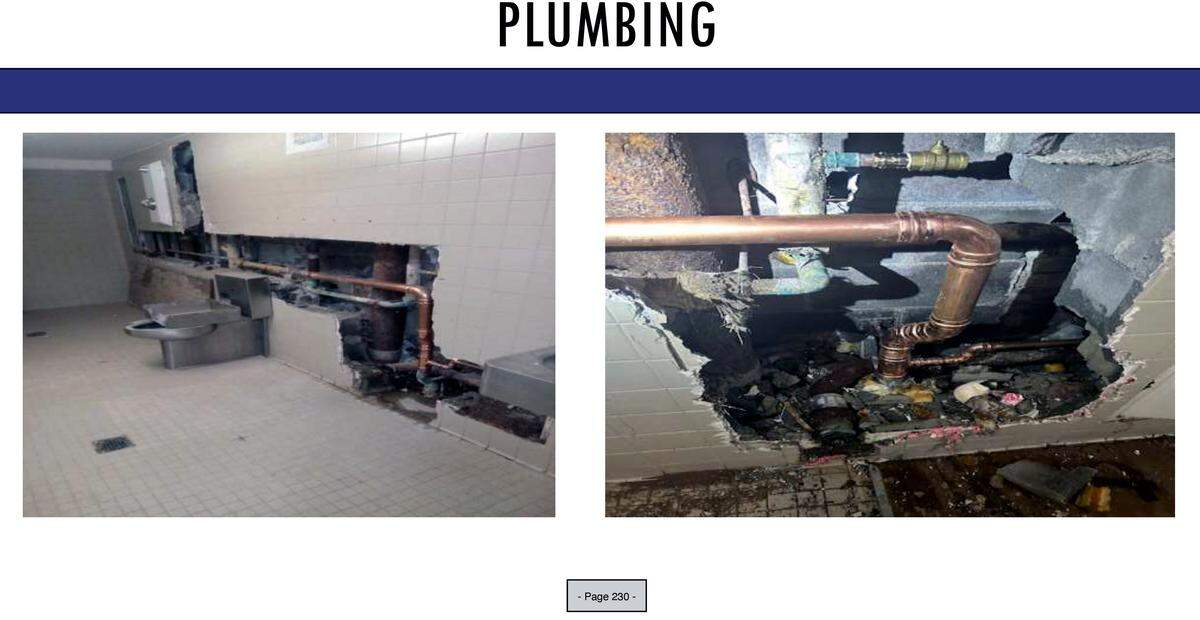
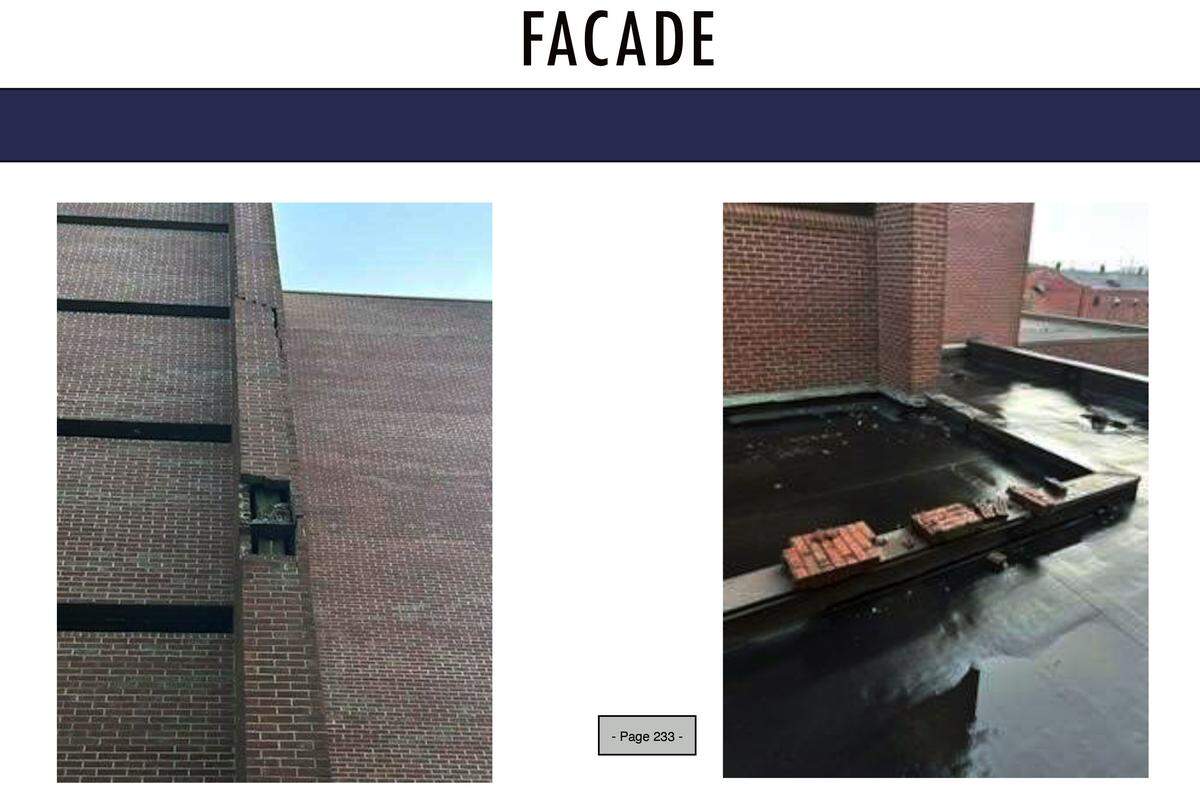
In examining the current jail, a several infrastructure issues were identified, Kleppin told the council, including the failing building envelope and exterior brick, problems with the roof and leaking pipes.
The group compared building a new jail in various locations, including a remote site, another downtown site or renovating the existing jail. Using the current site is the more expensive option, Kleppin said.
Attempting to piecemeal the construction in the existing jail while it’s in full operation, along with security concerns, increases the costs, he said.
Previously, cost estimates for a new jail ranged from $340 million to $370 million, Kleppin said. Between 2024 and 2025, these estimates rose to around $400 million because of inflation, he said, without the group changing anything with the design.
In August 2025, a new jail was estimated to cost $398,697,600. Now that the schematic design process is complete, the estimated cost increased to $481,663,833.
The estimated square footage increased from 488,600 in August 2025 to 576,000 in 2026. The estimated number of beds increased slightly from 1,600 to 1,604, and the estimated number of cells increased from 800 to 898.
Areas of the jail and addressing mental health
One major consideration in the design was how a new jail would be structured, Kleppin said, and the design team considered concepts for a two-story jail and a three-story jail.
“It’s not going to be a vertical tower like you currently have,” he said.
Areas in the jail include:
- Recorder’s Court
- Public area/visitation
- Detention administration
- Booking, transfer and release
- Security administration and classification
- Program services suite
- Medical services
- Food services
- Laundry services
- Secure housing area
- Staff support areas.
The design team worked with Muscogee County Sheriff Greg Countryman to determine the types of people who would be inside the facility and determined a priority for a new jail would be supporting mental health and having mental health beds, Shaw said.
“We talked a lot about the suicide beds that he has currently,” Shaw said. “And we wanted to expand that because he’s got needs for suicide beds, but he doesn’t have the actual facility for them.”
In these discussions, the size of the building increased from previous estimates, Shaw said.
“When you do a mental health unit, you do it in a single story,” he said. “Most of the housing units in the regular housing are two-tier. You can do that with people who don’t want to jump over balconies, who don’t want to cause trouble.”
Since the mental health unit is a single level, Shaw said, it increases the footprint and geometry of the building, resulting in more square footage.
The increase in the number of cells and beds accommodates the specialized population in the jail, Shaw said.
“I think it’s fair to note that this has built-in expansion because there are things that could be done to (house) a denser inmate population with this amount of square footage,” he said. “You, in effect, have built in some contingency with this respective program.”
Another factor in the design process was having the ability to bring services, like Alcoholics Anonymous or GED programs, to the inmates, rather than inmates having to go to the services, Shaw said.
“That’s usually a security risk when you move these guys,” he said.
Potential jail’s layout
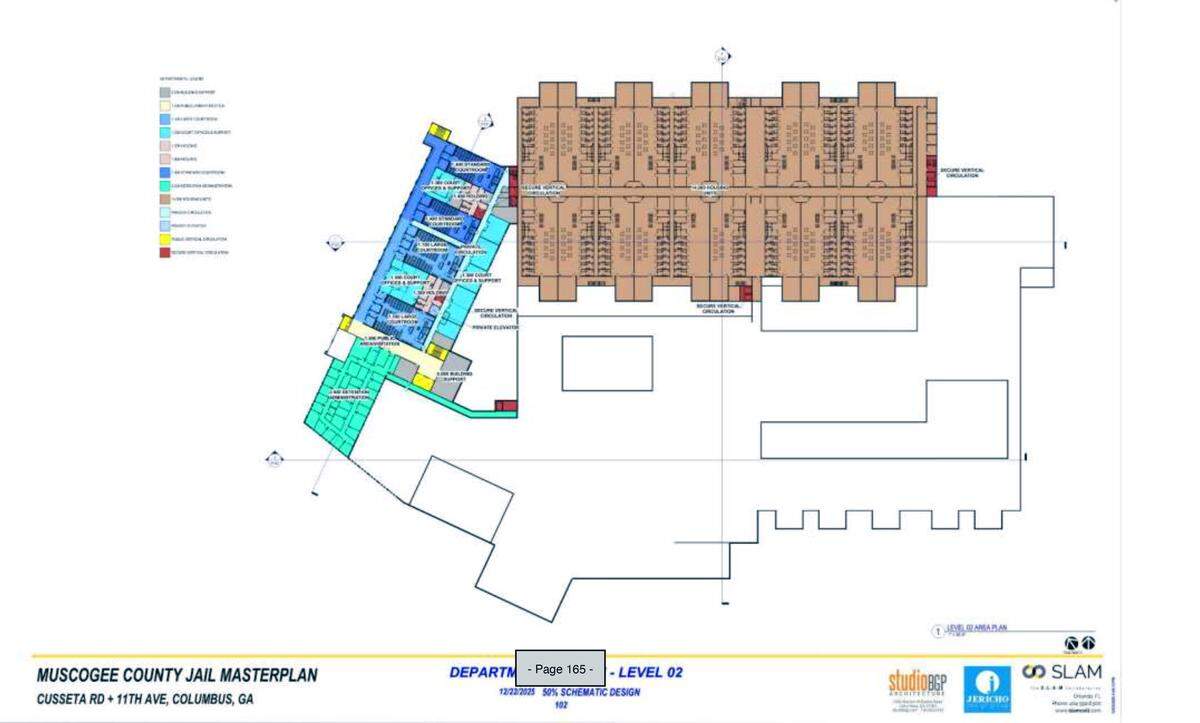
Shaw presented a layout of a proposed two-story jail and Recorder’s Court.
Housing units occupy the center of the plan, with an area at the top of the layout representing the general population.
“That’s a double-loaded corridor that has housing units on either side,” Shaw said. “It allows them to be monitored from a singular security desk at the mezzanine level.”
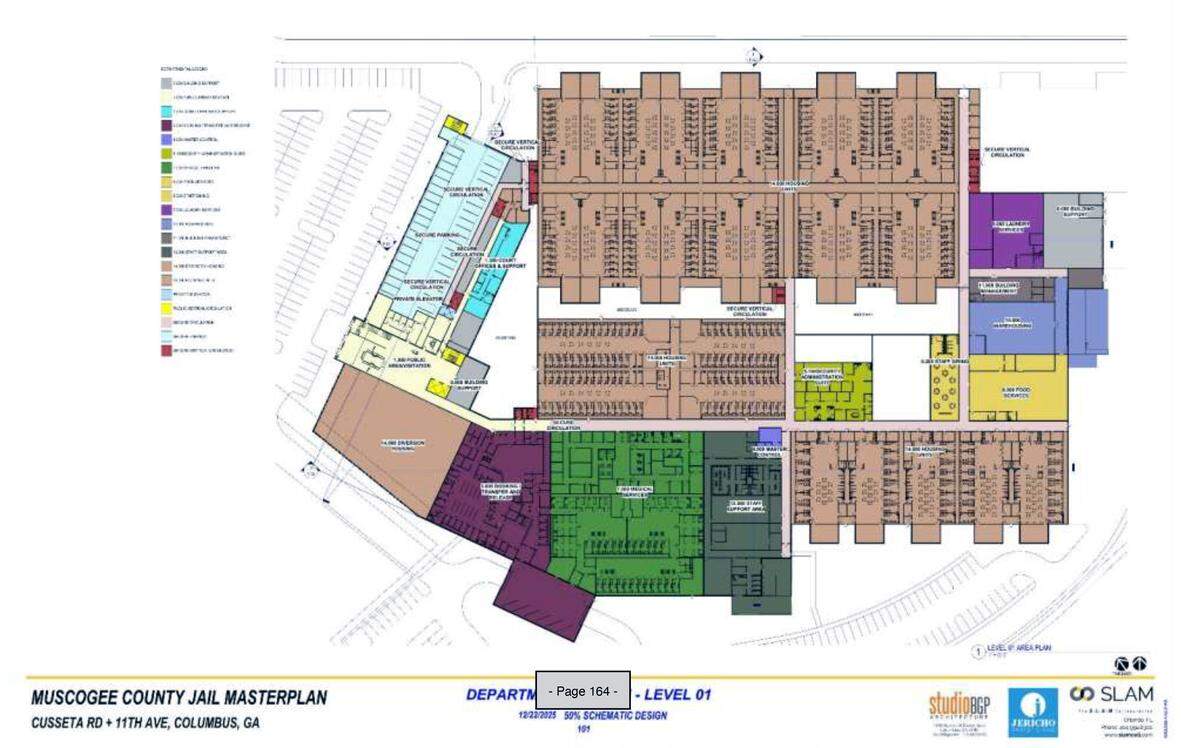
On the south side of the plan is the mental health unit, medical and booking. The west side of the building is the public face, Shaw said, and houses the Recorder’s Court.
“There’s secure parking for those individuals who are a part of that secure part of the Recorder’s Court.,” he said.
The warehousing, kitchen and laundry facilities would be on the other side of the building.
On the second floor is another area for Recorder’s Court, highlighted in blue on the layout. There are also administrative offices for the jail and general housing.
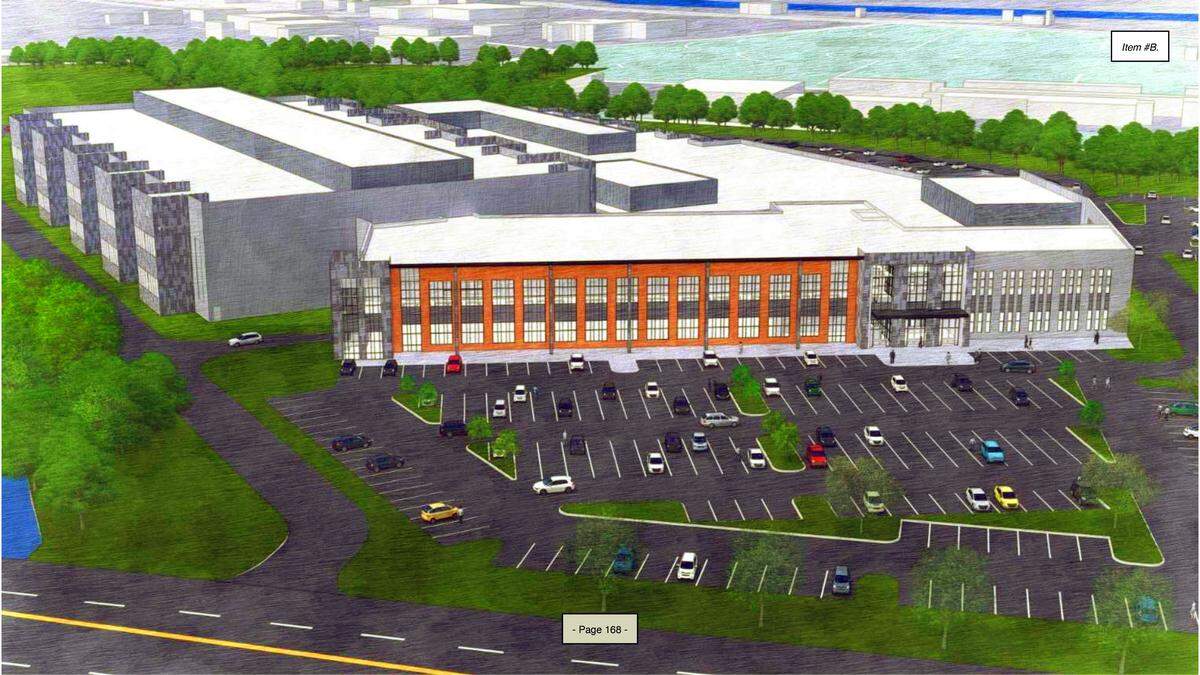
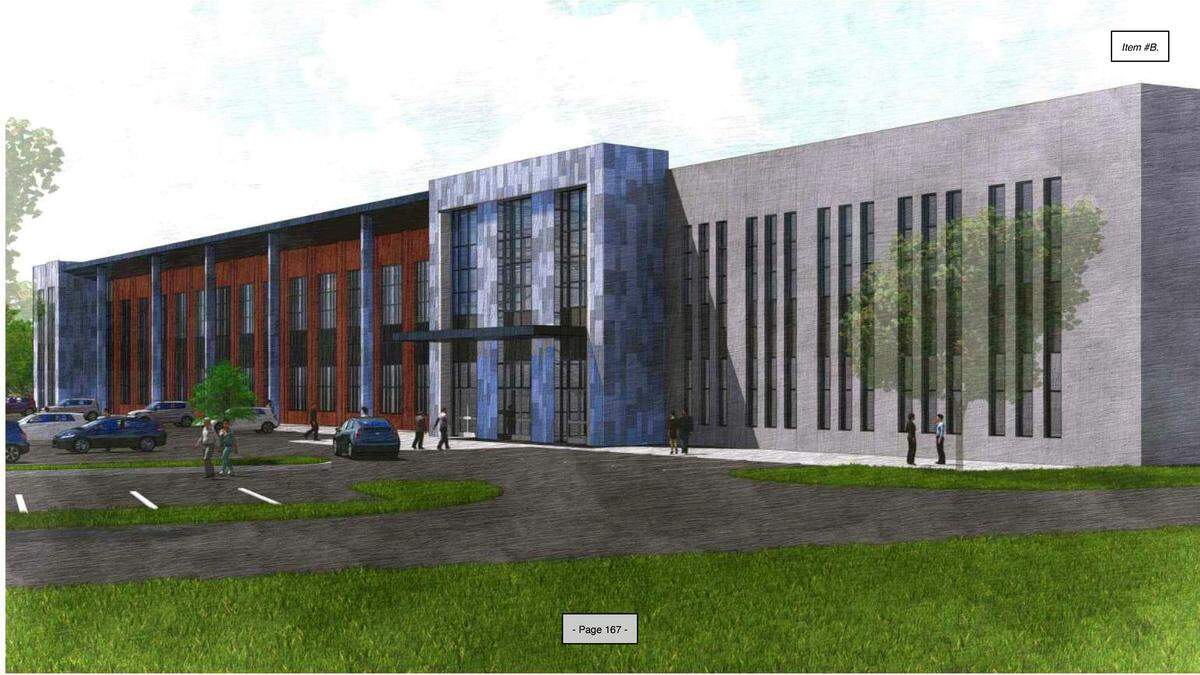
Shaw also presented some early renderings of what the exterior of the Recorder’s Court side of the jail could look like.
Changes to the design after August 2025
Painter explained during the presentation some of the notable changes to the jail’s design since the last update in 2025.
The increased number of cells will help Countryman manage the population better, Painter said.
This includes adding 24 suicide cells to the medical unit, totaling about 7,200 square feet, and increasing the number of single-occupancy cells throughout the building.
With the new cells, a multipurpose/exam room was added to the mental health single-cell unit, totaling 4,800 square feet, and additional circulation and mechanical spaces necessary to support the additional space.
A multipurpose room was added to each housing unit, totaling 38,000 square feet.
Case management offices were also added to the housing areas.
Changes to the proposed new Recorder’s Court include adding two additional courtrooms and a separate secure staff parking area under the court.
Columbus Councilors react, comparison to other jail construction projects
Mayor Pro Tem and Columbus Councilor Gary Allen of District 6 expressed concerns about the scale of the proposed new jail and the number of beds it would hold.
Included in the presentation slides was a comparison to other jail construction projects, showing their size and cost estimates. This included phase one of a new construction project in Fulton County that would have 1,800 beds and cost $536 million.
“They have over a million population,” Allen said. “Columbus is a little over 200,000, and we’re building 1,600 beds. I don’t see how that relates. We shouldn’t be building 1,600 beds.”
Pruett explained that the project in Fulton County was not the county’s only jail.
“That’s phase one,” he said. “But they’ve got two existing jails, and they total, I think, about 4,500 beds.”
Phase one was used in the presentation because it was a better comparison to what Columbus is considering, Kleppin said. But Fulton County is also doing renovations and other projects related to their jails, which would be difficult to compare.
Allen also asked questions about the number of single-occupancy cells. Pruett explained, in total, there are 320 single-occupancy cells, and 200 of them could be converted to double-occupancy.
“Would there be a way to make all of them convertible?” Allen asked
Pruett said this would have to be discussed with the sheriff because people in the mental health unit would likely not be compatible with a roommate.
Allen clarified that he was asking if a cell did not have someone with mental health needs, could it be used for a double-occupancy unit.
Pruett explained this would be complicated because those cells would still be in the mental health unit and this decision could involve mixing security levels.
“My question is can you reduce the number down, so that you don’t have the 1,600 beds,” Allen said. “I just can’t understand why we’re building such a large (jail).”
Allen said he didn’t understand why so many more cells are proposed when some can already be converted to double-occupancy.
The current jail’s maximum capacity is 1,069 inmates, Countryman told Allen.
“We are probably around 1,170, as of today,” he said.
The most inmates the jail has held is around 1,230, Countryman said. The sheriff’s work with state court judges to stop the sheriff’s office and the police department from bringing certain cases into the jail is the reason the occupancy dropped below that number, he said.
“If I had not done that, we would probably be around 1,300,” Countryman said. “Even if we build a 1,600-bed jail, at the rate we’re going, we’re probably going to be there by the time this jail is built because we’re doing everything we can to minimize the population.”
The sheriff’s office is “begging” the state prisons to take state inmates out of the Muscogee County Jail, Countryman said.
“I don’t want the monthly fee that they pay us,” he said. “I want them to get the inmates out of the jail because the more state inmates, and the more people, we have in jail, the more it drives up the medical cost.”
The jail has an increasingly sicker constituency, Countryman said, and building a 1,600-bed jail would reduce assaults because they can’t put inmates where they need to be.
“It’s frustrating,” Allen told Countryman. “I understand you have a job to do, but it’s frustrating to me because we’ve got to come up with the dollars to pay for it.”
Allen said he still doesn’t understand why so many single-occupancy rooms were included, but he agreed to have further discussions with Countryman about the issue.
Councilor Glenn Davis of District 2, who also asked questions about the square footage and the number of cells, emphasized the type of construction needed to build the jail is different from other construction projects.
“I just want to highlight that we’re not building for today, we’re building for tomorrow,” Davis said.
The “can’s been kicked down the road” for a while when it comes to building a new jail, and the city can’t wait any longer, he said.
“It’s specialty construction,” Davis said. “It’s at another level. It’s at a totally other level at a high cost. It’s not in the cost of your standard construction. I can just tell you that.”
The council is making decisions for people decades from now, Davis said, and he doesn’t want the city to have to return to deal with problems again in 10 to 15 years rather than investing the money now for a more long-term solution.
Councilor Joanne Cogle of District 7 questioned the design team on the proposed new jail’s maintenance cost per year.
Pruett said they would work to determine that answer. Cogle said it’s important for the decision-making because it would be a major factor in the overall cost of the project.
“It’s not something that I want our future generations to have to be forced into doing,” she said. “Our hand is being forced a little bit at this point.”
This story was originally published May 7, 2026 at 5:00 AM.