Columbus Council votes on rules to allow any hyperscale data center in Muscogee County
With a 6-2 vote Tuesday morning in the Muscogee County Public Education Center, the Columbus Council approved amending the Unified Development Ordinance of the Columbus Code to create a technology overlay district.
Councilors Bruce Huff District 3 and Toyia Tucker of District 4 were absent from the vote. Councilor Joanne Cogle of District 7, who is a candidate in the mayoral runoff election, and Councilor Simi Barnes of District 1 voted against the ordinance.
This approval will allow Choose Columbus, the marketing arm for the Development Authority of Columbus, to continue pursuing its proposed hyperscale data center, Project Ruby. The $5.18 billion project is targeted for 865 acres of wildland in northeast Muscogee County, also known as Upatoi. It can be built if the newly added requirements in the UDO are met and if the council approves the developer’s yet-to-be-submitted rezoning request.
The decision comes after four months of protest from Columbus residents in town and neighboring the proposed site, an online petition with 5,000 people opposing the idea, town halls against the data center, informational sessions conducted by data center proponent Choose Columbus, Columbus Planning Advisory Commission meetings, city council meetings with demands for a pause in the development, and an unofficial committee coordinated by the Greater Columbus Chamber of Commerce revising the technology overlay ordinance.
The PAC recommended the overlay March 23, with an intent to regulate data centers and related technologies, as request by the Columbus Consolidated Government.
Based on the 2025 combined millage rates from the city and the Muscogee County School District, Project Ruby would generate escalating annual property tax revenue, climbing to $68.7 million per year by 2030 before depreciation, and the data center would create 195 jobs with salaries ranging from $80,000 to $120,000 per year, Choose Columbus said in its February news release.
Cogle acknowledged hearing a lot from people who have emailed, called and a variety of recommendations sources, and said she still isn’t satisfied with where the ordinance has landed.
“This is a premature thing, and I’m not completely satisfied the enforcement will protect citizens,” Cogle said during Tuesday’s meeting.
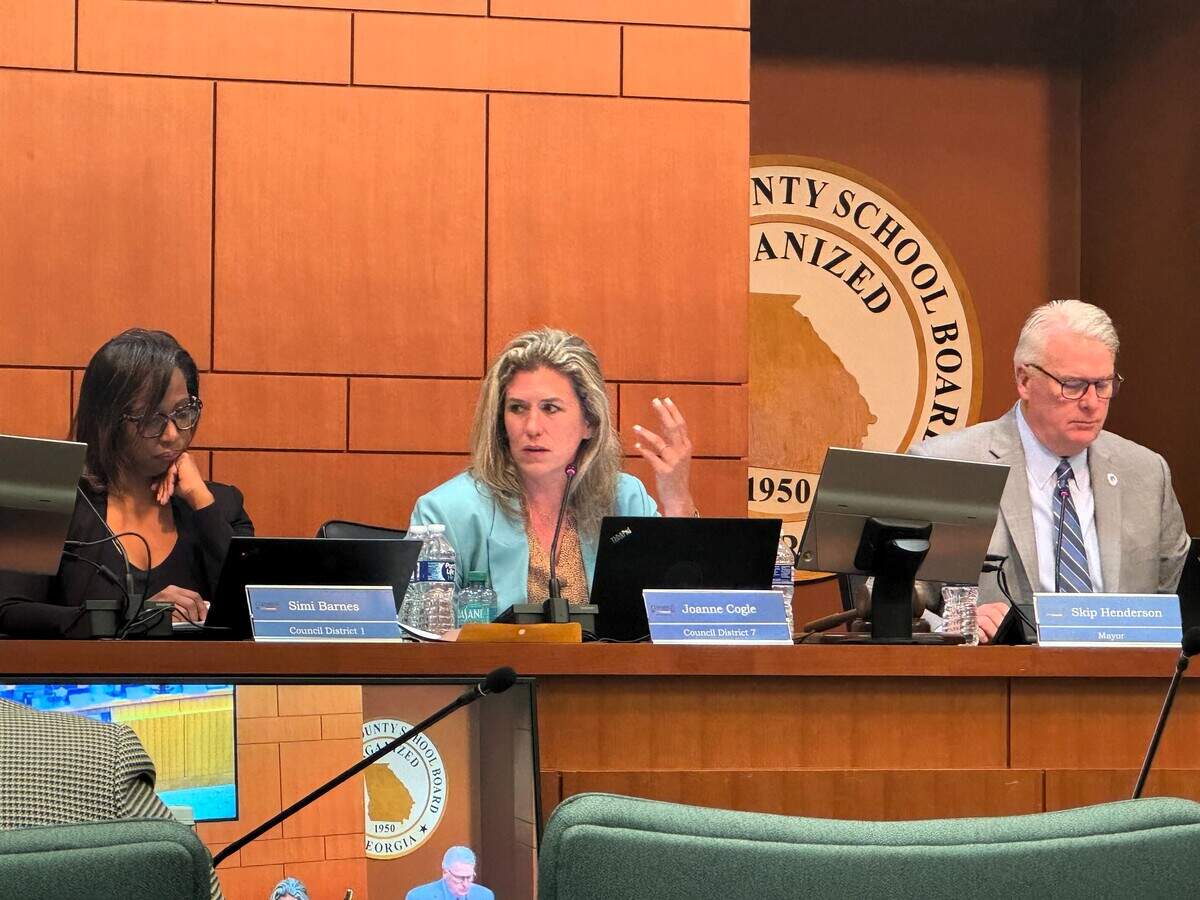
Applause echoed throughout the room.
Ahead of Cogle speaking, Councilor John Anker of citywide District 9 and Mayor Pro Tem Gary Allen of District 6 spoke, emphasizing this is not an ordinance for a data center but for an overlay.
“This is a tool,” Allen said. “We have no applications (for a data center).”
Anker also called the technology overlay a tool and said he is listening to both sides.
“We took the 500-foot recommended buffer by planning and zoning,” Anker said. “I’m prepared to vote no on any data center if it doesn’t follow 13 strong conditions. But this is not for a data center; it’s an overlay.”
Councilor Chairman Crabb of Disrict 5 said this overlay would help development other than data centers like Chips4Chips, robotics, “anything in the tech industry,” and encouraged people to continue to wear their red shirts protesting Project Ruby.
“I encourage you to keep your rural red shirts and signs,” she said, but, “this is not about a data center; it’s about a tech overly.”
The four main reasons the fight has consumed the residents of Columbus are affects on environment, property value, health and safety, which the ordinance does address.
Things like noise decibels for a data center would be between 55 decibels and 75 decibels depending on time of day, water is to be pre-treated on site before going to the Columbus Water Works treatment center, and diesel generators are to be Tier IV, the highest quality available.
The data center would require more power than all of Columbus currently uses at 600 MW.
A final plea
In a letter to Columbus Council on Sunday, resident Kate Wilson, pleaded with the councilors to vote no on the overlay. Wilson lives on Cartledge Road, less than a mile from proposed Project Ruby. She called the data center project a “threat” and “monstrosity” that has “consumed her and her husband since March.”
She mentioned the stress the other 350 families that live within two miles of the Project Ruby property and 1,250 people who live within the Upatoi area who are all in their “forever homes.” She called the Project Ruby fight the most important fight of her life.
“Vote No on the overlay, save this beautiful rural area from disaster, this stress is harming us all,” she wrote. “We don’t talk or think about anything but this. We don’t know what we’ll do if it happens or where we’ll go. Who would buy our home anyway knowing this was coming? Data centers belong in industrial parks. This ‘Project Ruby’ is selling your soul to the devil. Please don’t.”
No councilors had responded to her email at the time of this story, she said
A complaint with the AG
Columbus resident Paul Olson sent the Georgia Attorney General’s Office a complaint alleging the PAC violated the state’s open meetings law.
“Mayor Henderson and City Council I advised last time that we should not be at the juncture for them to vote for the Ordinance for the Overlay District because they failed to adhere to the letter of the Law,” Olson told the Ledger-Enquirer via email.
Olson claims the March 4 PAC meeting, ahead of the the March 23 recommendation, was not posted within the legal organ of the area, and therefore in violation of the law to have this ordinance discussion as far along as it is. The attorney general’s office has not made a decision about this complaint.
This story was originally published June 16, 2026 at 10:41 AM.