Over a dozen Columbus residents plead with city council for data center moratorium
Tuesday’s meeting of the Columbus Council took just over nine hours, with three of those hours discussing a proposed ordinance for a technology overlay district that would allow any data centers to be built in Muscogee County.
Like the June 9 meeting, a sea of red “No Data Center” and “Keep It Rural” shirts dominated the council chamber seats to protest and comment on the first reading of the proposed overlay. If approved June 16, it would be added to the Unified Development Ordinance or consolidated government code.
Choose Columbus announced in February the Development Authority of Columbus is working with Georgia-based Habitat Real Estate Partners on Project Ruby, a “private and secure site” to build a hyperscale data center for an undisclosed company that “includes a multiyear capital investment that could total more than $5.18 billion, spanning land acquisition, building construction and equipment installation between 2027 and 2030.”
Two weeks later, the Ledger-Enquirer confirmed the site comprises 865 acres of wildland in northeastern Muscogee County, bordering Harris County and Talbot County.
Based on the 2025 combined millage rates from the city and the Muscogee County School District, Project Ruby would generate escalating annual property tax revenue, climbing to $68.7 million per year by 2030 before depreciation, and the data center would create 195 jobs with salaries ranging from $80,000 to $120,000 per year, Choose Columbus said in its February news release.
The Project Ruby end user would be one of the Big 5 hyperscalers, Choose Columbus president and CEO Missy Kendrick has said: Amazon Web Services (AWS), Microsoft Azure, Google Cloud Platform (GCP), Meta (Facebook) or Apple.
While proponents of Project Ruby tout the economic benefits of a hyperscale data center, opponents have expressed concerns about environmental risks and possible utility rate increases.
Among the 24 people who spoke during the public comment period about the proposed technology overlay ordinance Tuesday afternoon, 13 people requested a pause on data center development and requested a moratorium.
Columbus residents Darlene Laird, Dalia Collins, Alicia Hercord and Theresa El-Amin asked for a one-year moratorium to slow this process and make a more informed decision.
“Power concedes nothing without a demand,” El-Amin told the council. “The demand is you must push forward on a moratorium on the data center in Muscogee County. That is the request. It’s the only thing that makes sense. We are not desperate for this.”
Laird said she doesn’t believe the council fully understands the issue and read an overlay moratorium resolution to council. She brought up the petition with more than 5,300 signatures and a Facebook group with approximately 1,400 members against the hyperscale data center. She also argued Columbus Water Works president Jeremy Cummings should have been around to answer questions, or council should have moved the overlay issue to earlier in the day when he was available.
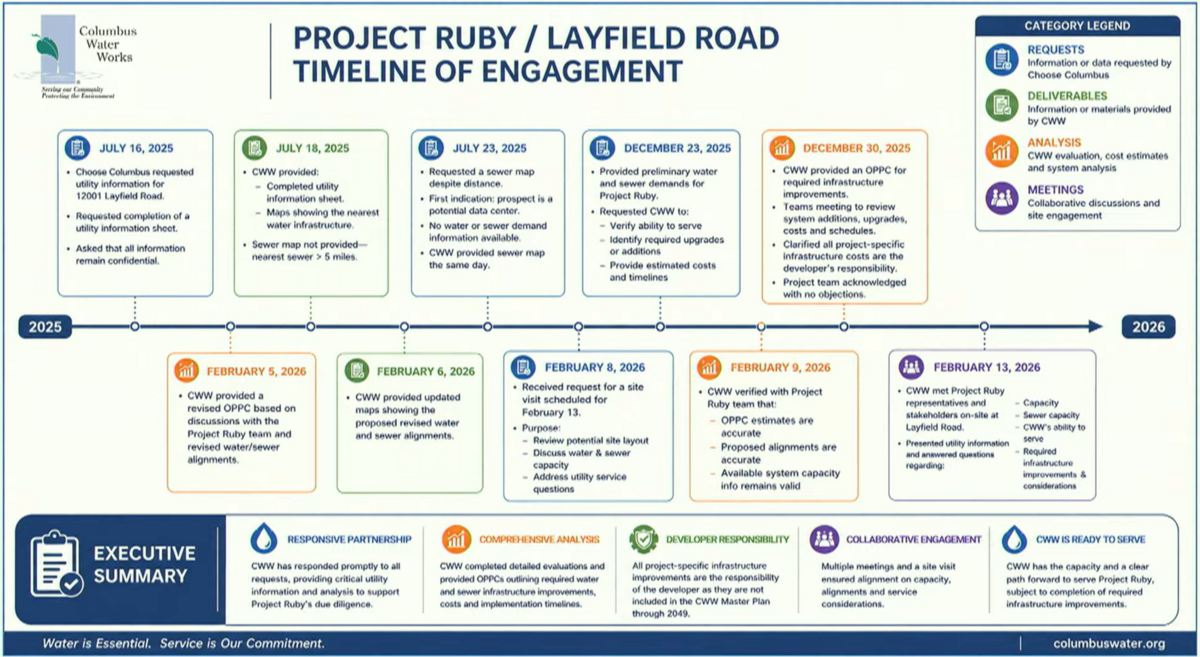
During his presentation to the council, Cummings pointed to a timeline of Project Ruby information, showing the data center water request and capacity questions began as early as July 2025. El-Amin spoke to this and the issue of being “bamboozled that the data center isn’t part of the overlay” and called data centers a “corporate fungus, spreading across the South.”
“Water is life, and CWW made it very clear they are only using a third of their capacity,” El-Amin continued. “This (data center) is a real thing. It has a name and a timeline. ... It’s on the fast track.”
Other reasons for a moratorium included a lack of a cap on water and energy capacity for Project Ruby in the technology overlay ordinance, pointed about by resident Dan Veach. Resident Eric Rivera is concerned about the AI bubble bursting and thinks it’s best to wait for the dust to settle. He went as far as to say he doesn’t think the facility will ever be built because of the volatility of the AI market.
Chattahoochee Riverkeeper technical program specialist Ashley Desensi listed the concerns the water watchdog has with the proposed overlay, emphasizing a Tier IV diesel generator should be required and PFAS (forever chemicals known to cause harm to human health) should be more closely examined, among other issues in their 10-page letter to the council.
Bob Haven, manager of local news website 706report.com, proposed a “Declaration of Protections” and a “People’s Ordinance,” which he compared to the Bill of Rights and the Constitution, as something for the 10-member council to adopt.
Councilor Toyia Tucker of District 4 made two motions shortly after Haven’s comment, requesting verbiage about PFAS be added to the proposed ordinance and a setback of 200 feet revert to the original draft of 500 feet. It was approved, however, it was not clear which councilor seconded the motion.
Residents in the council chamber showed thumbs up and shouted, “Higher!”
Mayor Pro Rem Gary Allen, the District 6 councilor, emphasized to Tucker and the audience that this is a “template, not a final document, and we can condition it anyway and add to it is as we go forward. We could increase the bond, notice to residents. It’s a fluid document.”
Tucker said “when we vote on this next week” during her motion, and that disturbed Upatoi resident Carolyn Weinbaum because, if they aren’t considering a moratorium, “this is just a dog and pony show.”
Midtown resident, Alexa Anderson said the reason 30 or more people have been waiting over seven hours since the meeting started is because they are waiting for a moratorium.
“At least 30 people are here, so if we’re looking at man-hours, that’s 210 man-hours invested in this meeting,” Anderson said. “We’ve made it very clear that people need more time and want a moratorium.”
The moratorium was echoed by a Upatoi resident whose son is autistic and appreciates the serenity of the area.
“One of the few places my son can escape from sensory overload is our backyard,” Ashley Washington said. “He needs calm, quiet where the only buzzing he hears is from bees.”
If the council enacts a moratorium, Columbus would join the 32 counties and cities across Georgia that implemented a moratorium on data centers since May 2025.
Mark Woodall, legislative chairman for the Sierra Club, called data centers the “number one threat to the environment and power bills in the state of Georgia” and concurred with a moratorium.
Clean Energy Columbus representative Christine Difeliciantonio did not say she was for or against a moratorium, but she said four areas are missing from the proposed overlay: a decomissioning plan, using an overlay only in areas zoned industrial, include language for community benefit agreements, and using combined natural gas and renewable or adopt best available controllable technology.
“You took the Chamber’s recommendations outright last week,” she said. “We’d like you to take ours for our environment and our people.”
Like last week’s council meeting, only one person came to the podium to speak in favor of the data center: Gregory Foster.
“I recommend the council approve the ordinance,“ Foster said. “If we are foolish enough to pass on this ($5.18 billion investment) opportunity, it will simply be moved to Talbot County.”
Allen made a final motion to shorten the days of a noncompliance penalty from 30 days to 15 days and diesel generators to be prohibited. Councilor Garrett Walker of District 8 agreed Tier 4 generators should be added, and the motion was approved.
No councilor motioned for a moratorium.
The Ledger-Enquirer asked every councilor for a reason why they did not vote for a moratorium when so many people requested it. No councilor replied before publication.