
234 homicides. 5 years. What we found in analysis of deadly violence in Columbus
Willie Phillips devoted years to fighting crime in his old neighborhood, forming the Neighborhood Watch group Winterfield on the Move Against Drugs when he was 36.
At age 61, this past November, he gave it up, selling his home on Lumpkin Court off Cusseta Road and moving north.
He heard gunfire every night, he said: “It was bad... When the police leave, that’s when it gets bad. I had to leave. I couldn’t take it anymore.”
Last October, he was dozing in a recliner at 3 a.m. when his security-camera monitor showed a rental truck come slowly up the street, and fire five or six shots at the house next door, he said: “When that drive-by took place, we had to go. My wife couldn’t take it anymore. I couldn’t either.”
Gun violence in Columbus lately has exacted a heavy toll.
After the 46 homicides reported here in 2020 marked a record, residents further were alarmed when the pace of killings appeared to pick up this year, with 19 since Jan. 1. The spike prompted city leaders to call a news conference, and drove grassroots organizations to hold marches and meetings.
With so much attention on the issue, the Ledger-Enquirer reviewed homicides here since 2015, to look for any insights.
Columbus homicides
A decade ago, Columbus’ annual homicide tallies averaged around half what they are now.
From 2005-2009, they averaged 24. From 2010-2014, the average was 20.
Columbus had 22 homicides in 2015, according to the Muscogee County coroner. It had 28 the next year, comparable to previous tallies.
But then the lives lost began to mount: 45 in 2017; 34 in 2018; 41 in 2019; and then 46 last year. In four years, the average jumped to 41.
The newspaper analysis of homicides since 2015 showed most are shootings; most victims are men in the age range 17 to 35; and most are killed away from home, in the street, in a car or at a party.
Comparing its annual counts to the coroner’s, the Ledger-Enquirer analyzed 234 Columbus homicides from Jan. 1, 2015 to March 7, 2021.
Dividing victims by gender, the ratio showed:
- 86% were male.
- 14% were female.
By cause of death, the numbers showed:
- 83% were shot.
- 8% were stabbed.
- 6% were beaten.
- 3% died from other causes, such as being struck by cars.
A breakdown of victims by age showed:
- 6% were 16 or younger.
- 66% were ages 17 to 35.
- 23% were ages 36 to 60.
- 5% were 61 or older.
The newspaper did not divide victims by race or other ethnicity, because news reports do not identify a victim’s race unless it is relevant to the case.
BEHIND THE STORY
MOREHow we did this story
Ledger-Enquirer crime reporter Tim Chitwood spent a little over two weeks researching every news brief and court story related to homicides recorded in Columbus over the past 5 years. He documented and categorized each one in order to find any trends that might speak to the spike in fatal shootings at the start of 2021.
We also wanted to provide readers a greater context on how homicides might be connected to other crimes, and if the spike was typical of previous years’ trend lines. While we recognize our role in providing daily news on shootings, arrests and homicides, it’s also important to take a step back and look at the news cycle from a broader view.
This is the first in a series of upcoming stories related to homicides in Columbus. If you would like to share your experience or ideas, please email Tim Chitwood at tchitwood@ledger-enquirer.com.
Contributing factors to crime
The circumstances leading to a slaying can be hard to determine, from initial reports, as police rarely reveal all they know before a case goes to trial. This analysis depends primarily on initial news reports of crimes, on preliminary hearings in Columbus Recorder’s Court, and on cases that went to trial.
Sometimes the context of a homicide is obvious: When a Columbus father stabbed his girlfriend and three young children to death at Elizabeth Canty Homes on July 17, 2019, it was family violence.
The Ledger-Enquirer found family or domestic violence was a factor in at least 12% of the homicides, including the double-slaying March 1 outside a Floyd Road Family Dollar, where a man shot his ex-girlfriend in front of her daughter, and killed a friend driving the car.
At least 15% resulted from some dispute, sometimes a long-running feud. A few times someone was killed intervening in a fight between others.
Robbery was a motive at least 13% of the time, and slayings police said were drug related came to 9%. Often the two were connected: Drug deals became robberies, and robberies became homicides.
That’s what led to a double-homicide Aug. 25, 2019, on Mellon Street, where armed men gathered for a deal involving a large amount of cash and marijuana, and bullets flew from varying directions, according to court testimony.
A 24-year-old and 28-year-old were left dying. A third man with multiple wounds escaped.
At least 9% of the homicides had connections to other deaths.
On Jan. 7, police announced they’d arrested a woman in the 2017 shooting of Destiny Nelson, 17, gunned down in her Bull Creek Apartments home in what police called gang retaliation targeting the wrong person.
Investigators said Nelson’s Jan. 16, 2017 shooting was to avenge the Jan. 5 homicide of Dominique Devonte Horton, 22, mortally wounded when gunfire erupted at Cusseta Road and 32nd Avenue, where a crowd gathered to watch two women fight.
Nelson had nothing to do with that, and police believe her killers went to the wrong apartment.
The suspect in Nelson’s case, Keyonna Latrice James, 19, is charged in another 2017 homicide, an April 19 shooting outside a south Columbus church, where a 39-year-old man was killed.
At least 5% of the 234 homicides were related to gangs, among the more prominent the March 26, 2016, assassination of Anthony Meredith, 24, shot 10 times at Peachtree Mall by three people associated with the Crips.
Court testimony showed those convicted waited for Meredith, and gunned him down in retaliation for the Nov. 21, 2015, fatal shooting of Christopher Twitty, killed in his home on Wickham Drive.
Authorities said Twitty, also a Crip, had a dispute with Meredith over $3,000 worth of marijuana.
Killings: Accidental, random, ‘justified’
At least seven homicides were thought to be accidental, usually the result of mishandling loaded firearms.
One on Feb 10 killed a Hamilton, Georgia, teen who was a guest at a Carmel Drive home where others had been dancing with the gun and filming videos, police said.
Though so-called “random” killings are rare — the killer and victim usually have some connection — they’re not unknown. About a dozen cases appeared to be random, including a 74-year-old man found dead in his car, on April 28, 2018, on Alta Vista Drive.
Police said a suspect was testing a gun he wanted to buy, firing it from a passing car, when one of the stray bullets hit the victim.
At least 10 homicides were characterized as justified, with no charges filed. Some were the result of residents shooting intruders trying to break into their homes. Some involved mutual combat.
Five were deaths involving police. One more recently in the news was the 2017 case of Hector Arreola.
The 30-year-old died after a struggle with officers who restrained him by pressing him to the floor, leading to allegations he could not breathe because police used excessive force.
Coroner Buddy Bryan, who has been on the job since 2013, said Arreola’s cause of death had been sudden cardiac arrest and methamphetamine toxicity. But state medical examiners since have ruled the death a homicide, and among the causes added “struggle with police” before the other factors, he said.
Time and place
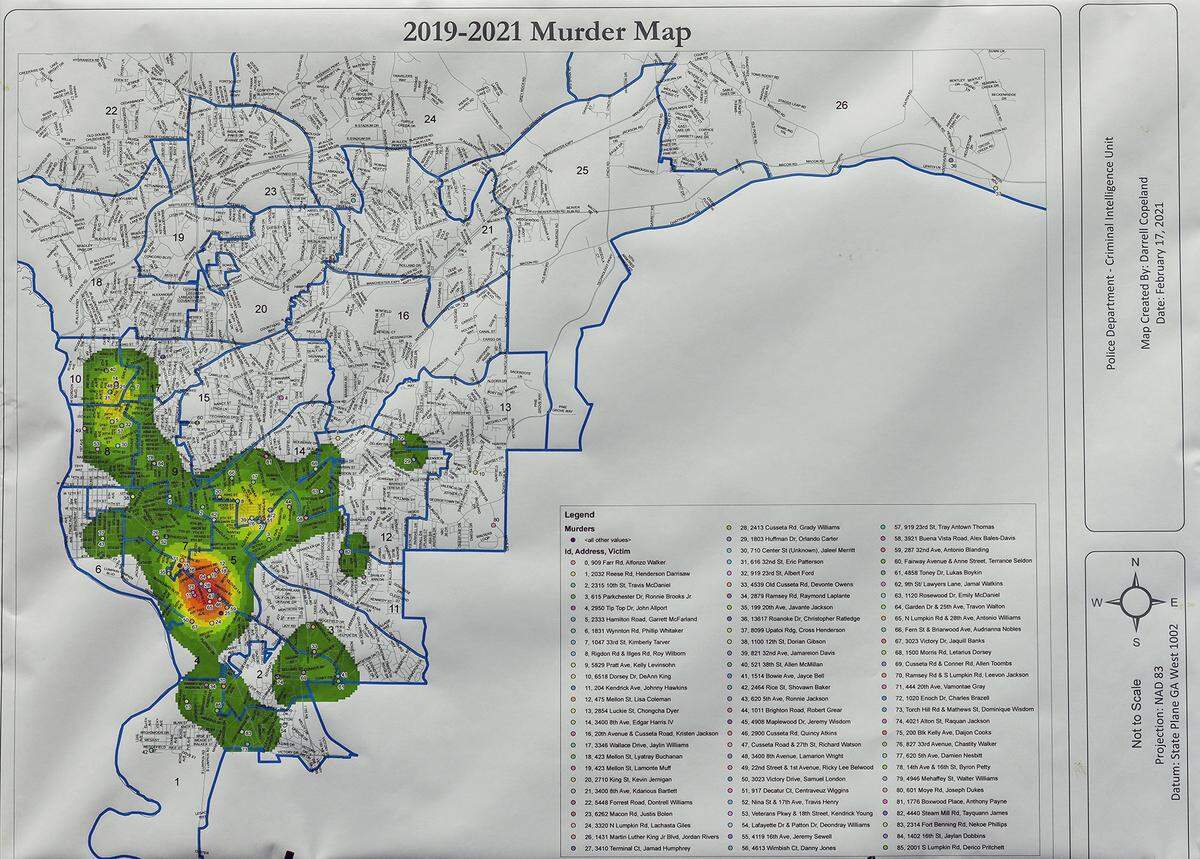
To roughly gauge where homicides were happening, the Ledger-Enquirer divided the city into quadrants, using the 11th Street, Wynnton Road and Macon Road corridor as the line between north and south, and Interstate 185 to divide east and west.
That put about 44% of the slayings in the southwest quadrant, encompassing the neighborhood Willie Phillips fled.
“I had a whole lot of trouble with gang members over there,” he said, alleging they would stand in front of his house and scratch up his cars at night, to intimidate him.
Of the other three portions of the city, two were close: 27% of the homicides were in the southeast quarter, and 24% in the northwest section. The northeast had only 5%.
Phillips found a new home in the northeast, around Flat Rock Park, where he said his grandchildren safely can visit him, again.
“I couldn’t bring my grandchildren over,” he said. “To tell you the truth, I wouldn’t go back over there.”
The group he once led disbanded, he said.
“You talk about neighbors getting involved. Who’s going to protect the neighbors?”
Anyone with information on a Columbus homicide may contact investigators at 706-653-3400, call Crime Stoppers anonymously at 706-653-3188, or text VACS and a message to 274637.
This story was originally published March 21, 2021 at 7:00 AM.