
Why don’t police count all of Columbus’ homicides in 2021 as murders? Here’s a breakdown
Out of 70 homicides in Columbus last year, police counted 63 as murders.
The difference of seven illustrates why the city’s count of homicides and murders rarely matches.
The county coroner counts homicides. The police department tallies murder cases. Each agency operates differently.
Homicides
Homicides in Columbus are only a fraction of the fatalities handled by the Muscogee County Coroner.
Coroner Buddy Bryan says homicides measure about 6% of all the deaths he and his staff investigate.
On a Georgia death certificate, homicide is among five categories for “manner of death.” It means the deceased was killed by another person.
The other four manners are accident, suicide, undetermined, or “natural,” such as death from disease.
“We do about 1,050 death investigations a year, so 70 homicides are just a small portion,” Bryan said. “We do all the homicides, all the suicides, all the accidental deaths, all the natural deaths.”
Homicides can be more time-consuming: If asked to remain until police finish documenting a crime scene, the coroner or one of his deputies can be there for six to eight hours, he said.
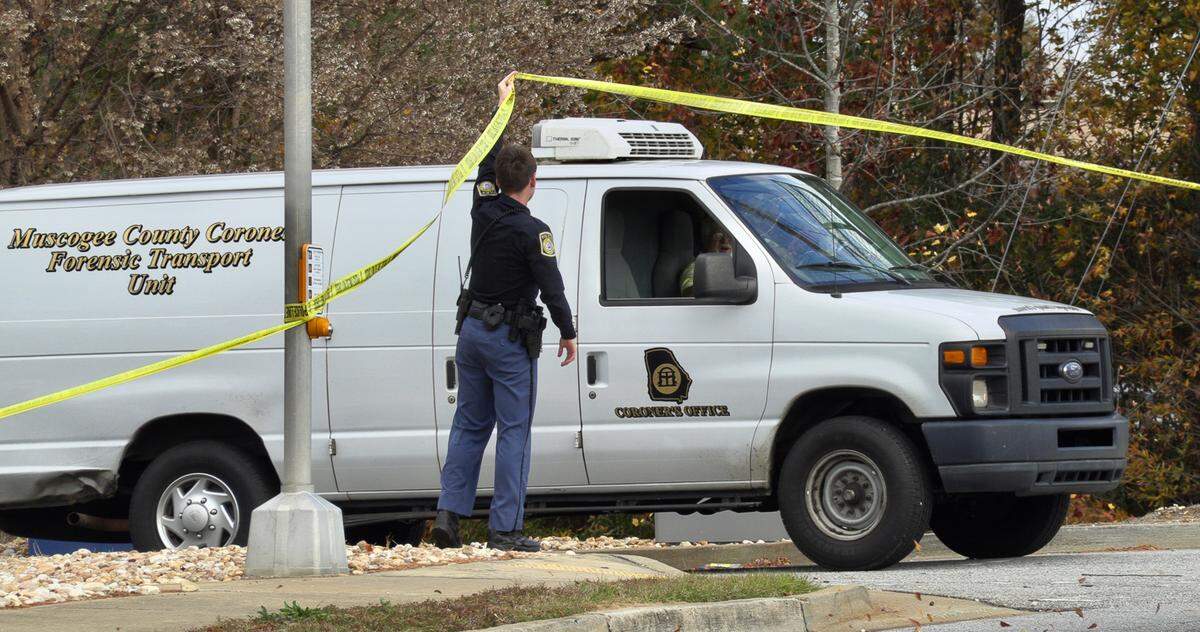
They have to wait for crime scene technicians to wrap up their work before moving the body, lifting clothing to look for wounds, and checking tattoos police might recognize, if the victims have no ID.
Many of the young men slain here carry no identification on them, Bryan said. Police have a scanner that can identify them by fingerprints, if their prints are on record.
State law requires sending the bodies to Atlanta for autopsies performed by state medical examiners, who are licensed physicians.
Autopsies confirm the “cause” of death, such as gunshot wound, or stabbing, or blunt trauma from a beating. The cause of death is listed separately from the manner of death.
Murders
Of the 70 homicides Columbus recorded in 2021, police investigated 63 as murder cases. They so far have arrested or issued warrants for suspects in 37 of those, said Police Chief Freddie Blackmon.
One reason some homicides don’t warrant murder charges is that they are self-defense, or justifiable, police say. Another reason is that some are accidental.
A third reason for discrepancies between the coroner’s homicide count and the police murder count is that police don’t include cases other agencies investigate, like those referred to the Georgia Bureau of Investigation.
Of seven homicides not counted as murders last year, two were GBI cases:
- Kevin Caldwell, 33, of Sharpsburg, Georgia, fatally shot by a state trooper during a gunfight June 8 at Macon Road and Interstate 185, after a car chase from Troup County.
Curtis Mincey, 74, an inmate found dead July 22 at the Jack T. Rutledge State Prison, off Schatulga Road in east Columbus. Bryan said Mincey’s cause of death was blunt force trauma to the head and torso, the result of a “physical altercation.”
Another case police did not count as a murder last year was Darian Hall, 26, who died at home Jan. 24 2021, after he was shot Sept. 7, 2020, on Dogwood Drive.
Bryan said the shooting left Hall unable to move from the waist down.
Police did not count Hall among their murders because they tie it to the date the assault occurred instead of the day the victim died.
Also excluded from the police murder list was the Feb. 10 death of Sara Holtrop, 18, of Hamilton, Georgia, shot while visiting a home on Carmel Drive in Columbus.
Detectives said her shooting was an accident. A friend, Elijah Farral, 20, was charged with involuntary manslaughter.
Holtrop’s death was the result of Farral’s trying to “scare” her with the handgun, after friends there danced and played with the loaded gun, police said.
‘Justifiable’
The three remaining homicides police did not count as murders involved shootings believed to be self-defense, the department said.
According to information provided the Ledger-Enquirer, those were:
- Emory Stephens, 31, shot Feb. 12 during an altercation inside the Suite Bar & Grill at 5300 Sidney Simons Blvd. The evidence in that case is to be presented to a Muscogee County grand jury for review, said Acting District Attorney Sheneka Terry.
Billy Joe Crocker, 55, who was shot July 5 in the 2500 block of Walker Street, and died in the hospital two days later.
Larry Walton, 27, who with another man was shot multiple times July 17 in the 700 block of Palmetto Avenue.
This story was originally published February 3, 2022 at 6:00 AM.